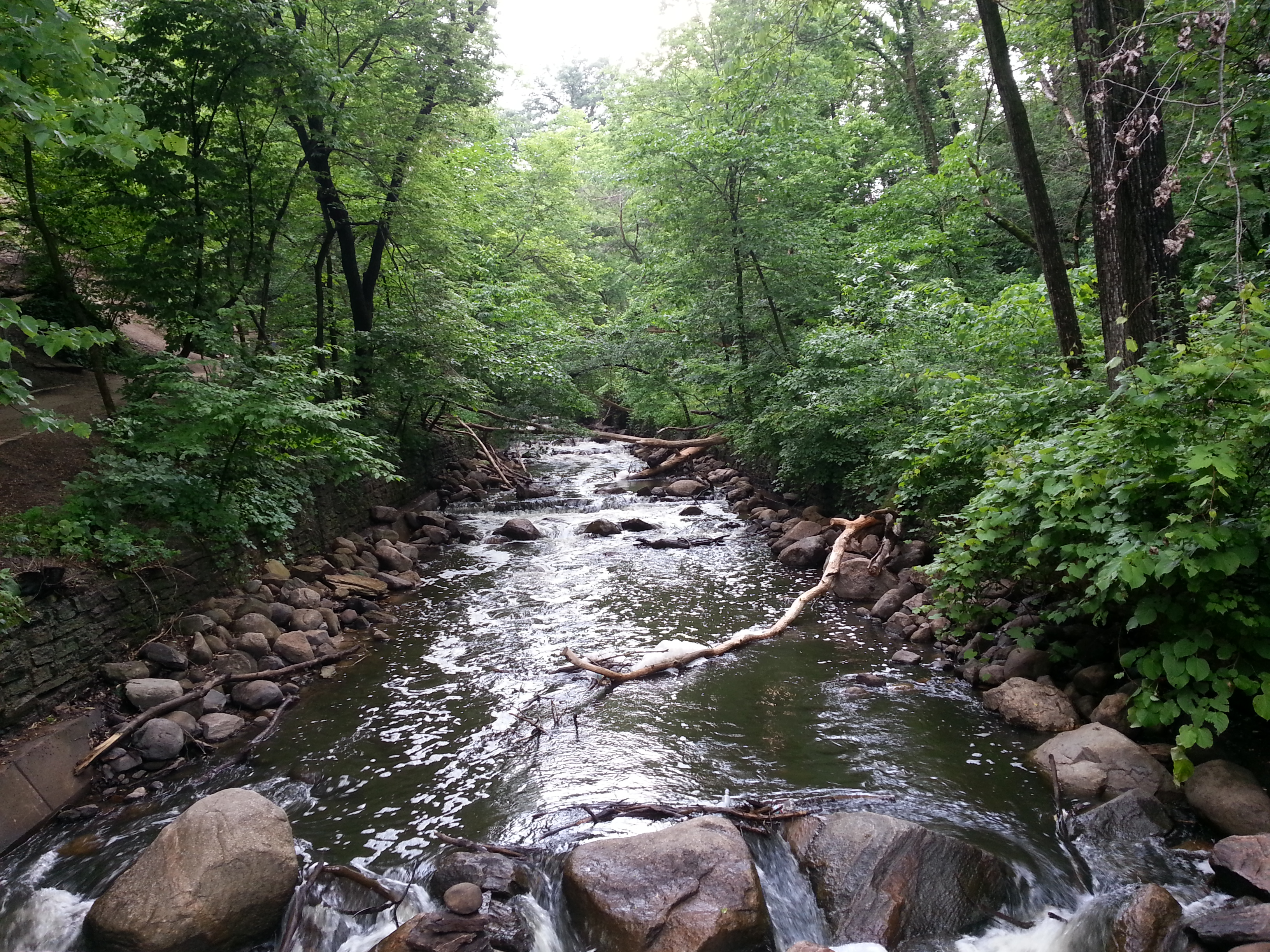
Fart Smelling State Park

Fart Smelling State Park

Today I hopped out of bed more easily than usual and was at my desk, with coffee, by seven. Work was fine. So far I have not screwed up anything major (except once) and I learn new things every day. I just realized I am past my six-month mark.

When biking in I don’t like that I arrive in the morning harried and feeling like I’ve just performed a dance with death. I don’t like seeing people playing on their phones while rocketing down the roads and brushing past my left handlebar. I don’t like tasting the exhaust and hearing the roar of cars as I cross the Mendota Bridge. The problem is, it gets worse and worse as I approach work. The beginning of the trip is that marked bike path on the river road, which seems relatively safe. Then I cross the Highway 5 bridge, which is at least protected from vehicles and is broad. Then I pass Fort Snelling, which is nice. But then I must cross the Mendota Bridge, which is noisy, too narrow to meet another cyclist safely, and only one side is open to non-motor traffic. From there it is dangerous suburban roads. This is where the real risk of distracted drivers is upon me. On these roads high speeds combined with cell phone law impunity make it truly dangerous. As I get close to work I veer around people who have obstructed the crosswalk, heedless. I see them yakking on the phone and wonder who they are talking to at 6:45 am.

When I finally get to work I am relieved not to have been maimed. But it is not a good way to start my day. Well, there are good things: I like having got my blood moving before work instead of just rolling out of bed all crusty. I like seeing the sunrise. I like seeing the fog burn away over the Minnesota River Valley. And I twice see Fort Snelling, a historical site people come from all over to visit.

The ride home is the reverse: it gets better and more peaceful as I approach home. I sometimes stop and sit on the ridge overlooking the Ford Dam in the shade of the oak tree there. Today I watched vultures and cormorants fishing and soaring above the dam. These are two despised birds, persecuted, poisoned, trapped, shot, even now in 2015. But I like them both. I like the rocking dihedral of the vulture’s flight. I like the kinsmanly rows of cormorants as they sit there, lined up on a log at the base of the dam, amid the spray, where I cannot go. And if I can like the birds that others hate, then I can muster the focus and good-nature to look left toward the mists of the valley, and ignore the roar of traffic in my ears.

Kayaking and some recent reading

I went for a historical and sightseeing tour with a river tour company, en français. It was fun. The company has two French speakers, by coincidence. We kayaked up to the Broadway Avenue bridge and saw part of an Aquatennial event on the river. I realized that as long as I continue getting culture with the Alliance Française, and continue playing video games in French (while talking back to the game, in private, behind a locked door), I will never totally lose the language, and will be able to get by. However, I don’t want to lose any at all, and I want to improve. To lose it would be triste, dommage pour le fromage!

Some recent reading:

Faith Versus Fact: Why Science and Religion Are Incompatible

  • I enjoyed how the author, Jerry Coyne, addresses accommodationist philosophers, scientists and theologians directly and calls them out for how they will do anything to avoid conflict with science. They are in a position of weakness and are desperate to avoid confrontation.
  • He points out that many scientists depend on shrinking public budgets and must appease religious politicians and leaders to avoid getting even less for their research.
  • I liked the description of theologians as “people who specialize in justifying beliefs acquired in childhood.” It jives with my own view of theology as being kind of like the study of leprechauns. He diligently cites the text of their arguments for non-overlapping “ways of knowing” and points out again and again how religious people make scientific claims of fact about the universe, and as soon as you make those factual claims, you are obligated to defend them.

Circumcision Exposed: Rethinking a Medical and Cultural Tradition

  • This book is from 1998. Intactivists are waging a highly successful online battle against infant genital cutting. In addition major scientific studies and ethical papers increasingly discredit the practice. But we need more physical books on the subject, to provide the sweeping view of infant genital cutting, its cultural and tribal roots, and the way the medical reason for it changes as soon as the previous reason is discredited.
  • The author, Billy Ray Boyd, offers an optimistic thought on how intactivism is neither right nor left, but has the potential to bring out the best of liberals and conservatives. They can both get behind the movement for the right reasons. Conservatives ought to be in favor of autonomy and freedom of choice and an open future for the child. And liberals ought to be in favor of removing culturally entrenched violence, and of guaranteeing every child a birth without violence.

Against Football: One Fan’s Reluctant Manifesto

  • This one was actually pretty funny. It interspersed the outrage we should all feel (the new publicly financed Vikings stadium was prominently described) with some great humor.
  • This book is very short but the author, Steve Almond, names and exposes each problematic aspect of pro football, including the racial/social, economic, medical and sexual aspects.
  • Chronic traumatic encephalopathy is now a household term (or at least its acronym, CTE, is). Seeing once-fine physical specimens turn forgetful, depressed, suicidal and unpredictable in their forties and fifties will wake people up. According Almond, even Brett Favre has admitted he could’t remember attending his daughter’s soccer games.

​​​​​
20150719_120132

Informed shopping

After working the night shift for two years I was miserable. Toward the end of that long grueling trial I was willing to take almost any job I could get, including one where I would be on call essentially all hours of the day and night. I gave serious consideration to some very undesirable positions.

During that time I also made a written resolution to myself that I would not support night work, and would never adopt the attitude, “I did it, so why can’t they?” Thus I try to avoid shopping at grocery stores late at night; I avoid late-night food deliveries and even late check-ins at parks and hotels (admittedly this is easier because I have a normal schedule now).

However, I also order from Amazon a lot, and Amazon is opening a giant order fulfillment center in the region. I saw an ad for a hiring event where they specifically sought part-time overnight positions.

So supporting night shift work is difficult to avoid! The economy is so complex, and parts of it are so invisible, that it is impossible to make fully informed, deliberate choices about what you vote for with your money. This is true for both social and environmental considerations in one’s purchases. Being deliberate, a quality I prize, is hard. A friend – retail insider – confirmed that Amazon hires part-time in order to keep costs down.

Additionally when I worked overnights I had the slight comfort that it was in healthcare that I worked and that people needed those services regardless of the hour. But Amazon is about low-wage warehouse jobs, and it is totally frivolous to demand that I get my headphones/pocket knife/coffee beans in one day instead of in three, at the expense of someone’s health, family life, and so on.

I don’t have a solution, except to acknowledge that those considerations are partly accounted for in the price of the items. If people become increasingly aware of the damage and misery of night shift work, then they will demand higher wages for it, and the cost of one-day shipping and round-the-clock service will increase, and then demand for night work will go down.

But this is imperfect. Workers are not empowered to demand higher wages like they should be. And I only did the night shift because I felt trapped. So I think if the science advances enough to demonstrate the harm of night shift work, and those harms become widely understood, then comprehensive night worker protections should be detailed in the law.

Sakatah Lake State Park bike touring

After work I thought “fuck it” and drove to Faribault. I parked at the trailhead of the Sakatah Singing Hills State Trail and biked 15 miles to Sakatah Lake State Park. I went there because I saw a public television special on the place and it looked fun, and they have an exclusive bike-in campsite.

The park is tiny but I had the place almost to myself so it seemed big enough. I sat on the dock during the enchanted sunset to dusk period and watched everything going on around me:

  • an island colony of at least a thousand cormorants, herons and egrets making a cacophony
  • two American white pelicans that floated across the lake unexpectedly
  • orioles, green herons and occasional fireworks explosions
  • a turtle that crawled out of the muck, looked around, and yawned. I did not know reptiles yawned.
  • four dark sunspots that I could only see because of the haze due to the wildfires currently burning in Saskatchewan. The sun was hazy red and mild at that time of night and safe to view with binoculars, or so I assumed.

I looked it up later and confirmed there is sunspot activity now. It’s a wonder to me how a sphere of hydrogen undergoing fusion should be anything but uniform. Then again, with the huge forces at work there, why shouldn’t it be dynamic and violent? I also learned that the spots I saw were larger than earth in size.

I also found an aigrette, the fine feather of the egret’s breeding plumage. I had never seen one up close before.