I witnessed the total solar eclipse of 2017. I watched as the moon slowly overtook the sun over the course of about an hour and a half. I watched the daylight subtly change as the moment approached. I saw the sun appear as a bright waning crescent, like the familiar crescent moon. I saw beads form on the edge of the ring as it winked out, as a result of the uneven surface of the moon. Finally, I witnessed the landscape go dark in less than a second at the moment of the beginning of totality.
For the next 2 minutes and 29 seconds I removed my safe-for-direct solar-viewing-glasses and observed totality. I have never seen anything like it: a black sun, surrounded by wispy white swirls (the Sun’s corona). Two planets came into view. I believe they were Mercury and Venus. I could not find Mars and Jupiter.
After this short but profound period of darkness daylight returned in an instant and the process began to reverse itself. The Army band played Holst’s “Mars, the Bringer of War,” in a rendition that really got my heart pumping. Over the course of the next hour and a half the eclipse ended.
While driving there and back I had a lot of time to think. Is it wrong to draw meaning from events in nature that are essentially random? In many instances, yes. Call it apophenia or patternicity or whatever. It can lead the mind astray. But from the occasion of this chance alignment of spheres I indulged in drawing a great deal of meaning:
New eyes
This was my first big astronomical event since getting LASIK surgery. I had skipped the Perseids because of sheer negligence. Seeing everything in clarity was awesome.
Bike
I threw my bike in the back of my car. When I arrived in Jefferson City, Missouri I moved swiftly about the city to scope out the best spot, to find a restaurant to eat lunch before the event and to check out some other sights. I am so glad I brought it. Everyone else looked hot, sweaty and slow in comparison. A bike is a great thing to have with you when checking out a new town.
Misinformation
A lady walked up to a couple near me who were setting up advanced optics for recording the eclipse. She asked about whether planets would be visible during the eclipse. They answered no.
To the contrary, four would be visible. I only identified two. Even with a Newtonian physical phenomenon like an eclipse, details of which were calculated many years previously, people still give you the wrong information. And as for “how often this kind of thing happens,” wildly different statements circulated.
Local milk people
Driving through the county roads of Missouri to get back to Interstate 35, I saw a lot of the local milk people. Rural Missouri is not much different than parts of rural Minnesota, just more hilly and hot.
Traffic. Woman who died.
A Minnesota woman named Joan Ocampo-Yambing died in eclipse traffic when a semi driver rear-ended car the car she was in. Many details of the crash was similar to my situation: she was in a small Toyota. She was headed to Nebraska (instead of Missouri, like me). It occurred at 10 am, when I too was on the road. She also wrote (https://www.createspace.com/7292322). Sadly, the linked page still says “Joan Yambing is currently a student at Creighton University pursuing a Computer Science degree…”
I reflected on the countless semis I passed, some of which drifted about as if the driver was falling asleep. Not to mention the people looking down at their phones or eating Subway sandwiches and steering with their knees. In 20 hours of driving there was only one close call (that I noticed), when a driver in a pickup truck made a left turn in front of me that required me to brake hard from 65 mi/h to avoid hitting him. During the thunderstorms I drove through I could have crashed into a stalled car with the lights out and been killed in one gory instant.
The news of the death was a reminder that when you hop in the car for a road trip or for a trip to the grocery store you are rolling the dice with your life. It is up to the individual to estimate the risk in advance and then decide whether to accept it.
Phone. Airbnb. Car. Kindle.
I am grateful for my tablet phone with its great battery life and navigation. I am grateful for Airbnb for letting me book a room just outside Des Moines at the very last minute as I watched the weather. I am grateful for my Kindle and for the ability to send eclipse-related articles to it so that I could read up in the days and hours leading up to the event. Finally, I am grateful (and a little astonished) that my 2008 Corolla made it 1080 miles without a problem, through 95 F heat, thunderstorms in Iowa, stop and go traffic, and 75 mi/h plus conditions.
Human event
I really enjoyed seeing people get excited about this eclipse. The chatter and anticipation leading up to it was great. One commentator stated it well when he said it was not just a science nerd event; it was a human event.
Were people watching in “awe and wonderment?” Hardly. Most people were highly informed, with a plan for how to appreciate the event. Some were equipped with advanced optics. Most had safety in mind.
The whole thing exemplified the pursuit of knowledge, beauty and understanding. The scale of the shared appreciation of the event was only possible today, in the information age.
Among the astonishing facts I learned is that the last eclipse in this “series” will occur in the year 3009. The first one was in 1639. The greatest duration of totality will be during an eclipse in 2522 lasting 7 minutes, 12 seconds.
I won’t be around for any of those. But I am already determined to be there for the next total solar eclipse in 2024. I might watch it from Carbondale, Illinois, the only place where the path of totality coincided with the eclipse of 2017. Or I could select a more exotic vantage point such as Mazatlan, Mexico. In the meantime I will watch more occultations as well.
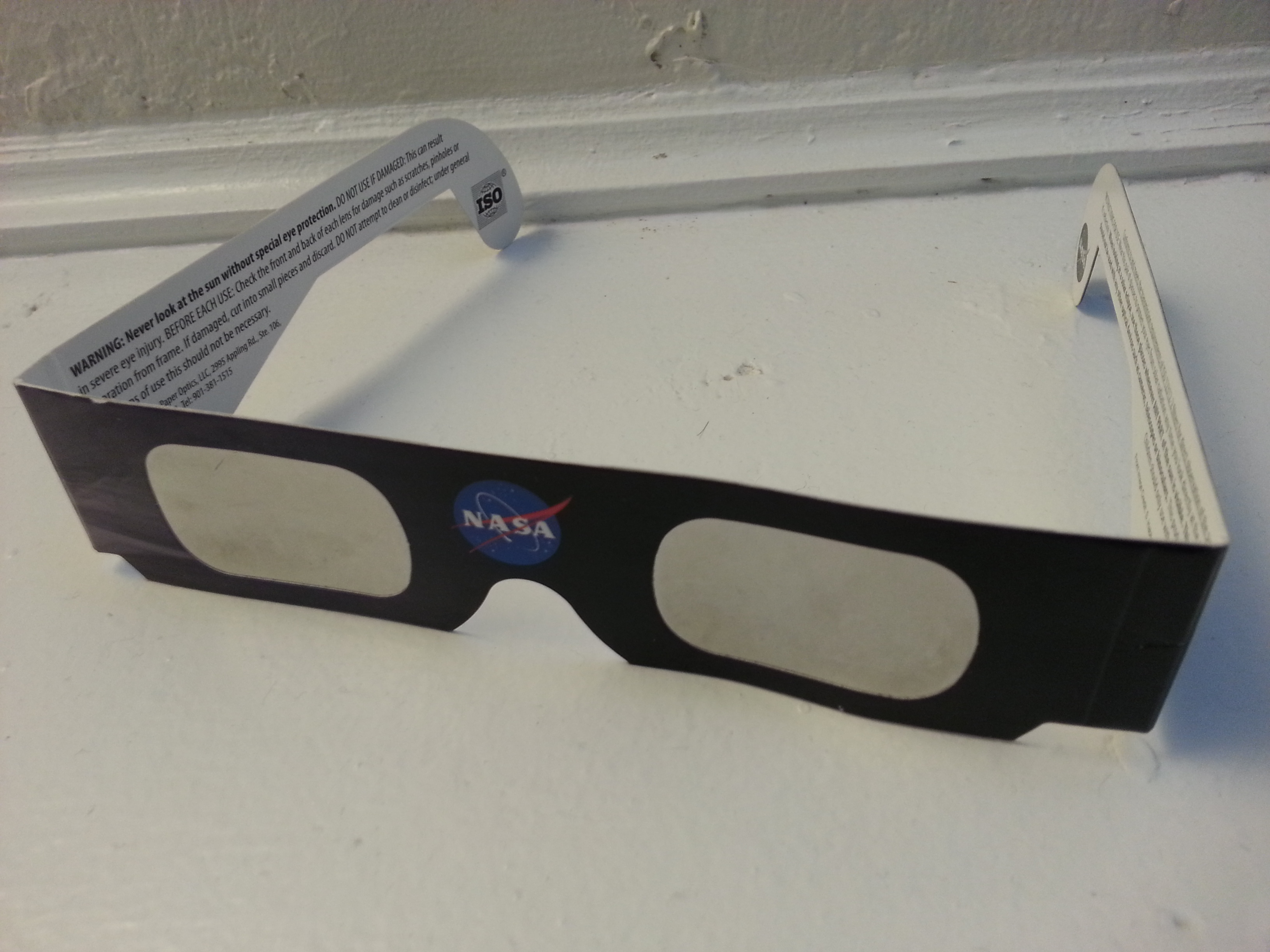
Included: my ISO conforming glasses for direct viewing of the sun
 pseudoisaac