Six great resources to acquaint yourself with financial independence

Financial independence (FI) is a movement that started as early as the 1990s and is now catalyzed by online communities, podcasts and blogs. It is about finally answering the question, “What would I do if I didn’t have to work for money?” It is about deciding how much is enough, and about optimizing your lifestyle to reach your goals and live according to your values.

I have been consuming FI literature and multimedia for about a year. The more I learn, the more I hunger for more. Fortunately there is a thriving community to explore. There are so many topics to dive into, and each one has been explored, critiqued, defended, and expanded upon in some blog or forum. Some of the original bloggers active during the Great Recession have passed on the torch to new ones. New podcasts and Youtube channels are springing up and maturing. Forums are blossoming and are organizing all the knowledge that has been published.

I feel like I’ve stumbled upon something that will alter the arc of my life. With the forewarning that your life trajectory may permanently change, I wanted to share six fantastic resources to acquaint you with FI:

1. Your Money or Your Life: 9 Steps to Transforming Your Relationship with Money and Achieving Financial Independence: Revised and Updated for the 21st Century

YMOYL was originally published in 1992. As self-help and personal finance books go, it is in a class of its own.

The authors help you to confront yourself and your own beliefs about money in very clear terms. Some central concepts include deciding how much is enough, constructing your own wall chart that shows when your passive income exceeds your expenses, simple living, and the concept of trading life energy for money. Results of some of the simple exercises, such as calculating your real hourly wage, will at first shock you. The authors are not preachy or judgmental. Instead they give you the firm push you need to get started on the path to FI.

2. Mr Money Mustache

This blog is also a great place to start. The author credits YMOYL as a foundational influence. The author has special appeal to me because of its anticonsumption message. He delivers a great deal of face-punching and straight talk, which is exactly what many of us need to snap out of our insane consumer lifestyle.

There are plenty of frugal hacks and an overall engineering mentality of efficiency and optimization.

If you visit and read just the top ten all-time posts, you won’t be disappointed. You can also visit (http://www.mrmoneymustache.com/all-the-posts-since-the-beginning-of-time/) and read sequentially. I have read almost every post from 2011 to 2014 and have laughed often and learned quite a bit.

3. The Financial Independence subreddit

This is a great place to answer questions about index fund investing, retirement accounts, health savings accounts, budgeting, and frugality. There are good personal accounts of successes in the daily thread, some of which will encourage you because they closely mirror your own situation.

Take one of the best user-created spreadsheets on budgeting and the best one that generates the key FI numbers. Plug in your own numbers. Tweak it for your own situation. You’ll find you understand where you are on the path to FI a lot better. If you are like me, you will at first be awed by the challenge, but not at all discouraged.

4. Early Retirement Extreme

This blog (and the book that is a more organized version of the blog) exemplifies the early retirement aspect of financial independence. The author did the extreme route to FI. Then, since he was financially independent, he wrote and pursued other projects. He then went back to work for an investment firm as an analyst. A highly paid analyst, I can only assume.

There are some striking insights in this book. It is more philosophical than practical. It will help you to start asking the right questions. The forum also has some good older threads with very involved users. And the author was active in responding to comments in the forum. I would read the book or blog after dabbling in some of the other resources listed here.

5. The Simple Path to Wealth blog (especially the stock series at jlcollinsnh.com/stock-series)

Read this series on stock market investing to reinforce for yourself what is becoming conventional knowledge: you should invest in low-cost index funds, minimize your expenses wherever possible, don’t pay anyone to manage your money, and keep it simple.

6. ChooseFI podcast

I love the attitude of these two guys. The show is full of practical tactics and strategies for frugality, tax-advantaged investing, and simple living. There are some great case studies from their listeners as well as interviews with FI bloggers.

They appear to have a good Facebook community. I can’t confirm this because I hate Facebook. But I highly recommend this podcast. It averages more than an hour in length. Take their efficiency tip and listen at 1.25 speed!
Hone your bullshit detector

I had a really interesting experience recently that illustrated the importance of sharpening your skeptical tools.

The setting was a long table at a brewery. A person I had just been introduced to was describing her involvement in a project using “californium muriaticum” to treat AIDS patients in Africa. I was confused. What is californium muriaticum? It turns out that it is the same as californium chloride. But people who believe in homeopathy use archaic names for the same compounds for some reason, perhaps to add a bit of woo (dressing an idea in the trappings of science).

It feels good

AIDS already has an effective treatment: antiretrovirals. And since these drugs reduce the blood and body fluid viral load, they also constitute prevention. But this does not matter to the homeopath. A homeopath thinks: if it feels good, do it. And extolling “californium muriaticum” certainly feels good. She made sure to provide irrelevant details as well such as, “Chlorine is a halogen, do you know what a halogen is?”

Interesting contrast

The thing that made it interesting was the contrast between the two ends of the table. At one end was a conversation about relatives who were building a human breast milk bank in Minnesota. This is an effort grounded in quality science. At the other end of the table pure quackery was being aired. Yet to someone standing nearby they both would seem like science-based conversations.

This is why bullshit can be so dangerous. The purveyors of bullshit do not know they are bullshiting and they certainly don’t think they are doing harm. They are also unlikely to be contradicted in a friendly setting like that. And who is going to call them out when their aim is the ever-sympathetic goal of “helping AIDS patients in Africa?”

Eventually I tuned this person out. But I noticed she had selected another subject for her lengthy exposition of pseudoscience. She even dropped the term “major histocompatibility complex” at one point. Again, painting on a veneer of legitimacy while the poor guy nodded politely.

Be skeptical

What a tricky situation! In my left ear is science. In my right ear is bullshit. Yet both sides appear at first glance to be equally articulate and informed. It struck me that this mixing of truth and falsehood happens all the time in life, and sorting it out is effortful and imprecise.

This all served as a reminder of my commitment to skepticism. Skepticism as the withholding of assent until someone does the work needed to convince me. Skepticism not as a stance, but as a set of tools for separating the true from the false. Skepticism as a bullshit detector.​​

Another Hawk Ridge trip

Duluth was sunny and pleasant on Saturday when I visited this birding hotspot. The foliage is still green up there except for a few yellowing aspens and reddening sumacs.

In absolute numbers the migration that day was a bit subdued, but there was still plenty to look at, including osprey, northern goshawks, red-tailed hawks, turkey vultures, sharp-shinned hawks, ravens, sandhill cranes, and American kestrels. A few days prior, 26 000 broad-winged hawks had passed overhead!

A highlight of my visit was a 1.5 hour hike with a naturalist to the auxiliary lookout, which is deeper within the network of trails in the nature reserve. From this lookout you can observe raptors rising from the woods in the morning as the sun reaches the tops of the trees they roost in. On this day the auxiliary lookout was busier with migrants than the main lookout. But for scientific reasons the count must be conducted consistently from the main lookout.

On the hike the naturalist pointed out flowers and plants I wouldn’t have noticed otherwise. We paused to listen for songbirds and woodpeckers and other critters. She explained that part of the reason for the migration bottleneck is the exposed basalt rock along the Sawtooth Mountain ridge, which causes thermals, which the raptors soar on instead of expending energy flapping their wings. She pointed out the downed trees in various stages of recovery from last year’s storm (whose destruction I recall vividly). She took apart an aster blossom and explained how each aster flower is actually a group of tiny individual flowers, and how what we see as a flower is the superstructure formed by these parts.

With a leader like that every sight and sensation along the trail becomes illuminated: the rocks are ancient exposed basalt providing optimal thermal passage for the birds overhead. The downed trees are food for the grubs that in turn fed the hairy and pileated woodpeckers. The nondescript chip sounds are from the juncos passing south through the understorey and trying to avoid being prey to the hawks passing overhead.

Following her and listening, it occurred to me that every person is a fountain of knowledge and experience and interpretation. The way to unlock these streams of knowledge is to get them to be voluble, uninhibited and enthusiastic. And you do this through interpersonal warmth, genuine interest in their interests, and the give-and-take of normal conversation. Maybe in 20 years augmented reality glasses will provide all this info exhaustively and engagingly to people who crave an information feed. But it won’t match the oral narrative of a person.

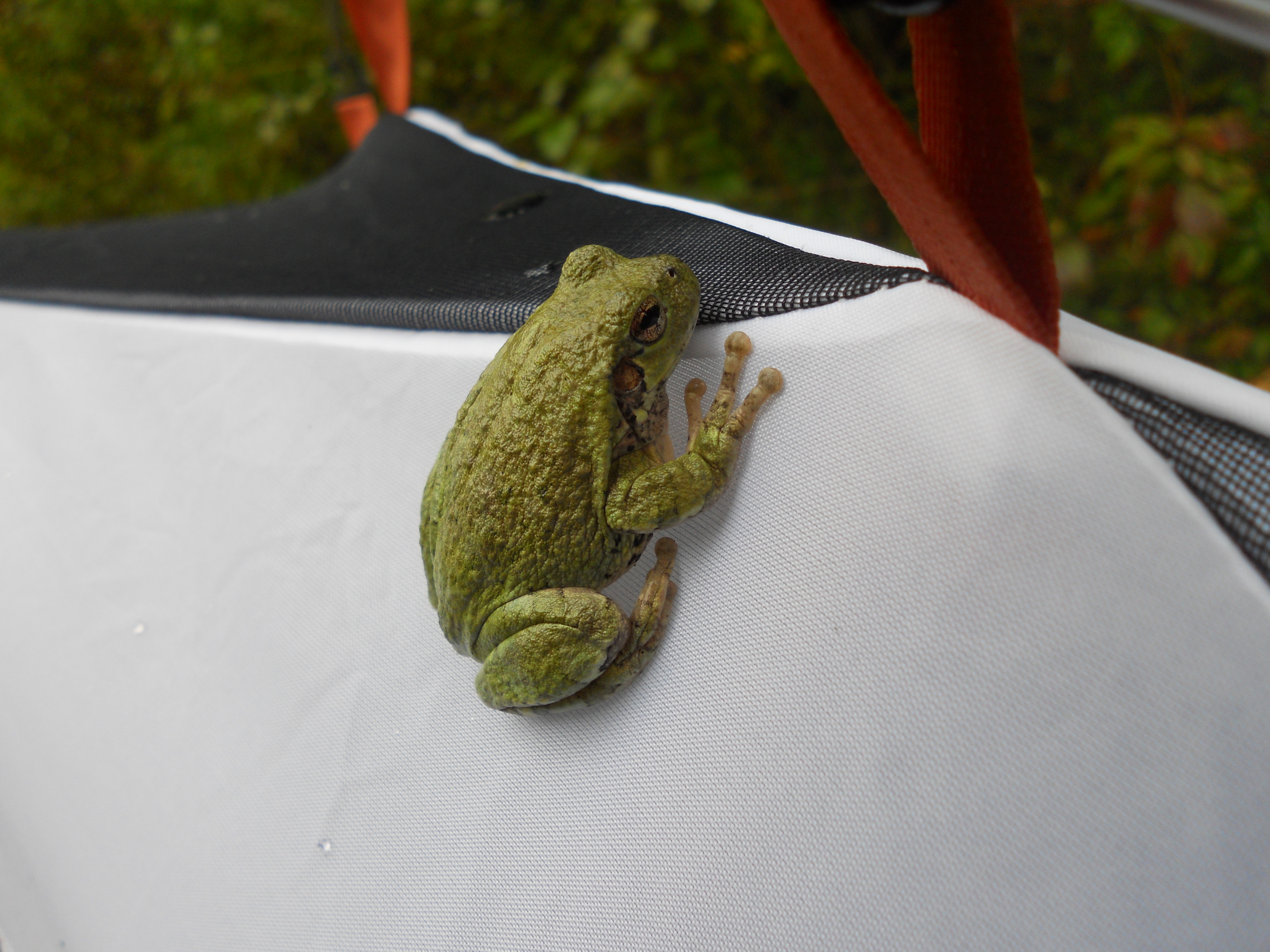
Included: not the first time I have woken up to find that a treefrog had crawled under my rainfly to escape the cold overnight rain.