Duluth was sunny and pleasant on Saturday when I visited this birding hotspot. The foliage is still green up there except for a few yellowing aspens and reddening sumacs.
In absolute numbers the migration that day was a bit subdued, but there was still plenty to look at, including osprey, northern goshawks, red-tailed hawks, turkey vultures, sharp-shinned hawks, ravens, sandhill cranes, and American kestrels. A few days prior, 26 000 broad-winged hawks had passed overhead!
A highlight of my visit was a 1.5 hour hike with a naturalist to the auxiliary lookout, which is deeper within the network of trails in the nature reserve. From this lookout you can observe raptors rising from the woods in the morning as the sun reaches the tops of the trees they roost in. On this day the auxiliary lookout was busier with migrants than the main lookout. But for scientific reasons the count must be conducted consistently from the main lookout.
On the hike the naturalist pointed out flowers and plants I wouldn’t have noticed otherwise. We paused to listen for songbirds and woodpeckers and other critters. She explained that part of the reason for the migration bottleneck is the exposed basalt rock along the Sawtooth Mountain ridge, which causes thermals, which the raptors soar on instead of expending energy flapping their wings. She pointed out the downed trees in various stages of recovery from last year’s storm (whose destruction I recall vividly). She took apart an aster blossom and explained how each aster flower is actually a group of tiny individual flowers, and how what we see as a flower is the superstructure formed by these parts.
With a leader like that every sight and sensation along the trail becomes illuminated: the rocks are ancient exposed basalt providing optimal thermal passage for the birds overhead. The downed trees are food for the grubs that in turn fed the hairy and pileated woodpeckers. The nondescript chip sounds are from the juncos passing south through the understorey and trying to avoid being prey to the hawks passing overhead.
Following her and listening, it occurred to me that every person is a fountain of knowledge and experience and interpretation. The way to unlock these streams of knowledge is to get them to be voluble, uninhibited and enthusiastic. And you do this through interpersonal warmth, genuine interest in their interests, and the give-and-take of normal conversation. Maybe in 20 years augmented reality glasses will provide all this info exhaustively and engagingly to people who crave an information feed. But it won’t match the oral narrative of a person.
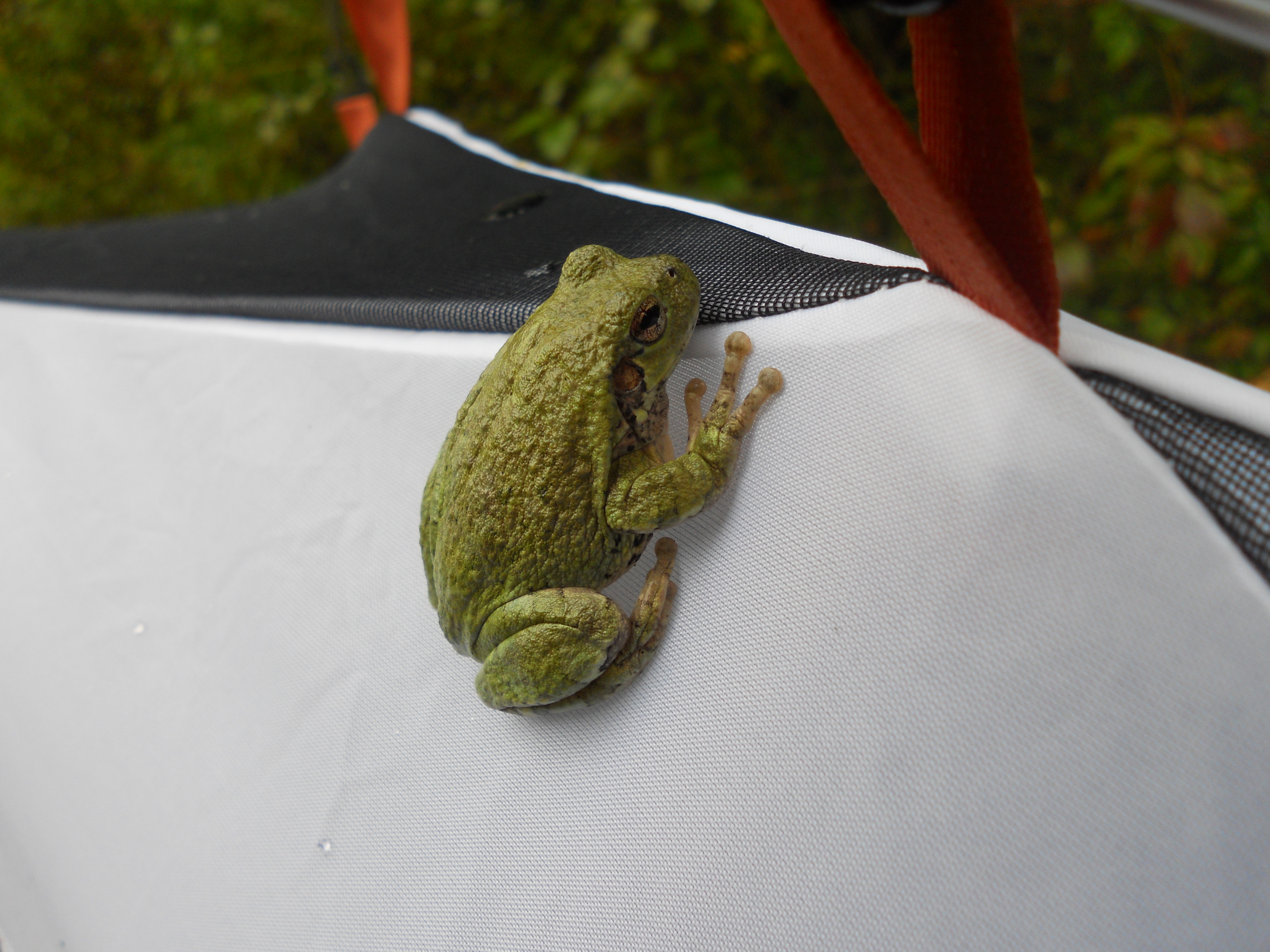
Included: not the first time I have woken up to find that a treefrog had crawled under my rainfly to escape the cold overnight rain.
 pseudoisaac