My little sister updated me and my siblings via text that she was undergoing testing for multiple sclerosis (MS).
She is 30 years old, a young healthy woman with a new house, wife, master’s degree, career and dog. Recently numbness in her abdomen had bothered her. She went in for an exam and magnetic resonance imaging confirmed transverse myelitis. However this is merely the name of a condition, not an underlying disease. The doctor counseled her that the myelitis could be an early sign of MS. So she will visit a neurologist next week for further testing. That’s when she hopes to find out what it all means.
My reaction was typical. It seemed so random. Of all the thousands of diseases out there, getting signs of MS seems like winning some shitty lottery. Fewer than 200 000 cases occur per year in the US, according to Doctor Google. I knew it affected young people, skewing toward women. Plus, the average age of diagnosis in women is 29.
I surveyed my own ignorance on the subject. I had done a bike ride for MS in the spring. But I acknowledged to a friend and rider that I knew almost nothing about the disease, and I knew no one who had it. Something about the body attacking the myelin coating of nerves. That was all I knew.
I thought about my aunt – a new Parkinson’s disease diagnosis. My other aunt – recently dead of ovarian cancer. My mom – advanced Alzheimer’s disease. My uncle – a painful, recurring fungal eye infection. My brother – depression and drug abuse. They all seemed equally likely to suffer and fade away. To fade away either suddenly or slowly (and which is more painful, when you think about it?).
The confirmatory appointment is days away. The waiting is awful for my sister. I told her to take care of herself. I resolved to check in regularly until then, as well as afterward.
But what else? What else do you do when you are jolted out of your complacency?
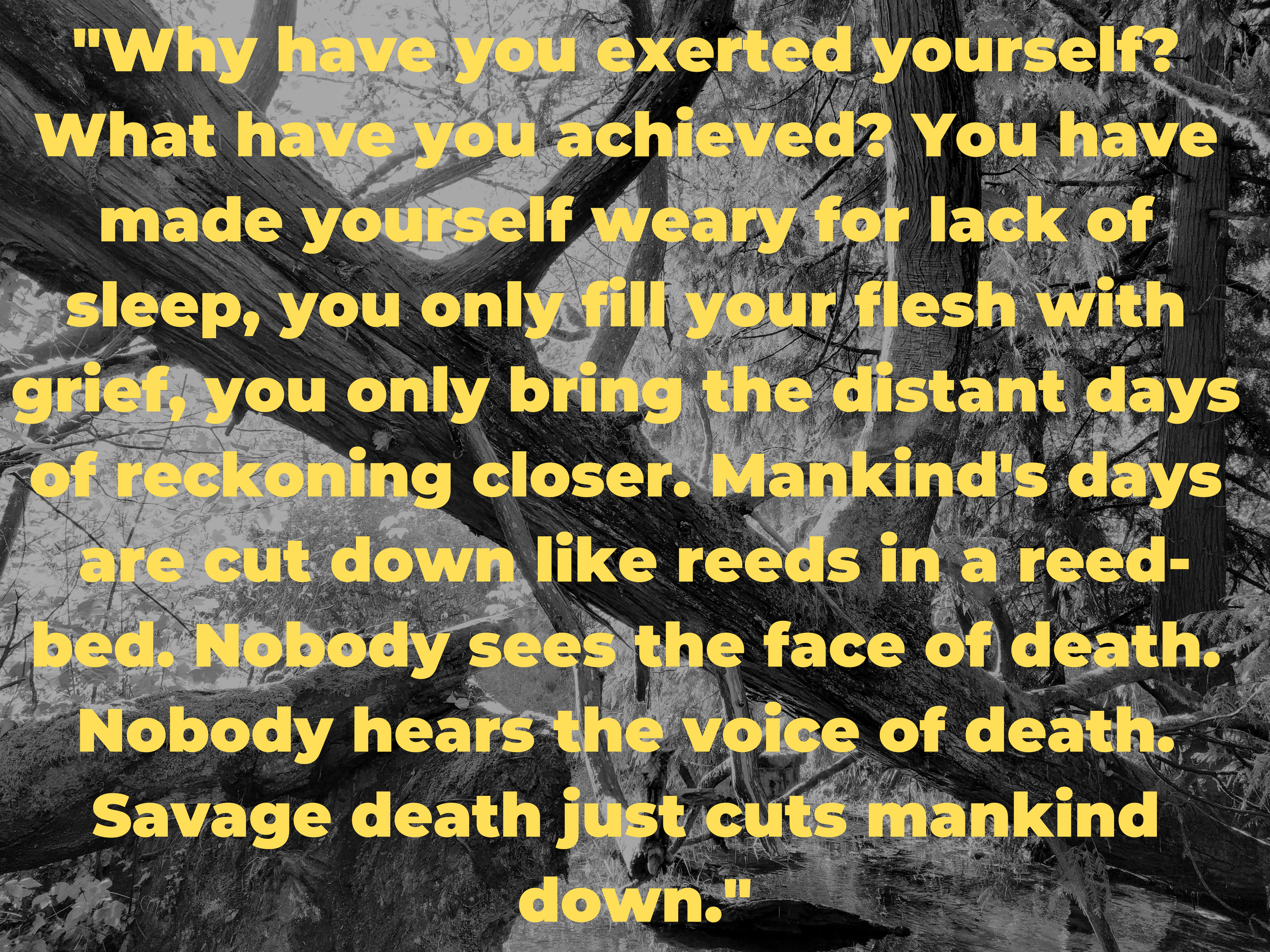
Refer to the quote. People living in the earliest cities 4000+ years ago faced death more frequently than we do now, in our comfortable remoteness. Some of them – the philosophers among them, the early humanists – recognized that there is no point in being stressed out, ill-humored, unfriendly. More than that – there is just not enough time. With the time you have you must speak often with the ones you care about. You must take a walk in nature and look about you. You must savor your long walks and run your hands through the reeds because tomorrow they could be cut down.
https://www.youtube.com/watch?v=sWppk7-Mti4 (At 8:51 see the quote from the epic of Gilgamesh)
 pseudoisaac