I once viewed this trail as a sad, short, decaying path along a polluted ditch. But after several bikes, walks and runs along it, I now see its potential as a rare nature trail in North Portland.
The path consists of broken asphalt, gravel and dirt. The air frequently reeks of nearby industrial operations and exhaust from cars and trucks. Sparse homeless people camp in muddy, trash-strewn squalor. Finding the trail at all is difficult.
But it has so much potential. I watched herons and swallows and hawks. I saw California ground squirrels (they charge across the grass with tails pointed straight up, unlike tree squirrels, that bound and hop). I looked around and thought about how this could be a corridor for people and wildlife. It could be a vibrant, healthy waterway.
I walked the trail with this more positive mindset and encountered an incredible piece of art on a drainage pipe that stunned me when I finally noticed it. I wish I could talk to the artist and see how long it took to create. I’d like to see previous iterations and know if this ensemble (raven, moon, bear and elk) is a theme for them. I would also like to know what the symbol at the bottom means.
This page from the Trailkeepers of Oregon goes into much greater detail about the trail.
Yesterday I hiked through Forest Park from the West end of the Saint Johns Bridge to the Leif Erikson trailhead on NW Thurman Street.
The day was beautiful. Some lucky mix took place to give me cloud cover during the middle of the day (to avoid burning my Norwegian skin) followed by a clear, dry late afternoon and sunset. I found that trail users were relatively sparse due to the pandemic precautions and the workday.
When the clouds cleared I saw flat-topped Mount Saint Helens to the north and Mount Hood to the east. I saw the invasive ivy expertly poisoned by targeted pesticide applications. I thought about the many missed hours of volunteer invasive plant pulls and native plant plantings that will have to be made up for this summer.
I passed by a duo on one of the narrower trails and noted the way one yakked nonstop about her job while the other listened. I smiled at the quiet second one in understanding. She looked like she was fulfilling her role as a listener and friend, even as her eyes wandered.
I passed by a young couple where the man was a good deal shorter than the woman. She seemed awkward and nervously talkative. I passed an Indian mother telling her adolescent daughter, “All the other girls your age do such and such…” I saw many people on gravel bikes, which are pricey contraptions with a front suspension and drop handlebars that didn’t exist ten years ago.
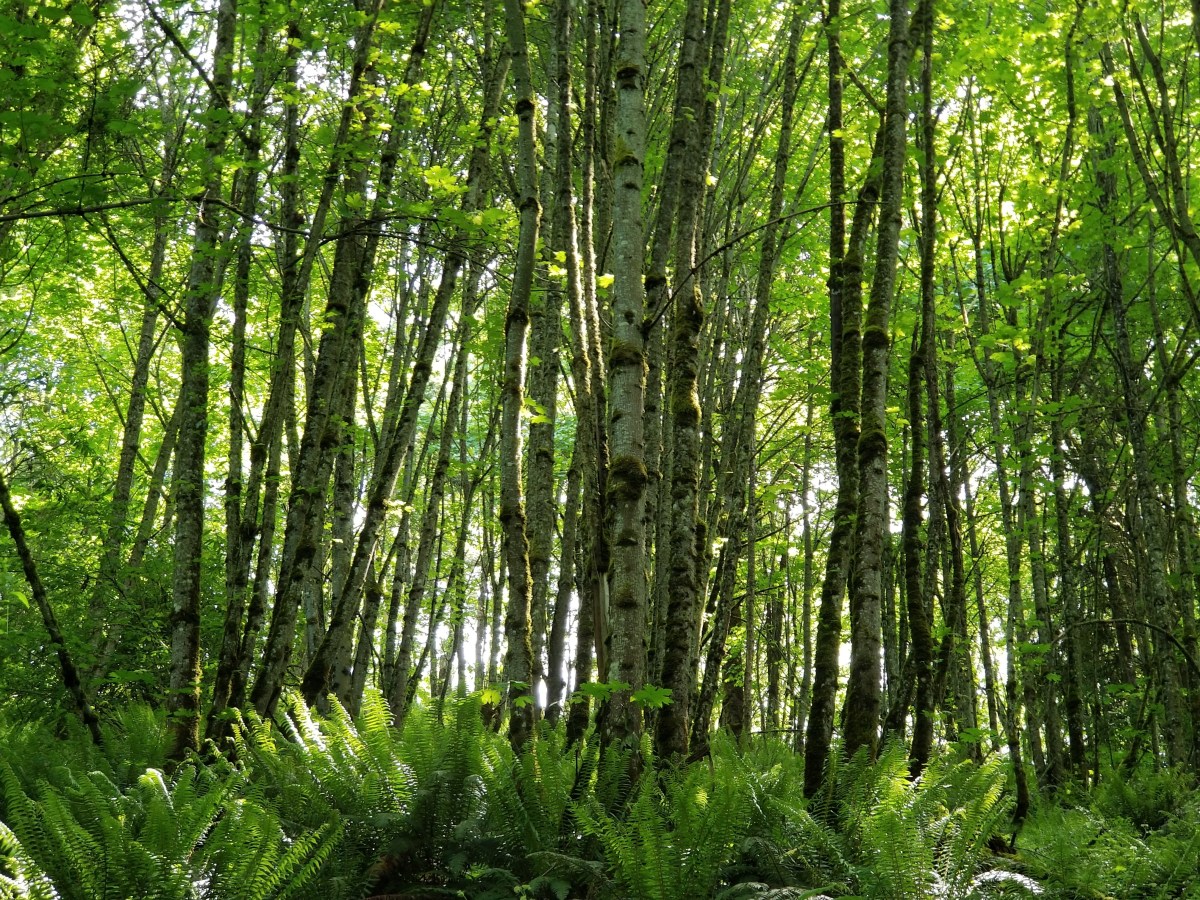
I snaked along the Ridge Trail, the Leif Erikson Trail, the Wildwood Trail and the Alder Trail and I relished the feeling that in those moments, there was no place I would rather be. I was doing exactly what I intended with my day off.
I encountered large native snails and banana slugs. I saw the even larger invasive banana slugs. A couple of them were everted from their wet translucent casings and turned into a yellowish speckled paste from being run over by bikes.
At one point I halted in my tracks and watched a beautiful woodpecker that was new to me. I observed its plumage (it looked like a sapsucker). And then I was delighted when I noticed it had a flight, foraging and drumming pattern that was distinct from other woodpeckers such as a downy woodpecker or a northern flicker. I think the bird was a red-breasted sapsucker. They must be common because later on I came too close to a nest of theirs and was scolded aggressively by the parents. I heard their chicks peeping while their parents defended them from me, the intruder.
Observing the bird illustrated what I have come to think of as the fractal nature of knowledge: when you look closely at a feature of the natural world, you resolve a thousand further minute but equally significant distinctions. You uncover those ones and then uncover further ones. And at the end of all this you grasp a hint of the pattern repeating in the whole and uniting all those endless details. You start to see unity in the midst of endless diversification.
And isn’t this what Darwin hinted at 161 years ago in On the Origin of Species? He did so in expansive style while also addressing details such as debates over mollusc morphology hashed out in the correspondence of gentleman scientists.
And although I have not read this foundational work in its entirety, I did listen to the audiobook version while delivering pizzas.
My grandma Cordelia tested positive for infection with the virus earlier in the week. This morning, after two days of shallower and shallower breathing, she died peacefully with her hands clasped over her abdomen. We were able to say goodbye while she was alive via video chat.
My grandma was 100 years old and was very spry and talkative for that age. She only lost her memory and mental orientation within the past several years, never developing dementia except for the slow-progressing senile variety. She lived in an apartment complex that accommodated multiple levels of independence for several years. Then we as a family moved her into a connected facility that had a greater level of nursing care.
Within the past week the facility alerted family members to the rising number of deaths in the facility (several) and the increasing positive tests among staff and residents (dozens). My grandma was too frail to withstand this infection. Her last hours were peaceful, with no tubes down her throat and no needlesticks and transports and other procedures, in accordance with our plans.
I’ll remember her for the care she gave us and for her gentle nature. She would always visit on Wednesdays when my little sister and I came home from school. She grew up during the Great Depression and this instilled habits in her such as rinsing and reusing ziploc bags. She ate tiny amounts of food but would always have room for ice cream or cake. She loved family, drives through the city (which always astonished her with how much it had changed), and visits with friends.
She was a strong link to the Norwegian culture of rural Minnesota and North Dakota and even spoke some Norwegian. The staff always commented on how sweet she was. She worked briefly as a nurse and told me she loved the chemistry curriculum.
I asked her once if she felt she was ready to die, and she said yes. This was six years ago. She had outlived most of her friends and her family cohort. She hated losing her memory. And her husband (who died when I was only 2) was long gone. She had a good life. She was the last of my grandparents. I will remember her with fondness.
Rats
I adopted 2 female rat sisters that a friend of a friend could no longer care for.
She provided a ton of supplies as well as a giant bird cage. This cage is a rat theme park and it’s so big they can escape through the bars so it needs additional chicken wire.
They are very different from the males I had in the past in that they are much smaller and more active, constantly darting about and squabbling and playing with each other. The males tend to just sit and chill but these ones are so fast and active I can hardly get a photo that’s not blurry.
I followed rat acclimatization videos to help them get comfy and feel safe. My favorite bit of advice was to wear a “rat shirt” that you seldom wash so that they know a familiar friend is approaching.
I’ll buy a clicker and train them to do some tricks. But I get the impression the previous two owners seldom had them out of their cage. Once they get used to the stimulating life I have in store for them, they will get more and more active and wily.
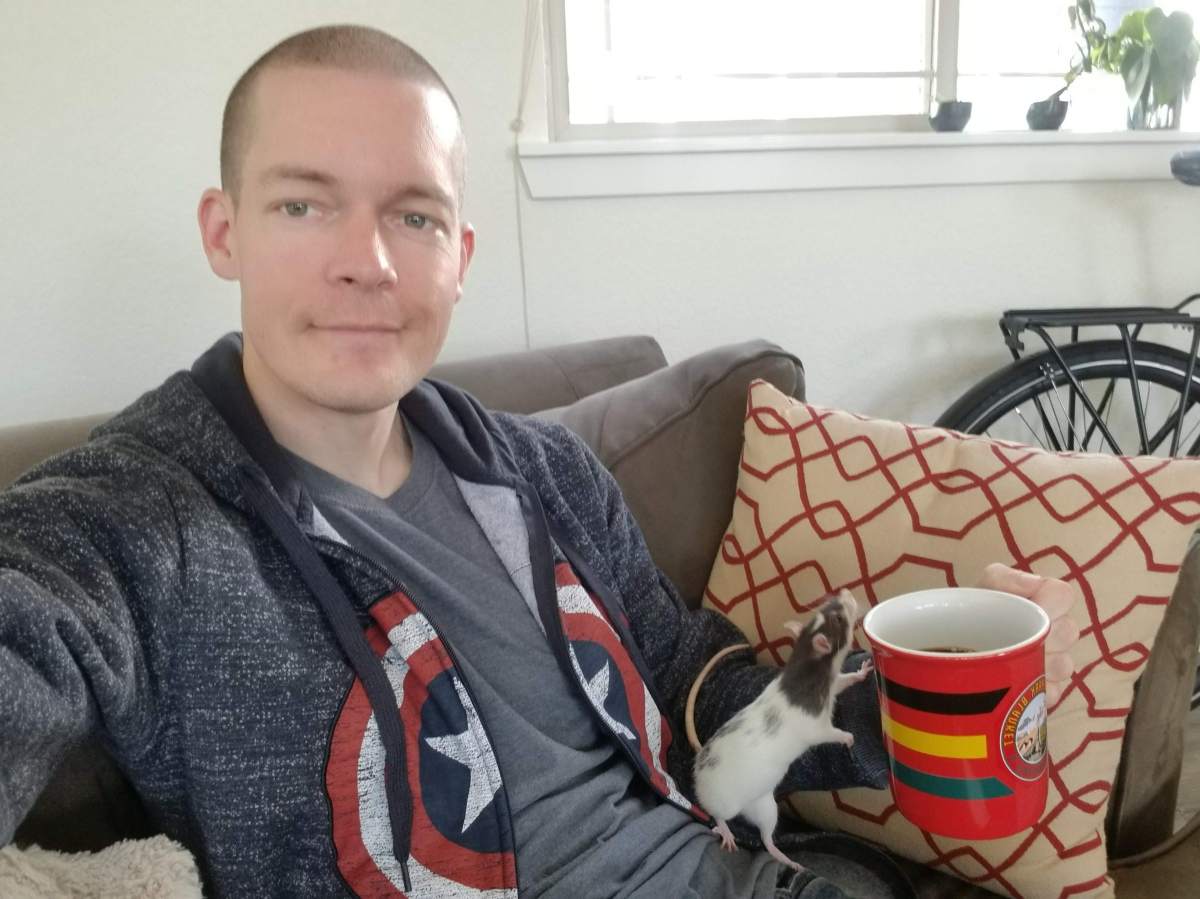
I enjoy sitting with them and sipping my coffee while they dart about investigating everything. Once they’ve sniffed out every possible corner and edge they curl up into a little rat ball and sleep in my shirt.
Rats are brave because two instincts are constantly competing in their little brains: curiosity and neophobia. Neophobia is the fear of new things and places. When a rat is afraid of something but haltingly checks it out until it has investigated every little corner of it, curiosity has proved stronger and it means they are brave.
Rats have short lives. You can expect them to be with you for only two or three years even with the best of care. The scope of their existence is a small fraction of yours.
They are small creatures that respond positively to care and tenderness. They also love mental and physical stimulation. While they are with me I am going to make sure their brief lives are filled with fun, security and love.
It’s very rare to find a good listener among either sex.
I recently asked for relationship advice from a female friend and I found that she talked about her own issues for most of the time. When I finally got a chance to speak, we soon had to leave and I only partly received the help I had made myself vulnerable by asking for.
When I spent half the day with a male friend I found the guy was even more voluble. His speech was like a motor: once he got revved up his mouth would hardly close for long stretches at a time. Despite being someone who is genuinely interested in knowing what I had to say, he just could not come down from his excited, lengthy talk. Somehow each of my words was met with 20 of his. I do not sense a growing understanding of me on his part, despite the quality time we’ve spent together.
A female colleague harps on the same issue that’s bothering her day after day. It seems to help her to talk about it with me and she has told me I helped her with certain insights and discovery. But I can’t unlock those same benefits for myself because she is unresponsive to my own problems.
Another male friend cannot seem to connect outside of a narrow range of geeky interests. He is suited for “side-by-side” pursuits such as setting up a camera or a Star Wars figurine. But not a conversational give-and-take. It’s hard to imagine him identifying an assumption of mine or ever challenging me on something. Instead he would shrug. I suppose it’s an accepting attitude, which is good, but it’s not listening and seeing whatever substance I may have to offer.
I wonder if the problem is with me. Maybe I am too quiet, like a blank canvas on which another person can fling their emotional and intellectual paint and swirl it around and see how they like the look of it. Maybe I make people feel understood. Or perhaps I am not asking for help and reciprocation in a way others can recognize and respond to.


 pseudoisaac