To me, this book is about learning to listen first instead of imposing your inevitably narrow and colored perspective on the world. It’s about trusting others who can help you. It’s about learning what is to be taken seriously and laughing at the rest.
The story is about healing
It is not a celebration of the lonely and unhappy protagonist, Harry Haller. Hermann Hesse says so in the author’s note:
Of course, I neither can nor intend to tell my readers how they ought to understand my tale. May everyone find in it what strikes a chord in him and is of some use to him! But I would be happy if many of them were to realize that the story of the Steppenwolf pictures a disease and crisis—but not one leading to death and destruction, on the contrary: to healing.
Haller has positive attributes in his rich inner life, his anti-war activism and his upholding of an ideal world of aesthetic harmony:
He had thought more than other men, and in matters of the intellect he had that calm objectivity, that certainty of thought and knowledge, such as only really intellectual men have, who have no axe to grind, who never wish to shine, or to talk others down, or to appear always in the right.
But he also offends good-natured people around him who extend genuine friendship and goodwill. He fails to strike the right chord in conversation. He appears arrogant but is seething with self-contempt like an angry adolescent.
He suffers psychologically even when he could find happiness and contentment in the people that are right in front of him:
In course of time I was more and more conscious, too, that this affliction was not due to any defects of nature, but rather to a profusion of gifts and powers which had not attained to harmony. I saw that Haller was a genius of suffering and that in the meaning of many sayings of Nietzsche he had created within himself with positive genius a boundless and frightful capacity for pain.
The book is not a sustained invective against “society’s sickness”
That is only a backdrop or a suggestion, though it is strongly framed this way:
But I see something more in them. I see them as a document of the times, for Haller’s sickness of the soul, as I now know, is not the eccentricity of a single individual, but the sickness of the times themselves, the neurosis of that generation to which Haller belongs, a sickness, it seems, that by no means attacks the weak and worthless only but, rather, precisely those who are strongest in spirit and richest in gifts.
Now there are times when a whole generation is caught in this way between two ages, two modes of life, with the consequence that it loses all power to understand itself and has no standard, no security, no simple acquiescence.
Haller belongs to those who have been caught between two ages, who are outside of all security and simple acquiescence. He belongs to those whose fate it is to live the whole riddle of human destiny heightened to the pitch of a personal torture, a personal hell.
The above framing might make him seem heroic, as taking a strong moral stand against the age. But this idea is picked apart and mocked later on the book. Jeremiads like that are extremely boring and this book is not one of them.
Even the central concept of having a divided nature (Harry and the Steppenwolf) is ridiculed.
Alas! I am of a divided nature, woe is me!
In the case of Harry, however, it was just the opposite. In him the man and the wolf did not go the same way together, but were in continual and deadly enmity.
Usually these were the most disappointed and angry of all; and so it was that the Steppenwolf brought his own dual and divided nature into the destinies of others besides himself whenever he came into contact with them.
In this connection one thing more must be said. There are a good many people of the same kind as Harry. Many artists are of his kind. These persons all have two souls, two beings within them. There is God and the devil in them; the mother’s blood and the father’s; the capacity for happiness and the capacity for suffering; and in just such a state of enmity and entanglement towards and within each other as were the wolf and man in Harry. And these men, for whom life has no repose, live at times in their rare moments of happiness with such strength and indescribable beauty, the spray of their moment’s happiness is flung so high and dazzlingly over the wide sea of suffering, that the light of it, spreading its radiance, touches others too with its enchantment. Thus, like a precious, fleeting foam over the sea of suffering arise all those works of art, in which a single individual lifts himself for an hour so high above his personal destiny that his happiness shines like a star and appears to all who see it as something eternal and as a happiness of their own.
Hesse contradicts the tired model of duality and elaborates on the many mixed and changing threads of one’s nature and on the ever-present possibility of renewal:
We demonstrate to anyone whose soul has fallen to pieces that he can rearrange these pieces of a previous self in what order he pleases, and so attain to an endless multiplicity of moves in the game of life. As the playwright shapes a drama from a handful of characters, so do we from the pieces of the disintegrated self build up ever new groups, with ever new interplay and suspense, and new situations that are eternally inexhaustible.
Haller is not a person to be celebrated:
But in the midst of the freedom he had attained Harry suddenly became aware that his freedom was a death and that he stood alone. The world in an uncanny fashion left him in peace.
Other men concerned him no longer. He was not even concerned about himself. He began to suffocate slowly in the more and more rarefied atmosphere of remoteness and solitude. For now it was his wish no longer, nor his aim, to be alone and independent, but rather his lot and his sentence. The magic wish had been fulfilled and could not be cancelled, and it was no good now to open his arms with longing and goodwill to welcome the bonds of society. People left him alone now.
Haller needs to be smacked:
Although he is a most cultivated person, he proceeds like a savage that cannot count further than two. He calls himself part wolf, part man, and with that he thinks he has come to an end and exhausted the matter. With the “man” he packs in everything spiritual and sublimated or even cultivated to be found in himself, and with the wolf all that is instinctive, savage and chaotic.
He who sentimentally sings of blessed childhood is thinking of the return to nature and innocence and the origin of things, and has quite forgotten that these blessed children are beset with conflict and complexities and capable of all suffering.
Genius is not so rare as we sometimes think; nor, certainly, so frequent as may appear from history books or, indeed, from the newspapers. Harry has, we should say, genius enough to attempt the quest of true manhood instead of discoursing pitifully about his stupid Steppenwolf at every difficulty encountered.
Man designs for himself a garden with a hundred kinds of trees, a thousand kinds of flowers, a hundred kinds of fruit and vegetables. Suppose, then, that the gardener of this garden knew no other distinction than between edible and inedible, nine-tenths of this garden would be useless to him. He would pull up the most enchanting flowers and hew down the noblest trees and even regard them with a loathing and envious eye. This is what the Steppenwolf does with the thousand flowers of his soul. What does not stand classified as either man or wolf he does not see at all. And consider all that he imputes to “man”! All that is cowardly and apish, stupid and mean—while to the wolf, only because he has not succeeded in making himself its master, is set down all that is strong and noble.
Haller lacks humor and lightheartedness, which gives you the ability to extract joy from the moment and rise above
Humor alone, that magnificent discovery of those who are cut short in their calling to highest endeavor, those who falling short of tragedy are yet as rich in gifts as in affliction, humor alone (perhaps the most inborn and brilliant achievement of the spirit) attains to the impossible and brings every aspect of human existence within the rays of its prism. To live in the world as though it were not the world, to respect the law and yet to stand above it, to have possessions as though “one possessed nothing,” to renounce as though it were no renunciation, all these favorite and often formulated propositions of an exalted worldly wisdom, it is in the power of humor alone to make efficacious.
His “artless simplifications” lead only to renunciation, nothingness, and suicidality
Death was decreed for this Steppenwolf. He must with his own hand make an end of his detested existence—unless, molten in the fire of a renewed self-knowledge, he underwent a change and passed over to a self, new and undisguised.
It is true that every time my life was shattered in this way I had in the end gained something, some increase in liberty and in spiritual growth and depth, but with it went an increased loneliness, an increasing chill of severance and estrangement.
Granting that I had in the course of all my painful transmutations made some invisible and unaccountable gain, I had had to pay dearly for it; and at every turn my life was harsher, more difficult, lonely and perilous. In truth, I had little cause to wish to continue in that way which led on into ever thinner air, like the smoke in Nietzsche’s harvest song.
He looks with contempt at normal people with normal jobs. He has little appreciation for others and the rich lives they might lead. Because he is unhappy, he judges the world as vacant and bleak:
Without really wanting to at all, they pay calls and carry on conversations, sit out their hours at desks and on office chairs; and it is all compulsory, mechanical and against the grain, and it could all be done or left undone just as well by machines; and indeed it is this never-ceasing machinery that prevents their being, like me, the critics of their own lives and recognizing the stupidity and shallowness, the hopeless tragedy and waste of the lives they lead, and the awful ambiguity grinning over it all. And they are right, right a thousand times to live as they do, playing their games and pursuing their business, instead of resisting the dreary machine and staring into the void as I do, who have left the track.
I walked through the grey streets in a rage and everything smelt of moist earth and burial. I swore that none of these death-vultures should stand at my grave, with cassock and sentimental Christian murmurings. Ah, look where I might and think what I might, there was no cause for rejoicing and nothing beckoned me. There was nothing to charm me or tempt me. Everything was old, withered, grey, limp and spent, and stank of staleness and decay. Dear God, how was it possible? How had I, with the wings of youth and poetry, come to this? Art and travel and the glow of ideals—and now this! How had this paralysis crept over me so slowly and furtively, this hatred against myself and everybody, this deep-seated anger and obstruction of all feelings, this filthy hell of emptiness and despair.
He is extremely lonely and views his human need for connection as below him, as an embarrassing instinct that contradicts his high and rarefied nature:
And while I, Harry Haller, stood there in the street, flattered and surprised and studiously polite and smiling into the good fellow’s kindly, short-sighted face, there stood the other Harry, too, at my elbow and grinned likewise. He stood there and grinned as he thought what a funny, crazy, dishonest fellow I was to show my teeth in rage and curse the whole world one moment and, the next, to be falling all over myself in the eagerness of my response to the first amiable greeting of the first good honest fellow who came my way, to be wallowing like a suckling-pig in the luxury of a little pleasant feeling and friendly esteem.
With that I got up and took leave of Goethe and of the professor. I seized my hat and coat from the rack outside and left the house. The wolf in me howled in gleeful triumph, and a dramatic struggle between my two selves followed. For it was at once clear to me that this disagreeable evening had much more significance for me than for the indignant professor. For him, it was a disillusionment and a petty outrage. For me, it was a final failure and flight. It was my leave-taking from the respectable, moral and learned world, and a complete triumph for the Steppenwolf. I was sent flying and beaten from the field, bankrupt in my own eyes, dismissed without a shred of credit or a ray of humor to comfort me.
This path leads nowhere but to suicide:
I saw no other way of escape from this dreadful specter. Suppose that today cowardice won a victory over despair, tomorrow and each succeeding day I would again face despair heightened by self-contempt.
A friend saves him and ridicules the difficulties he perpetually makes for himself
And this wonderful friend had talked to me of the saints and shown me that even when I had outdone myself in absurdity I was not alone. I was not an incomprehensible and ailing exception.
In her friendly way she elicited this and that about my life and thoughts without actually asking questions and listened attentively to my confessions, while at the same time she did not give them more importance than an intelligent and motherly woman would to the peccadilloes of men.
I realised that it was the unendurable tension between inability to live and inability to die that made the unknown girl, the pretty dancer of the Black Eagle, so important to me. She was the one window, the one tiny crack of light in my black hole of dread. She was my release and my way to freedom. She had to teach me to live or teach me to die. She had to touch my deadened heart with her firm and pretty hand, and at the touch of life it would either leap again to flame or subside in ashes. I could not imagine whence she derived these powers, what the source of her magic was, in what secret soil this deep meaning she had for me had grown up; nor did it matter. I did not care to know. There was no longer the least importance for me in any knowledge or perception I might have.
I might have made the most intelligent and penetrating remarks about the ramifications and the causes of my sufferings, my sickness of soul, my general bedevilment of neurosis. The mechanism was transparent to me. But what I needed was not knowledge and understanding. What I longed for in my despair was life and resolution, action and reaction, impulse and impetus.
Hermine saw through Haller completely and called him out:
Yet though she played at being a child she had seen through me completely, and though she made me her pupil there and then in the game of living for each fleeting moment, she seemed to know more of life than is known to the wisest of the wise. It might be the highest wisdom or the merest artlessness. It is certain in any case that life is quite disarmed by the gift to live so entirely in the present, to treasure with such eager care every flower by the wayside and the light that plays on every passing moment. Was I to believe that this happy child with her hearty appetite and the air of a gourmet was at the same time a victim of hysterical visions who wished to die? or a careful calculating woman who, unmoved herself, had the conscious intention of making me her lover and her slave? I could not believe it. No, her surrender to the moment was so simple and complete that the fleeting shadows and agitation to the very depths of the soul came to her no less than every pleasurable impulse and were lived as fully.
Hermine and Haller are another dual and complementary pair that leads to growth instead of antagonism:
“I don’t despair. As to suffering—oh, yes, I know all about that! You are surprised that I should be unhappy when I can dance and am so sure of myself in the superficial things of life. And I, my friend, am surprised that you are so disillusioned with life when you are at home with the very things in it that are the deepest and most beautiful, spirit, art, and thought! That is why we were drawn to one another and why we are brother and sister. I am going to teach you to dance and play and smile, and still not be happy. And you are going to teach me to think and to know and yet not be happy.
Though I might not see her every day, I was all the same continually under her eye, guided, guarded and counseled—besides, she read all my mad thoughts of rebellion and escape in my face, and smiled at them.
Hermine says what Haller wants to hear (perhaps because she’s not real and he stupidly imposed his own warped views on her):
You are right, Steppenwolf, right a thousand times over, and yet you must go to the wall. You are much too exacting and hungry for this simple, easygoing and easily contented world of today. You have a dimension too many. Whoever wants to live and enjoy his life today must not be like you and me. Whoever wants music instead of noise, joy instead of pleasure, soul instead of gold, creative work instead of business, passion instead of foolery, finds no home in this trivial world of ours—”
Ah, Harry, we have to stumble through so much dirt and humbug before we reach home. And we have no one to guide us. Our only guide is our homesickness.”
I was particularly thankful to her for having expressed the thought of eternity just at this time. I needed it, for without it I could not live and neither could I die. The sacred sense of beyond, of timelessness, of a world which had an eternal value and the substance of which was divine had been given back to me today by this friend of mine who taught me dancing.
I appreciate the preoccupation with sex
Sex led to rediscovery and realignment with reality and a new valuing of life:
And so in the tender beauty of the night many pictures of my life rose before me who for so long had lived in a poor pictureless vacancy. Now, at the magic touch of Eros, the source of them was opened up and flowed in plenty. For moments together my heart stood still between delight and sorrow to find how rich was the gallery of my life, and how thronged the soul of the wretched Steppenwolf with high eternal stars and constellations. My childhood and my mother showed in a tender transfiguration like a distant glimpse over mountains into the fathomless blue; the litany of my friendships, beginning with the legendary Herman, soul-brother of Hermine, rang out as clear as trumpets; the images of many women floated by me with an unearthly fragrance like moist sea flowers on the surface of the water, women whom I had loved, desired and sung, whose love I had seldom won and seldom striven to win. My wife, too, appeared. I had lived with her many years and she had taught me comradeship, strife and resignation. In spite of all the shortcomings of our life, my confidence in her remained untouched up to the very day when she broke out against me and deserted me without warning, sick as I was in mind and body. And now, as I looked back, I saw how deep my love and trust must have been for her betrayal to have inflicted so deep and lifelong a wound.
These pictures—there were hundreds of them, with names and without—all came back. They rose fresh and new out of this night of love, and I knew again, what in my wretchedness I had forgotten, that they were my life’s possession and all its worth. Indestructible and abiding as the stars, these experiences, though forgotten, could never be erased. Their series was the story of my life, their starry light the undying value of my being. My life had become weariness. It had wandered in a maze of unhappiness that led to renunciation and nothingness; it was bitter with the salt of all human things; yet it had laid up riches, riches to be proud of. It had been for all its wretchedness a princely life. Let the little way to death be as it might, the kernel of this life of mine was noble. It had purpose and character and turned not on trifles, but on the stars.
Sex led to valuing large parts of life itself that Haller had previously dismissed:
She had no need of these circuitous substitutes. Her problems all sprang directly from the senses. All her art and the whole task she set herself lay in extracting the utmost delight from the senses she had been endowed with, and from her particular figure, her color, her hair, her voice, her skin, her temperament; and in employing every faculty, every curve and line and every softest modeling of her body to find responsive perceptions in her lovers and to conjure up in them an answering quickness of delight. The first shy dance I had had with her had already told me this much. I had caught the scent and the charm of a brilliant and carefully cultivated sensibility and had been enchanted by it. Certainly, too, it was no accident that Hermine, the all-knowing, introduced me to this Maria. She had the scent and the very significance of summer and of roses.
In these matters, about which up to that time I was as little learned as in any language of the Eskimos, I learned a great deal from Maria. Before all else I learned that these playthings were not mere idle trifles invented by manufacturers and dealers for the purposes of gain. They were, on the contrary, a little or, rather, a big world, authoritative and beautiful, many sided, containing a multiplicity of things all of which had the one and only aim of serving love, refining the senses, giving life to the dead world around us, endowing it in a magical way with new instruments of love, from powder and scent to the dancing show, from ring to cigarette case, from waist-buckle to handbag. This bag was no bag, this purse no purse, flowers no flowers, the fan no fan. All were the plastic material of love, of magic and delight. Each was a messenger, a smuggler, a weapon, a battle cry.
In the mad theater Haller got to redo all his missed and regretted encounters with women and do “what his blood bade him do”:
She came, that day, alone and dreamingly up the hill towards me. She had not seen me and the sight of her approaching filled me with apprehension and suspense. I saw her hair, tied in two thick plaits, with loose strands on either side, her cheeks blown by the wind. I saw for the first time in my life how beautiful she was, and how beautiful and dreamlike the play of the wind in her delicate hair, how beautiful and provocative the fall of her thin blue dress over her young limbs; and just as the bitter spice of the chewed bud coursed through me with the whole dread pleasure and pain of spring, so the sight of the girl filled me with the whole deadly foreboding of love, the foreboding of woman. In that moment was contained the shock and the forewarning of enormous possibilities and promises, nameless delight, unthinkable bewilderments, anguish, suffering, release to the innermost and deepest guilt. Oh, how sharp was the bitter taste of spring on my tongue! And how the wind streamed playfully through the loose hair beside her rosy cheeks! She was close now. She looked up and recognized me. For a moment she blushed a little and looked aside; but when I took off my school cap, she was self-possessed at once and, raising her head, returned my greeting with a smile that was quite grown-up. Then, entirely mistress of the situation, she went slowly on, in a halo of the thousand wishes, hopes and adorations that I sent after her. And this time instead of standing ceremoniously cap in hand till she had gone by, I did, in spite of anguish bordering on obsession, what my blood bade me do. Her brown eyes lit up her strong face, and they showed me that my past life and loves had all been false and perplexed and full of stupid unhappiness from that very moment on a Sunday afternoon when I had let Rosa pass me by. Now, however, the blunder was put right. Everything went differently and everything was good.
Every girl that I had once loved in youth, I loved again, but now I was able to inspire each with love. There was something I could give to each, something each could give to me. Wishes, dreams and possibilities that had once had no other life than my own imagination were lived now in reality. They passed before me like beautiful flowers, Ida and Laura and all whom I had loved for a summer, a month, or a day.
All the girls I had ever loved were mine. Each gave me what she alone had to give and to each I gave what she alone knew how to take. Each had her secret and the bouquet of her soil. Each kissed and laughed in a fashion of her own, and in her own peculiar way was shameful and in her own peculiar way shameless. They came and went. The stream carried them towards me and washed me up to them and away. I was a child in the stream of sex, at play in the midst of all its charm, its danger and surprise. And it astonished me to find how rich my life—the seemingly so poor and loveless life of the Steppenwolf—had been in the opportunities and allurements of love. I had missed them. I had fled before them. I had stumbled on over them. I had made haste to forget them. But here they all were stored up in their hundreds, and not one missing. And now that I saw them I gave myself up to them without defence and sank down into the rosy twilight of their underworld. Even that seduction to which Pablo had once invited me came again, and other, earlier ones which I had not fully grasped at the time, fantastic games for three or four, caught me up in their dance with a smile. Many things happened and many games, best unmentioned, were played.
Even when guided by friends out of his torment, Haller still clings to his stupid dualism
He held the little glass before my eyes (a childish verse came to my mind: “Little glass, little glass in the hand”) and I saw, though indistinctly and cloudily, the reflection of an uneasy self-tormented, inwardly laboring and seething being—myself, Harry Haller. And within him again I saw the Steppenwolf, a shy, beautiful, dazed wolf with frightened eyes that smoldered now with anger, now with sadness. This shape of a wolf coursed through the other in ceaseless movement, as a tributary pours its cloudy turmoil into a river. In bitter strife, each tried to devour the other so that his shape might prevail. How unutterably sad was the look this fluid inchoate figure of the wolf threw from his beautiful shy eyes.
Haller’s spiritual absolutism is finally, rightly, ridiculed and dismissed
Haller is anguished by hearing Mozart (his idol) played in a distorted way through a radio. Mozart himself, in the madhouse dream, mocks him:
All life is so, my child, and we must let it be so; and, if we are not asses, laugh at it. It little becomes people like you to be critics of radio or of life either. Better learn to listen first! Learn what is to be taken seriously and laugh at the rest. Or is it that you have done better yourself, more nobly and fitly and with better taste? Oh, no, Mr. Harry, you have not. You have made a frightful history of disease out of your life, and a misfortune of your gifts. And you have, as I see, found no better use for so pretty, so enchanting a young lady than to stick a knife into her body and destroy her. Was that right, do you think?”
But of course you are ready for everything in the world except what will be required of you. You are ready to stab girls to death. You are ready to be executed with all solemnity. You would be ready, no doubt, to mortify and scourge yourself for centuries together. Wouldn’t you?” “Oh, yes, ready with all my heart,” I cried in my misery. “Of course! When it’s a question of anything stupid and pathetic and devoid of humor or wit, you’re the man, you tragedian. Well, I am not. I don’t care a fig for all your romantics of atonement. You wanted to be executed and to have your head chopped off, you lunatic! For this imbecile ideal you would suffer death ten times over. You are willing to die, you coward, but not to live. The devil, but you shall live! It would serve you right if you were condemned to the severest of penalties.”
“As if there were not enough unhappiness in all you have designed already! However, enough of pathos and death-dealing. It is time to come to your senses. You are to live and to learn to laugh. You are to learn to listen to the cursed radio music of life and to reverence the spirit behind it and to laugh at its distortions. So there you are. More will not be asked of you.”
I understood it all. I understood Pablo. I understood Mozart, and somewhere behind me I heard his ghastly laughter. I knew that all the hundred thousand pieces of life’s game were in my pocket. A glimpse of its meaning had stirred my reason and I was determined to begin the game afresh. I would sample its tortures once more and shudder again at its senselessness. I would traverse not once more, but often, the hell of my inner being.
Learn to laugh
One day I would be a better hand at the game. One day I would learn how to laugh. Pablo was waiting for me, and Mozart too.
THE END
About the photo
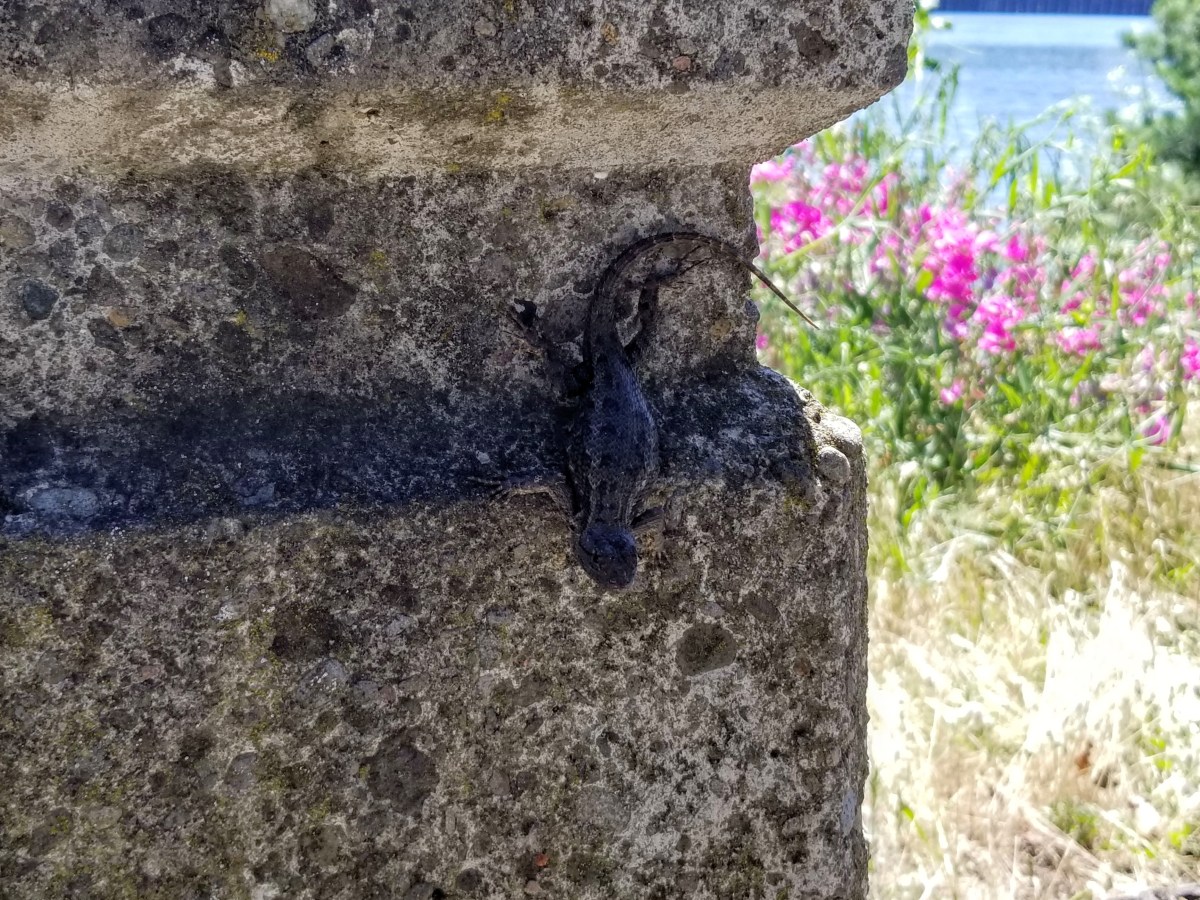
These little lizards fascinate me. Western fence lizards are common along the Willamette River in dry rocky and sandy areas, including on sidewalks. They creep about in an upright stance pretty boldly. They seem to think they are hidden, even when you photograph them from a couple of feet away.
 pseudoisaac