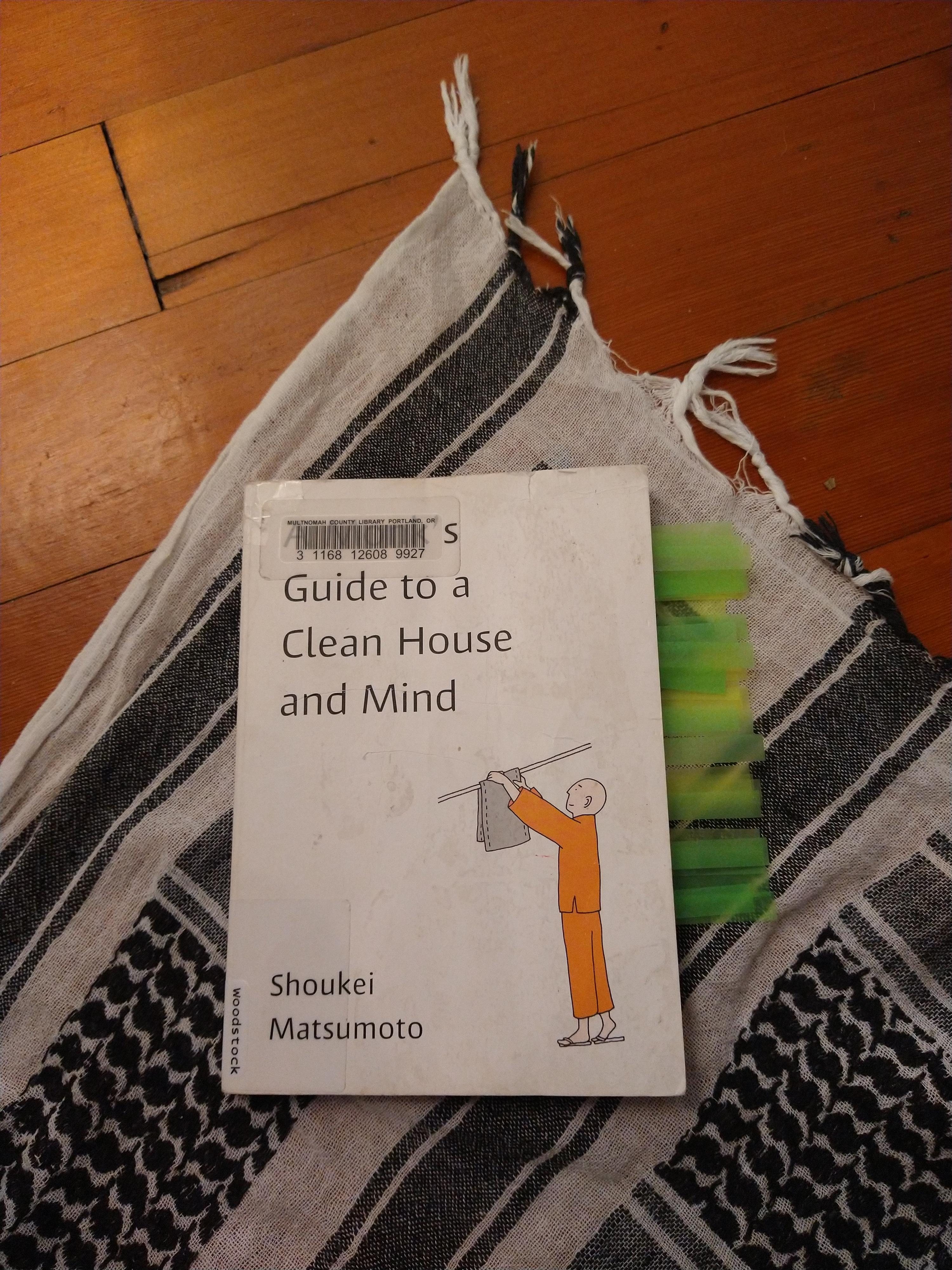
I found this little book after watching an excellent video on living out of one bag. The video creator recommended it. My reading of it occurred at just the right time in my life, as I examine my values and once again purge bags and bags of possessions for a move.
Some excerpts (italics are mine)
A monk’s day begins with cleaning. We sweep the temple grounds and gardens and polish the main temple hall. We don’t do this because it’s dirty or messy. We do it to eliminate the suffering in our hearts.
There is a notion in Japan that cleaning isn’t just about removing dirt. It’s also linked to cultivating the mind.
Family ties are the strongest of all human bonds. Use household chores as an opportunity to deepen them.
Zengosaidan. This isn’t just about how you feel. Do what you need to do without delay. Eliminate the seeds that distract your mind with unnecessary thoughts about things you will be dealing with tomorrow or things that went wrong yesterday. The longer you neglect the impurities of the heart, the harder it is to remove them. Never put off what you need to do until tomorrow, and enjoy each and every day.
Traditionally, in Zen Buddhism, practitioners wear funzoun clothing, that is, clothes made from old pieces of fabric that are sewn together. The wearing of these repurposed rags symbolizes the importance of caring for worldly objects as well as casting out conceit. This practice removes impurities from the heart.
This commitment to treasure objects until they can no longer be used or repurposed is at the heart of Buddhism.
Since the toilet is clean, you do not leave it dirty. Since you have not left it dirty, the toilet will stay clean. When this rule is broken, the toilet becomes dirty immediately. The first step to keeping your toilet clean is to adopt this mantra into your own life.
The point of housework is to clean up dirt and grime, isn’t it? So you might be wondering what the point is of cleaning something that is already spotless. But for monks the physical act of polishing the floor is analogous to cleaning the early dirt from your soul. This grime accumulates in your body and poisons your mind. This manifests itself as a dirty room and cluttered surroundings. Wipe your floor and see. Each blemish you find is a sign of unrest in your mind. Once you learn how to see how your inner turmoil manifests itself through your surroundings, you can reverse engineer this, mastering yourself by mastering the space in which you live.
It goes without saying that dust will accumulate in a home that is never cleaned. Just as you have finished raking the leaves, more are sure to fall. It is the same with your mind. Right when you think you have cleaned out all the cobwebs, more begin to form. Adherence to the past and misgivings about the future will fill your head, wresting your mind from the present. This is why we monks pour ourselves heart and soul into the polishing of floors. Cleaning is training for staying in the now. Therein lies the reason for being particular about cleanliness.
As you polish the floor, avoid any unnecessary thoughts, instead allowing your body to focus only on the task at hand. When doing this alone, you should be looking inward. When doing this with others, allow yourself to notice those around you, being conscious of your role in the team effort.
In the world of Buddhism, light is a symbol of wisdom and compassion. In order to cultivate wisdom and compassion in our lives, we should do our best to keep the sources of illumination in our homes free of grime or anything else that might obscure them.
The ultimate goal of Buddhist teachings is to conquer the suffering in people’s lives and open them up to enlightenment. In most cases we regard the root of human suffering as mumyo. Literally translating as “no light,” mumyo refers to the condition of being figuratively lost in the dark. Since you are unable to see the true nature of what is around you, your mind succumbs to worry and anxiety.
Dishes must be carefully held in both hands. Holding things in this way displays a sense of natural sophistication and shows that you take care of each and every thing you hold. I recommend that you give it a try.
Nowadays it is very easy to find a wide variety of items that are exactly alike and more or less serve the same function. When something breaks, rather than repairing it, many people buy a replacement because this is faster and cheaper. However, if you continue to live your life in this way, your relationships with others will begin to resemble how you relate to objects. This will lead to the exhaustion of your heart.
If you use an object for as long as you can, carefully, repairing it when necessary, you will find that not only your relationship with objects begins to change but so will the way you relate to people. This will help return your heart to a pure state.
Rather than chasing after the new, live a life in which you use the same objects for a long time. If you do this, you will naturally be able to care for and treasure the people around you as well.
People who endlessly chase after new things have lost their freedom to early desire. Only those who can enjoy using their imaginations when working with limited resources know true freedom. What sort of life do you wish to lead?
Glass is the very symbol of transparency and nonattachment. If your windows are cloudy or dusty, your mind will become cloudy as well. Buddhist teachings stress the importance of shattering the blurry filter of the self and viewing the world around you as it truly is. See and accept things the way they are. Learning to do so will help you achieve a state of enlightenment.
Temples will often have a long walkway, called a sando, leading up to the main building. The people who come to worship will take this path all the way to the altar, where they will straighten up their posture and offer a prayer. As we walk this path, we prepare our hearts to come face to face with Buddha. When you are on the path, try to stop at some point, take a deep breath, and let yourself be filled with gratitude.
You can create a clean and comfortable place for you and your loved ones to take care of business. Every time you step into your toilet you should appreciate how your body is expelling toxins and waste. You should feel refreshed and grateful.
We monks work hard all day, then read aloud from sacred texts, effectively using up all of our energy. When it is time to crawl into bed, our bodies never protest. We don’t have trouble falling asleep, and we always naturally get the right amount of sleep.
Quite honestly, a life free of possessions is very comfortable. After Ippen Shonin’s pilgrimage, he continued living a life without possessions and never again settled down to live in one specific place. By not being anchored down by worldly possessions, his mind was able to achieve true freedom.
There are some things you start to realize when living the Zen life of simplicity, namely, that you only keep things of good quality. They are the final products of many people’s diligent work. They are the kinds of things that you can continue to use again and again for many years.
Scrutinize merchandise thoroughly when you shop and consider whether or not you truly need an item before purchasing it. Also consider whether you can live comfortably with it. There is an old Zen saying that goes, “Where there is nothing, there is everything.” By letting go of everything, you can open up a universe of unlimited possibilities.
Use your possessions carefully and listen closely with your heart. Sooner or later you will begin to hear the voice as well. As you do so, you should also try to be knowledgeable about where to store things in your living space. Think of your home as an allegory for your body. Keep cleaning it every day. An object will tell you where it wants to be kept if you learn to see its true essence.
Clean your home thoroughly and let the seasons pour in. By stripping away unnecessary possessions and living simply, we can enjoy the seasons and our surroundings to the fullest extent. Get up and open a window. Take in the fresh air that blows through. The smell of the wind changes from season to season. The sounds of insects and the songs of birds tell us what season it is. Day in, day out, time marches forward and the seasons slowly shift. Buddha comes through nature and reaches out to us all. The nature you see around you is reflecting back at you what is in your heart.
Owning my neatness and tidiness
I keep my space neat and tidy and clean frequently. I sometimes arrange things according to a quasi-ritual order that’s personally pleasing to me. I sometimes got defensive in the past when others called my habits and spaces fastidious, sterile, immaculate, or anxiety-based.
But it is part of who I am. Now, I can laugh about it, I can flexibly respond, and I can often let things slide. I’ve eliminated rigidity just as I’ve eliminated clutter. I enjoy clearing out surfaces of stuff and placing one object of beauty, usefulness, or significance there instead. I enjoy examining each item that I initially assumed I would keep. Then I question that assumption rigorously and usually end up discarding it.
I think these overall habits came partly from the example set by a specific family member. Recently I noticed how neat and tidy this family member is. He abides by daily rituals of cleaning and arranging and laying practical things out for the next day. He does periodic deep cleans in tune with the seasons. He also decorates faithfully for the holidays, especially family-oriented ones.
On the other hand, I have another family member who grew up during the Great Depression and held onto useless junk such as thin plastic jars and lids for decades. I remember feeling exasperated at her habit of never letting go. Another family member accumulates DVDs, furniture, clothes, shoes, and other large, expensive collectibles that quickly lose their value. I am thankful for the influence of the tidy one. And I love getting rid of things that don’t matter, to make room for those that do.
The challenges of keeping a clean house and mind are with me, but addressing them brings me peace
I struggle against procrastination but cleaning quasi-ritualistically helps me a lot. I struggle to get rid of books and papers, but this helps me to internalize the ideas better and make room for new books and knowledge. I struggle to get rid of “aspirational” items, such as athletic gear I never took to. But I find peace by selling that shit to willing buyers starting a new hobby. And I like looking around my space and seeing only well-chosen essentials.
This book helped me connect my cleaning and discarding habits to a certain wider meaning and significance that I hadn’t fully articulated to myself.

 pseudoisaac