Beach naturalist on Puget Sound

I joined up with some nature geeks and looked at creatures living in the intertidal zone on a Seattle beach. I’m thankful for these naturalists who show me life forms I might have overlooked.

On this pocket beach at Olympic Sculpture Park a large group of people was gathered for a wedding ceremony. Many nicely dressed people lined the beach seated on giant bleached driftwood tree trunks in a semicircle, to watch two people make their vows on a clear, warm day in front of the vast Sound. Nearby a juvenile crow with blue eyes was struggling to subdue and swallow a large black minnow.

On the wet boulders there, sheltered from the hot sun, was a purple sea star. An expert educated me and my friend about the radial symmetry of these animals, an entirely alien body plan compared to us, an entirely alien way to experience the world.

The Seattle Aquarium guide says, “All sea stars can regenerate their arms, but the loss can reduce their self-defense and foraging abilities.”

That week, I paused over a throwaway comment from a character in “The Magic Mountain” that went, “Life means that the form is retained even though matter is being transformed.”

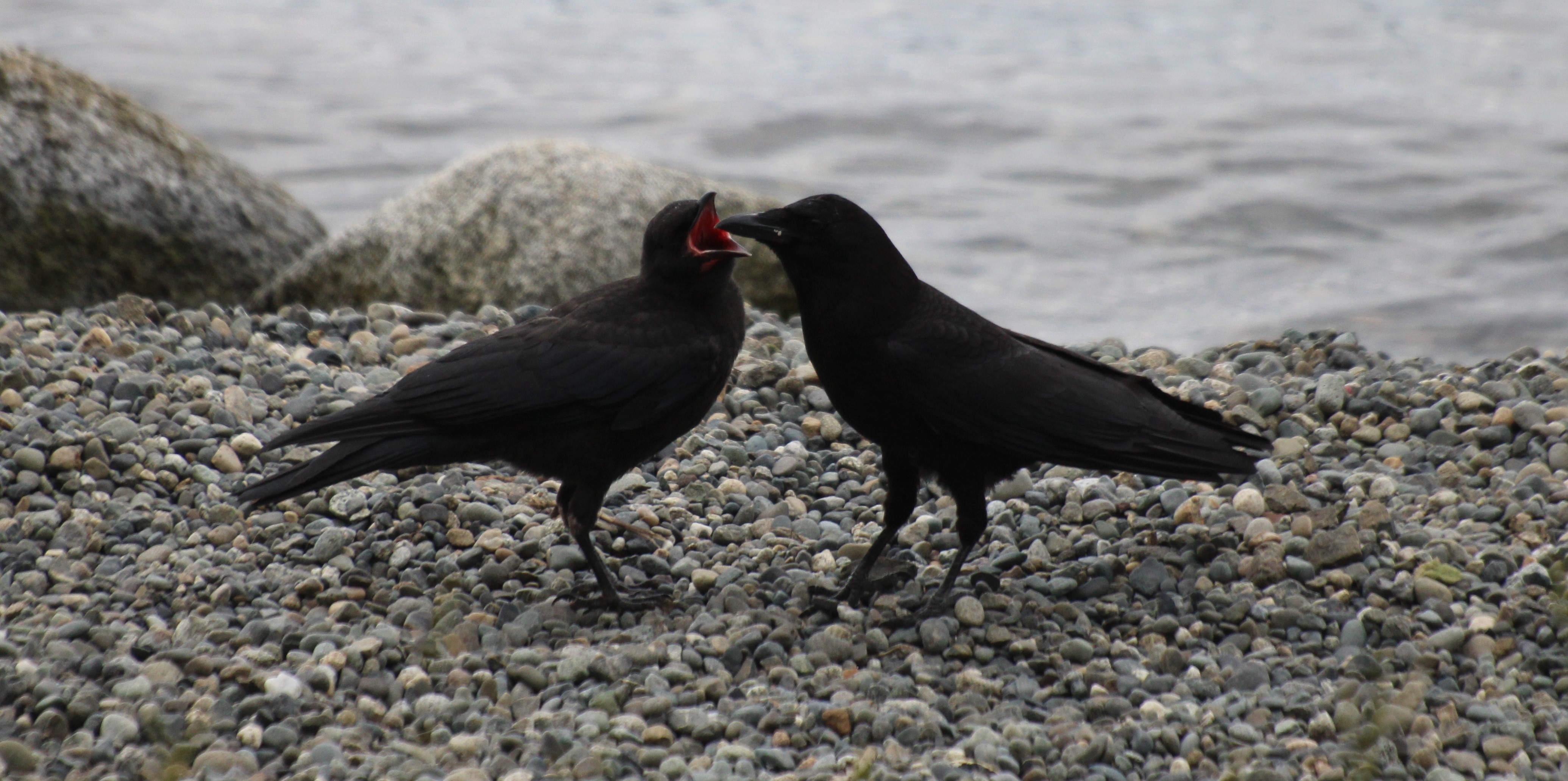
Crows on Lake Washington

I observed the begging behavior of a juvenile crow at Seward Park.

There was a group of three of the birds and their clamor caught my attention. I know to look when they make noise since they often turn up interesting things like a roosting owl or a fish to squabble over. This juvenile crow stood in place and vocalized with a raspy call with its red mouth wide open and waited for another to swoop in and touch or insert its beak. I didn’t see any food get transferred so perhaps it was some other gesture with a meaning other than begging for food. A third crow was nearby foraging and keeping watch.

I like crows for their intelligence and adaptability. They have a diverse array of vocalizations and the ones here in Seattle are noticeably smaller and raspier than the ones I grew up with in Minneapolis. They watch us all the time and continually call to each other about us, notifying the others when a human gets too close. I smiled recently when two crows scolded me loudly for picking up a large worn feather one of them had shed. I said, “I thought you didn’t want it?”

The juvenile has a brownish cast to its feathers and blue eyes. It benefits from cooperative raising of young. Crows partner up in mating pairs, groups, gangs, and flocks to survive in a sometimes-hostile world. My dad seems to despise them for religious reasons, which I can’t understand. Edgar Allen Poe wrote that his raven’s eyes had “all the seeming of a demon’s that is dreaming” and he called it a stately, ebony, ghastly, grave, stern, ominous bird of yore.

I can’t get enough of these smart little guys, these inky specters that share my city. A crow’s shifting silhouette always catches my eye and I try to look at what it’s looking at.