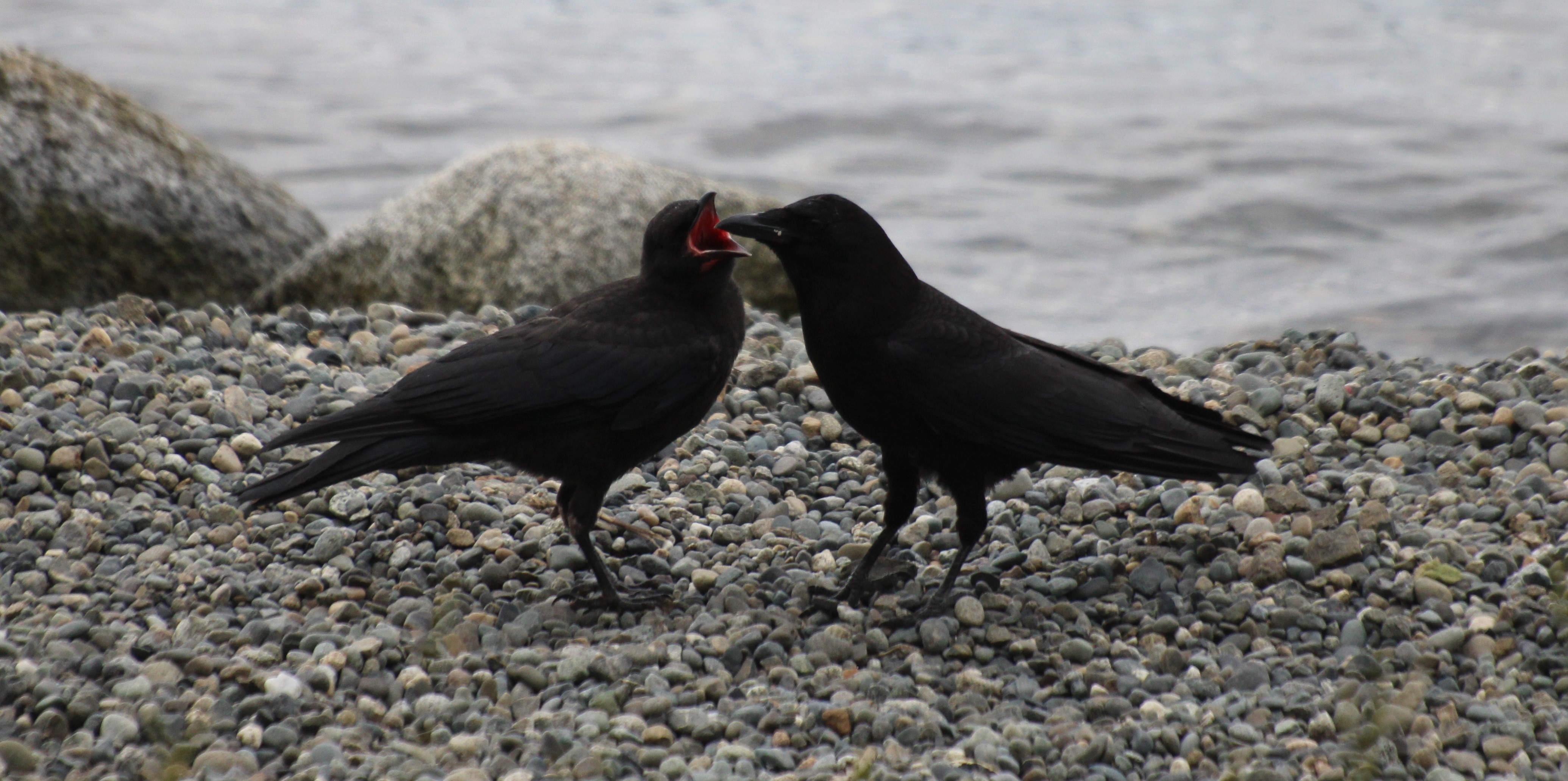
I observed the begging behavior of a juvenile crow at Seward Park.
There was a group of three of the birds and their clamor caught my attention. I know to look when they make noise since they often turn up interesting things like a roosting owl or a fish to squabble over. This juvenile crow stood in place and vocalized with a raspy call with its red mouth wide open and waited for another to swoop in and touch or insert its beak. I didn’t see any food get transferred so perhaps it was some other gesture with a meaning other than begging for food. A third crow was nearby foraging and keeping watch.
I like crows for their intelligence and adaptability. They have a diverse array of vocalizations and the ones here in Seattle are noticeably smaller and raspier than the ones I grew up with in Minneapolis. They watch us all the time and continually call to each other about us, notifying the others when a human gets too close. I smiled recently when two crows scolded me loudly for picking up a large worn feather one of them had shed. I said, “I thought you didn’t want it?”
The juvenile has a brownish cast to its feathers and blue eyes. It benefits from cooperative raising of young. Crows partner up in mating pairs, groups, gangs, and flocks to survive in a sometimes-hostile world. My dad seems to despise them for religious reasons, which I can’t understand. Edgar Allen Poe wrote that his raven’s eyes had “all the seeming of a demon’s that is dreaming” and he called it a stately, ebony, ghastly, grave, stern, ominous bird of yore.
I can’t get enough of these smart little guys, these inky specters that share my city. A crow’s shifting silhouette always catches my eye and I try to look at what it’s looking at.
 pseudoisaac