Recent population and birthrate articles finally identify a true childfree motivation

Lately I read with keen interest and a bit of bemusement about China’s first reported population decline from a high of over 1.4 billion people. I feel keen interest because of my strong opinions on the environment and bemusement because of the hand-wringing among worried opinion-havers that followed the news. Demographers, columnists and policy people are full of ideas and speculation about what the sharp and ongoing drop in births means for China, for the world, and for humanity.

China’s population decline

My view is that a country with extreme overcrowding and hypercompetition in education and work is now taking its foot off the accelerator toward resource depletion and military conflict. This is generally a good thing. And the worst-case scenario is that China will become like Japan: older, yes, but also long-lived, healthy, rich and deeply influential in the world.

Young people in China now have a chance to say no to one more burden in a context of hypercompetition in education and work, which some view as “a pointless hamster wheel, even a tool of control and repression. Last year the term “tangping,” or “lying flat,” went viral on Chinese social media. It was China’s version of the Great Resignation that began in the United States around the same time. Young people were quitting the rat race with all of its pain and stress. The government began censoring the term.”

South Korea women saying no to dating, marriage and motherhood

In a related, more extreme case of declining parenthood, women in South Korea are saying no to dating, sex, marriage and motherhood. Men are portrayed in the article solely as perpetrators of gender-based crimes who have no voice or impact on reproductive trends. But they also are saying no to breeding, as it takes two to tango. South Korea has a fertility rate that seems to be steadily approaching zero.

“Civilizational collapse” opinion

A NYT columnist who sees decadence in other people’s choices and moral failings in not reproducing blames “workism,” which elevates work and achievement above all other things in life. I agree that workism is a plague but it’s not the whole story in declining births. This is getting closer but still not there.

Also, this writer’s mind is polluted with Catholicism and he sees every societal trend and TV show he watches as a sign of the biblical end times and the wickedness and corruption of our souls. Instead of the rest of us having 3 children apiece, I’d suggest he have 12 more of his own and see if that stops his complaining. It is refreshing however to see a conservative writer begin to question capitalism, since capitalism seems to accompany fertility declines.

The writer opines against workism as being anti-fertility. Yet I have to point out that having kids yokes you permanently to the workism cycle. When you don’t have kids, you don’t have to grind yourself down in the relentless competition and feel you have no option but to train your kids to do the same.

Instead of fearing civilizational doom, I look forward to a bright future where fetuses are raised on an as-needed basis in vats of nutrient goo. Or perhaps incubated in computers. Perhaps Catholics can perform a blessing over the goo so that the humanoid life form that crawls out is still considered holy.

A prime reason: opportunity costs

Finally, I found an article that hit on an explanation that’s juicy and real:

The opportunity costs of having a child are too high.

Life is too good to sacrifice large chunks of it to a (current) nonbeing. The author is demographer Lyman Stone and he examines several explanations analysts have offered for why the birth rate declines everywhere, under seemingly all circumstances, and does not rebound.

He starts with a rare acknowledgment of uncertainty:

“And while their paper isn’t an exhaustive treatment of other presumed barriers to parenthood, they do suggest the conventional wisdom is lacking.”

Then he hits on something important:

“The opportunity cost of parenting—income, education, experiences, or career opportunities—forgone by having a child seem to be rising in an era of increasing affluence.

This insight cannot be underscored heavily enough. American incomes are at record highs, and standards of living are better than they were in decades past. Assuming would-be parents are opting out of having kids exclusively because of financial pressures misunderstands the dynamic at play.

The authors note that while women under 30 tend to see fertility falling the sharpest, “the decline is generally widespread across demographic subgroups, which gives reason to suspect that the dominant explanation for the aggregate decline is likely to be multifaceted or society-wide.” Building off the work of the late Sara McLanahan, Tomas Sobotka, and Suzanne Bianchi, they speculate that young adults in the U.S. are now much closer to what was already observed in Europe—preferences around childbearing, career, and opportunity costs have indelibly changed compared to prior generations. It’s worth noting that a 2018 poll of individuals who have chosen not to have children found the most frequently-cited reason for their decision was a desire for more leisure time. ”

THIS is why people turn away from having children: they take a balanced view of their future, realize that life is wonderful and having kids would take away 99 out of 100 of their current favorite things and future hopes. They recognize that all costs are opportunity costs, and parts of life are too good to give up for the sake of children.

Yes, financial pressures are real. Yes, people will always want more societal help and support when raising kids. And of course, they will accept free money from the government and several months of guaranteed parental leave. But people had huge numbers of children back when they were poorer and traditional gender roles were ironclad. Now, as life gets better and more equal, people still turn away from breeding. The trend is inexorable and, in my view, it’s a good thing.

Get fixed while you can

Half of pregnancies are unplanned, aka “oops babies.” So if people were more informed and aware, the birth rate would be plummeting even faster.

This is why, each night, in a gratitude ritual, I give my testicles an affectionate little pat and mentally thank the gentle nurse practitioner who severed the flow of the vas deferens with a titanium clip and prevented the little spermatozoa from ever, ever finding their way to an egg.

The childfree life is the way, the truth and the light and people all around the world are discovering this, for both negative reasons and positive ones, and making a future of their own choosing without the burden of babies.

About the photo

A smokestack in the SODO neighborhood of Seattle being reclaimed by nature.

I visited Minneapolis and it kind of sucked

I spent Christmas with my family in Minneapolis for the first time in four years. I expected to suckle contentedly at the tender bosom of family. Instead my weeklong stay was a mixed bag and a bit sad and disappointing.

The Good
I liked seeing the family after last visiting over a year ago. Many of my large close and extended family have changed. Kids have grown and developed, traditions have remained strong, and everyone survived covid except for my 99 year old grandma.

The Bad
The Weather
During my stay the weather was brutally cold, hardly rising above 0 F, with wind chills far below that. The news featured many exhortations to stay home and not spin out and die on the icy and snow covered roads. People mostly took this advice and stayed home, sheltering away from the lethal cold. The week reminded me of pandemic isolation. I did not leave the house much. It was a bit depressing and bleak, though pretty to look at. Interestingly the people who live there also hate the extreme winters and complain a lot and say they want to leave.

While I was there the Star Tribune published an article on how Minnesota continues to lose people who leave for other states. Experts interviewed for the article seemed flummoxed as to why this is happening.

Shooting at the mall
I visited the Mall of America with my dad so we could get some exercise (walking around Lake Nokomis was not an option because of the bitter cold). Before we could log a mile, a muffled voice came over the intercom that we could hardly hear. We realized everyone was rushing into the stores for some kind of lockdown. We were herded into the back of a bra store where we sheltered for an hour because of a shooting.

Twitter and messages from family gave us hints: groups of teenagers got in a dispute and shot and killed one of their own. After the shooters fled, they picked up food at White Castle. When arrested, all of them refused to talk to investigators.

This was sad. It came in the wake of another act of inhumanity that was on my mind: the killing of four students in their beds in Idaho by a PhD student living in Washington State. And just this morning I learned of the mass murder-suicide of 8 in a home in Utah. It occurred to me that the shooting among teenagers was less evil but of a more common type, and it involved cultural acceptance of violence. The Moscow, Idaho killings were extremely evil and infamous but also extremely uncommon. The Utah killings were relatively uncommon but also less infamous. Despite the scale of the Utah massacre, it hardly made the national news.

Kids and young people are dead, perpetrators are going to prison for life. Futures are derailed and denied. It’s all very sad.

Tantrum from my brother
I’ve seen so much positive transformation and growth in some family members. They have put troubled pasts behind them and started families and businesses and made an impact in life and in their own families.

Other family members have remained the same or regressed:

My brother threw a tantrum, including shouting and slamming doors, when someone gently asked him to shovel snow from a small stretch of sidewalk.

Later, when I gently asked him to stop touching me, he spazzed completely and and shouted, “DON’T EVER FUCKIN TALK TO ME AGAIN, GO BACK TO OREGON, I NEVER LIKED YOU ANYWAY! YOU FUCKIN PIECE OF SHIT. YOU FUCKIN PIECE OF SHIT” and so on. Then he threw a shoe box size gift box at me.

I marveled at this. I am fairly disgusted but also fascinated by meltdowns and sudden, extreme displays of emotion. This display was typical of him since age 5, but still striking.

I also monitored my own reactions. When he started shouting, I happened to be sitting in a meditative posture under a blanket with my legs crossed, clasping a mug of hot tea. I had spent hours in this posture in formal meditation, alone and in groups, watching my own mind and its ceaseless proliferation of thoughts, memories, feelings and bodily sensations. I was in the ideal state not to react but to simply observe the outburst and then to decide how to respond. In another odd and beneficial coincidence, within five minutes of the outburst I had come across this article on defusing family spats over the holidays.

One good bit of advice from the article is this: “When subjects “engage in highly charged emotional outbursts,” it can be helpful to stay silent for a beat or two, advised Noesner. When people fail to get a response, they often calm down to verify that the negotiators are still listening. “Eventually, even the most overwrought people will find it difficult to sustain a one-sided argument and will return to meaningful dialogue,” he said.”

I can’t say I employed any other piece of advice besides nonengagement. I could have taken an active approach and asked, “Do you mean it when you say you never want to talk to me again?” But it’s hard to keep the “principles of humanistic psychology” in mind when someone is shouting and throwing things at you like a goddamn ape.

The incident reminded me of other encounters with acquaintances and strangers, both male and female, in recent years (both before and after covid isolation) where they melt down and shout, “I’LL FUCKIN KILL YOU! I’LL FUCKIN KILL YOU! I’LL FUCKIN KILL YOU!” over some kind of perceived trivial slight. It is truly striking to watch this kind of display and it makes me believe all the more firmly in our shared ancestry with chimps.

I also gained a greater appreciation of what ACT (acceptance and commitment therapy) theorists mean when they say that a goal of values-based therapy is to “expand one’s behavioral repertoire” in response to inputs (stimuli). I now see how someone can fly off the handle when a small conditioned stimulus is introduced, just like a rat reacting to a tone under Pavlovian conditioning. When you select your response from an array of options, based on values and memory and choice, you are less like a rat and more like a full person.

Despite my monklike pose while waiting out the tantrum, I was not immune to a physiologic reaction. I monitored myself and noticed that while my brother’s voice was raised and his face contorted in rage, my heart started pumping harder and I felt a familiar flush in my face as blood welled up. I managed to just notice these reactions and remark on them with interest but no effort at suppression. In the language of fear and anxiety, I was exercising top-down control of the amygdala using attentional control directed by my prefrontal cortex, consciously dismissing a threat even as my nonconscious brain activated a defensive motivational state:

“We know that the discordance between what one says about one’s feelings and how one’s body is reacting in the face of a threat is a natural consequence of brain organization. Bodily responses are products of survival circuits that operate nonconsciously, and working memory, which is crucial to self-reports about consciousness, does not have direct, inside-the-brain access to the implicit systems that control these responses. Working memory acquires information about these states indirectly, by monitoring their noticeable consequences.”

All of which gives me more respect than ever for the work done by the nonconscious circuits of the brain. Not to mention respect for “Anxious,” a masterwork by Joseph LeDoux that I also was reading at the time.

I have come a long way in understanding people and responding to them in a way I choose. I dismiss the tantrums of my brother. But I wonder what effect he had on me when I did not have knowledge of emotion and psychology, when I was smaller than him and feared his rage and unpredictability. I am certain it left a mark and made the small child in me think that even close family members cannot be counted on and can become dangerous and threatening within a second. Perhaps I can judge the impact on me by how much I just vented. I could say I’m JUST LIKE this guy, who vented copiously and hot after the fact

when he was emotionally impacted, or realistically maybe this guy.

I also don’t know what he is capable of. After all, people own guns and kill family members all the time and I hardly know this person nowadays. He has over the years consistently taken several steps up the continuum of domestic violence and abuse. I wonder if it’s part of my I moved way the fuck across the country as soon as I could. That, and the awful cold.

In sum:
I think I will visit my home state once every two or three years and only during the warm months. I will not give my brother a chance to use violence against me. I will keep studying fear, anxiety and emotion. And I will probably avoid going into a shopping mall unless I absolutely have to.

About the photo
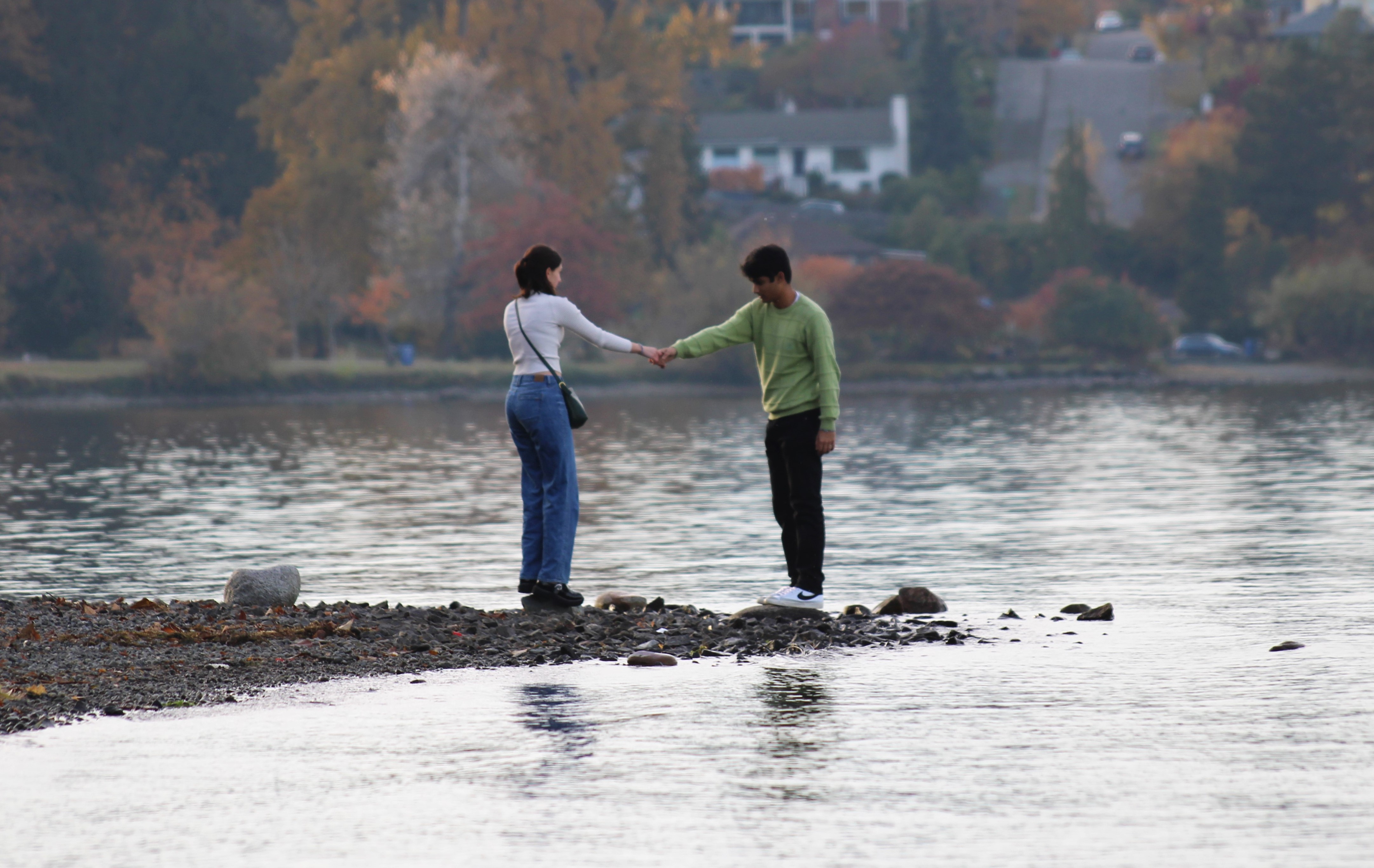
A couple at Seward Park, Seattle. (I could not have taken my camera out in Minneapolis’s bitter cold even if I had wanted to.)