I spent Christmas with my family in Minneapolis for the first time in four years. I expected to suckle contentedly at the tender bosom of family. Instead my weeklong stay was a mixed bag and a bit sad and disappointing.
The Good
I liked seeing the family after last visiting over a year ago. Many of my large close and extended family have changed. Kids have grown and developed, traditions have remained strong, and everyone survived covid except for my 99 year old grandma.
The Bad
The Weather
During my stay the weather was brutally cold, hardly rising above 0 F, with wind chills far below that. The news featured many exhortations to stay home and not spin out and die on the icy and snow covered roads. People mostly took this advice and stayed home, sheltering away from the lethal cold. The week reminded me of pandemic isolation. I did not leave the house much. It was a bit depressing and bleak, though pretty to look at. Interestingly the people who live there also hate the extreme winters and complain a lot and say they want to leave.
While I was there the Star Tribune published an article on how Minnesota continues to lose people who leave for other states. Experts interviewed for the article seemed flummoxed as to why this is happening.
Shooting at the mall
I visited the Mall of America with my dad so we could get some exercise (walking around Lake Nokomis was not an option because of the bitter cold). Before we could log a mile, a muffled voice came over the intercom that we could hardly hear. We realized everyone was rushing into the stores for some kind of lockdown. We were herded into the back of a bra store where we sheltered for an hour because of a shooting.
Twitter and messages from family gave us hints: groups of teenagers got in a dispute and shot and killed one of their own. After the shooters fled, they picked up food at White Castle. When arrested, all of them refused to talk to investigators.
This was sad. It came in the wake of another act of inhumanity that was on my mind: the killing of four students in their beds in Idaho by a PhD student living in Washington State. And just this morning I learned of the mass murder-suicide of 8 in a home in Utah. It occurred to me that the shooting among teenagers was less evil but of a more common type, and it involved cultural acceptance of violence. The Moscow, Idaho killings were extremely evil and infamous but also extremely uncommon. The Utah killings were relatively uncommon but also less infamous. Despite the scale of the Utah massacre, it hardly made the national news.
Kids and young people are dead, perpetrators are going to prison for life. Futures are derailed and denied. It’s all very sad.
Tantrum from my brother
I’ve seen so much positive transformation and growth in some family members. They have put troubled pasts behind them and started families and businesses and made an impact in life and in their own families.
Other family members have remained the same or regressed:
My brother threw a tantrum, including shouting and slamming doors, when someone gently asked him to shovel snow from a small stretch of sidewalk.
Later, when I gently asked him to stop touching me, he spazzed completely and and shouted, “DON’T EVER FUCKIN TALK TO ME AGAIN, GO BACK TO OREGON, I NEVER LIKED YOU ANYWAY! YOU FUCKIN PIECE OF SHIT. YOU FUCKIN PIECE OF SHIT” and so on. Then he threw a shoe box size gift box at me.
I marveled at this. I am fairly disgusted but also fascinated by meltdowns and sudden, extreme displays of emotion. This display was typical of him since age 5, but still striking.
I also monitored my own reactions. When he started shouting, I happened to be sitting in a meditative posture under a blanket with my legs crossed, clasping a mug of hot tea. I had spent hours in this posture in formal meditation, alone and in groups, watching my own mind and its ceaseless proliferation of thoughts, memories, feelings and bodily sensations. I was in the ideal state not to react but to simply observe the outburst and then to decide how to respond. In another odd and beneficial coincidence, within five minutes of the outburst I had come across this article on defusing family spats over the holidays.
One good bit of advice from the article is this: “When subjects “engage in highly charged emotional outbursts,” it can be helpful to stay silent for a beat or two, advised Noesner. When people fail to get a response, they often calm down to verify that the negotiators are still listening. “Eventually, even the most overwrought people will find it difficult to sustain a one-sided argument and will return to meaningful dialogue,” he said.”
I can’t say I employed any other piece of advice besides nonengagement. I could have taken an active approach and asked, “Do you mean it when you say you never want to talk to me again?” But it’s hard to keep the “principles of humanistic psychology” in mind when someone is shouting and throwing things at you like a goddamn ape.
The incident reminded me of other encounters with acquaintances and strangers, both male and female, in recent years (both before and after covid isolation) where they melt down and shout, “I’LL FUCKIN KILL YOU! I’LL FUCKIN KILL YOU! I’LL FUCKIN KILL YOU!” over some kind of perceived trivial slight. It is truly striking to watch this kind of display and it makes me believe all the more firmly in our shared ancestry with chimps.
I also gained a greater appreciation of what ACT (acceptance and commitment therapy) theorists mean when they say that a goal of values-based therapy is to “expand one’s behavioral repertoire” in response to inputs (stimuli). I now see how someone can fly off the handle when a small conditioned stimulus is introduced, just like a rat reacting to a tone under Pavlovian conditioning. When you select your response from an array of options, based on values and memory and choice, you are less like a rat and more like a full person.
Despite my monklike pose while waiting out the tantrum, I was not immune to a physiologic reaction. I monitored myself and noticed that while my brother’s voice was raised and his face contorted in rage, my heart started pumping harder and I felt a familiar flush in my face as blood welled up. I managed to just notice these reactions and remark on them with interest but no effort at suppression. In the language of fear and anxiety, I was exercising top-down control of the amygdala using attentional control directed by my prefrontal cortex, consciously dismissing a threat even as my nonconscious brain activated a defensive motivational state:
“We know that the discordance between what one says about one’s feelings and how one’s body is reacting in the face of a threat is a natural consequence of brain organization. Bodily responses are products of survival circuits that operate nonconsciously, and working memory, which is crucial to self-reports about consciousness, does not have direct, inside-the-brain access to the implicit systems that control these responses. Working memory acquires information about these states indirectly, by monitoring their noticeable consequences.”
All of which gives me more respect than ever for the work done by the nonconscious circuits of the brain. Not to mention respect for “Anxious,” a masterwork by Joseph LeDoux that I also was reading at the time.
I have come a long way in understanding people and responding to them in a way I choose. I dismiss the tantrums of my brother. But I wonder what effect he had on me when I did not have knowledge of emotion and psychology, when I was smaller than him and feared his rage and unpredictability. I am certain it left a mark and made the small child in me think that even close family members cannot be counted on and can become dangerous and threatening within a second. Perhaps I can judge the impact on me by how much I just vented. I could say I’m JUST LIKE this guy, who vented copiously and hot after the fact
when he was emotionally impacted, or realistically maybe this guy.
I also don’t know what he is capable of. After all, people own guns and kill family members all the time and I hardly know this person nowadays. He has over the years consistently taken several steps up the continuum of domestic violence and abuse. I wonder if it’s part of my I moved way the fuck across the country as soon as I could. That, and the awful cold.
In sum:
I think I will visit my home state once every two or three years and only during the warm months. I will not give my brother a chance to use violence against me. I will keep studying fear, anxiety and emotion. And I will probably avoid going into a shopping mall unless I absolutely have to.
About the photo
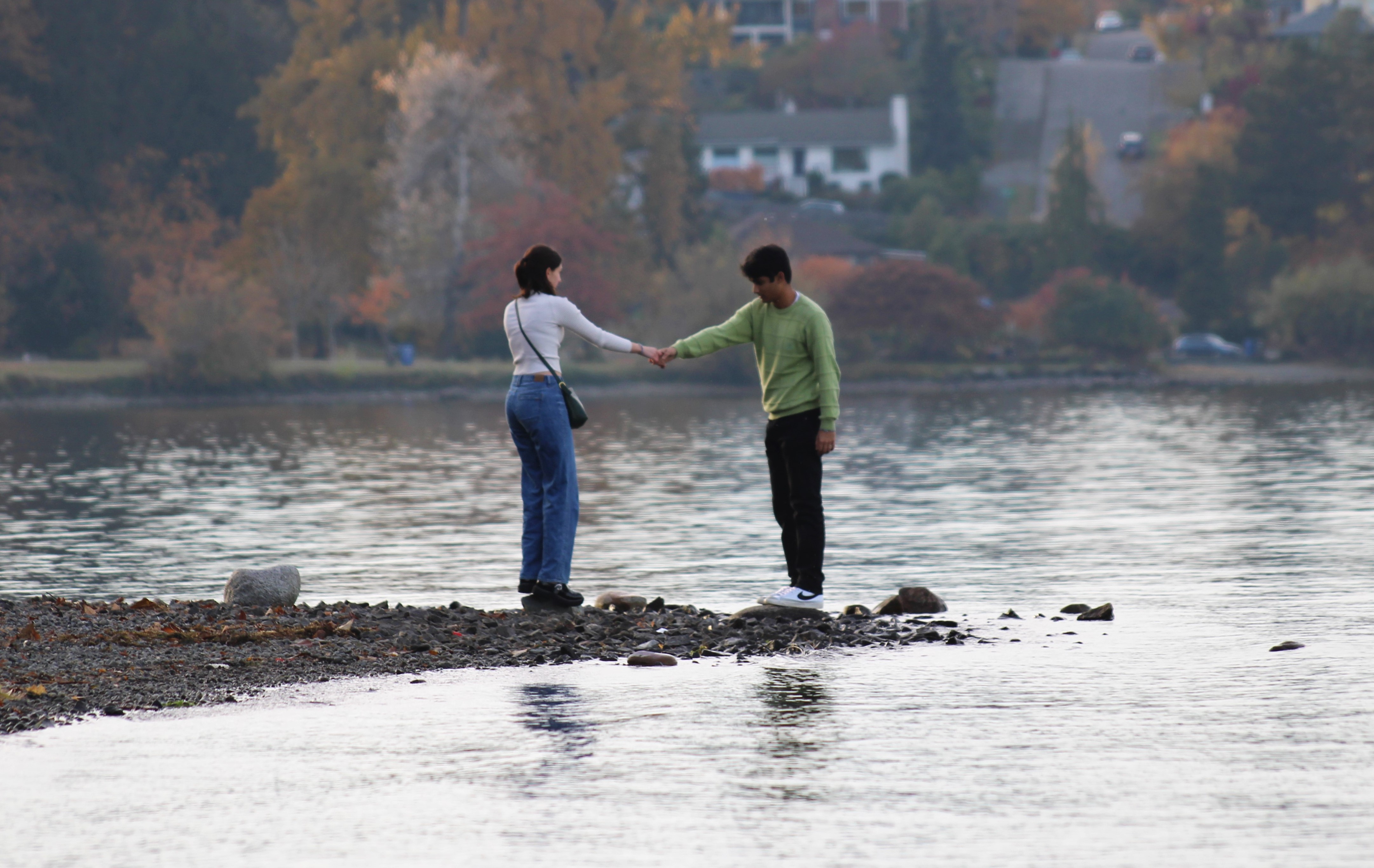
A couple at Seward Park, Seattle. (I could not have taken my camera out in Minneapolis’s bitter cold even if I had wanted to.)
 pseudoisaac