I have found that Paris is just like any other city: completely dominated by cars. In some ways, it is just as bad as any American city in this respect, and in some ways much better. However, it is making good progress in reversing the great car culture mistake of the 20th century, where cities across the planet made cars the center of their existence.
Examples of something good against Parisian car culture
Anne Hidalgo’s persistent efforts to retake the city for people instead of cars are commendable.
This interview showcases her patient, rational approach. She is not dismissive of the wails of parking advocates but instead points to the democratic process that elected her (a socialist) and other environmentalist leaders.
In the interview, she says, "Une partie de la droite parisienne s’est ‘trumpisée’ sous l’impulsion de Madame Dati. C’est délétère pour la démocratie." In other words, when a loud minority is losing the social tide, they resort to nasty attacks online and turn up the polarization by claiming to be under attack and using other such tactics. Another word for it is "gilet jaune-ification," referring to the movement in 2018 where rural drivers shut down intersections to protest a number of vaguely defined issues, with high gas prices at the center of it.
Automated fines for noise pollution:
France has drastically reduced traffic deaths through automated speeding cameras. Now, after a long process of technical and legal refinement, cities such as Paris will cut down on the hellish noise that rips through neighborhoods and impacts human health. Automated sensors will fine drivers. This is one issue where the smallest moped engines make the most noise. They are truly obnoxious. It has been said that a single moped driving across the city could wake up thousands of people. Residents hate them. For police patrolling the streets, it is not a priority. Finally, the government will do something about it.
Eliminating parking spots and raising parking fees, especially for the biggest, heaviest, and most dangerous cars:
Some cities, such as Oslo, have had success in the war on cars by simply eliminating parking spots. Paris has done this and is also consistently raising parking fees for cars. The biggest fees will go to the most destructive vehicles: SUVs, trucks, and vans that are large, heavy, highly polluting, and dangerous. In my opinion, these vehicles do not belong in the city at all.
Interestingly, in the linked article, some drivers are accepting of the fees. They seem to understand that the users of a road should pay for the negative impact they have. But they also do their share of whining. I think this is because drivers here also walk. In the US, drivers universally claim victimhood and outrage when their free, ubiquitous, unlimited parking is threatened. American drivers have only the windshield perspective and do not experience life on two feet.
Bike lanes everywhere:
You can bike everywhere in Paris, but you have to keep your wits about you. There is so much activity on the streets that I am grateful I bought an urban-style utility/commuter bike with an upright stance and wide handlebars. Cars are a threat, but they are only a part of the traffic. As a result, you don’t see endless streams of cars roaring past at high speeds like in the US, where stepping into the road is risking your life.
Even where there are no bike lanes, speeds are lower, stoplights are frequent, and there is safety in numbers. A driver cannot plow through a crowd of people without getting caught and going to jail, whereas in the US, a driver can easily kill a person and then use the ironclad defense, "I didn’t see them."
Drivers and politicians here are walkers too
This youtube channel does a great job of documenting the issues around non-car mobility in paris. The author recently posted a video and analysis of a local politician intervening in an altercation between a jackass cab driver and a cyclist.
A ban on rentable scooters:
These electric foot scooters, although fun, are simply not needed. Paris banned them because they were being left to block sidewalks, and clueless tourists were joyriding and breaking their skulls on the concrete. Micromobility is a good thing, but Paris pushed back against tech companies in this case, especially after it was shown that people who used the scooters would have just walked if they were not available. Paris does not bend over backward to serve tourists and tech companies. (Of note, a lot of those loud and polluting mopeds are from drivers working for gig delivery companies.)
Slower vehicle speeds and no stroads:
This has been proven again and again: slowing down cars saves lives and makes the city livable. Eliminating US-style stroads is also essential. The only taste of a stroad I have seen here is in the Périphérique, which rings the city. As expected, it is polluted, hostile, and dangerous, and there is often little reason to cross it since most of the good stuff is inside this ugly perimeter.
During recent days of higher than usual ozone and particulate pollution, citywide speed limits were reduced further.
I look forward to the day when all cars have a speed delimiter that allows them only to creep within the city and can be reduced until all traffic deaths have been eliminated. It is cars that kill. Once we control the cars, we eliminate the deaths.
Examples of something bad in Parisian car culture:
Diesel cars dominate:
Unfortunately, Paris has many diesel cars. The exhaust from these vehicles includes a huge amount of particulates, which cause cancer, pulmonary disease, dementia, and premature death. The streets reek of diesel exhaust, and it will be a long time before this gets better since these engines last forever. This is yet another example of a society prioritizing cheap convenience over human health.
On a recent day when particulate pollution was four times the WHO limit for health, I witnessed a driver sitting in his idling diesel work van for half an hour while he ate, picked his nose, and played on his phone. This was just feet from an outdoor workout area where people were trying to exercise. Just like in the US, I sometimes feel I live in a different world than certain people, where we each have alien arrays of facts, values, and understandings of what is acceptable and what is not.
Mopeds:
These vehicles are noisy and smelly and need to be electrified and reduced in number ASAP.
American-style SUVs, vans, and pickups are spreading here:
Sadly, I saw a Ram pickup truck on Rue St Jacques recently. It could hardly fit into the parking spot, so its ridiculous ass-end was extending out into the street. Other SUVs are growing in size and obnoxiousness as well. This Ram was dinky compared to the lifted douche wagons I see in Washington and Oregon, though.
Drivers kill and maim people here just as anywhere else
Tragically, a driver struck a cyclist in my neighborhood last week and then sped off. The young female cyclist had her legs amputated as a result. Bafflingly, the news publication referred to this as an “accident,” just as in coverage of car carnage in the US. Hit and run drivers (the scum of the Earth) are here, there, and everywhere.
European cities will figure this all out first. American cities will eventually get there.
European cities were designed before car culture came to dominate. They will be the first to create livable, climate-resilient cities where humans are centered, and not cars. Eventually, American cities will follow. I have seen a lot of progress in Minneapolis, Portland, Chicago, Seattle, and Paris. And I will keep pressuring my local politicians for car-free cities wherever I live.
About the photo
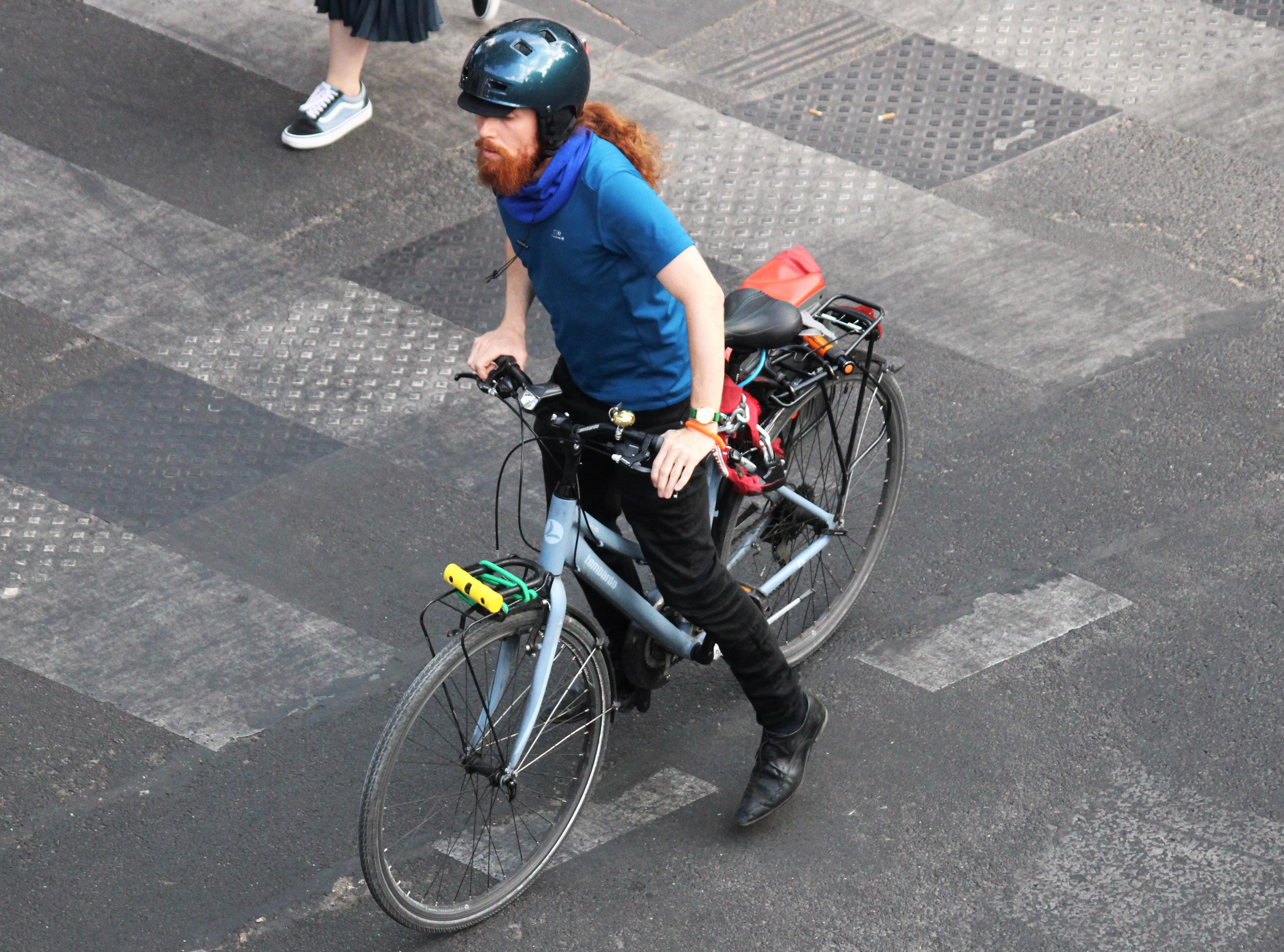
This guy channeled the spirit of Vercingetorix. Yet you shouldn’t have to be a fierce pagan warrior to survive biking the city streets.


 pseudoisaac