I visited this incredible gallery of life forms in paris and learned a lot.
French natural history museum, opened for an exhibition in the late 1800s
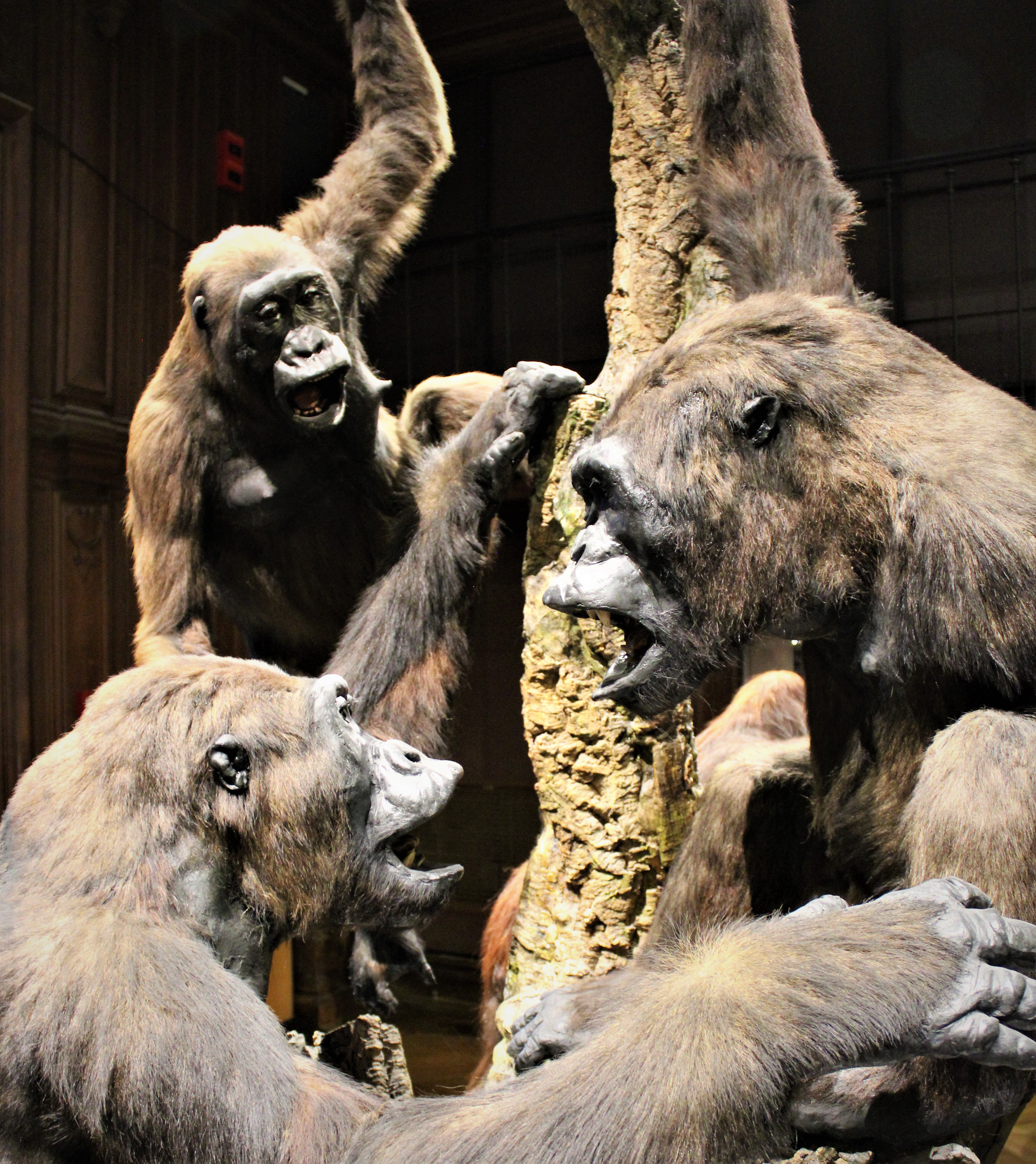
The Grande galerie de l’evolution opened during an exhibition during the heyday of Paris and was renovated more recently. The displays are lifelike and out in the open, a far cry from other natural history museums where the specimens are locked in cabinets and behind glass. The African animals on the second floor are in a procession, allowing you to see and compare their often immense size. The whale skeletons are unbelievably huge and allow you to look at the leg bones which have almost disappeared over the evolutionary timescale.
Blown away by the models and taxonomy. Informative text
The saddest gallery is of course the one on extinct or threatened species. I especially hate the thought that we continue to kill off our closest relatives, such as the chimp, gorilla, and orangutan.
Recent reports on the ivory billed woodpecker come to mind. A researcher once again used poor quality photographs and wishful thinking to claim that the species is still alive somewhere in Louisiana. We want to believe we didn’t kill off this iconic American bird by destroying its habitat. We want to preserve this one species while not restoring the swampland where it evolved.
Connect to my summer of reading in biology
This summer I read widely in biology. Two books were my highlights: on the Origin of species by Charles Darwin, and the Deep History of Ourselves by joseph ledoux.
My personal admiration for Darwin grew. I loved his homespun experiments and observations. I liked his extensive correspondence with scientists throughout the world, noted conversationally in the book. Several of them are cited in the Grande galerie and on the street names of paris. The book is actually pretty readable.
I wonder about the inductive method in biology and how it might serve us in the future. It is sometimes looked down upon as not being scientifically rigorous despite being the foundation of darwin’s method. For example, if you applied inductive reasoning to the motion of objects, you would be misled. Only experimentation and mathematization would lead you to the laws of motion or relativity.
But especially now, AI can synthesize a huge amount of information and come to conclusions without necessarily using the scientific method. The scientific method may just be a guard against human heuristic errors and thinking traps. An AI could bypass some of this if trained (or trained to train) in the right way. After all, some of the frontiers of science are partly speculative. We cannot run experiments on distant life forms or exoplanets. But we can model and induce and generalize based on what we observe, just as Darwin did.
The Deep History of Ourselves was fantastic and it felt like a powerhouse display of all we have learned since Darwin’s time. The book captures the endless inventiveness of nature, the tradeoffs of multicellularity, and the relentless selection pressures that eventually selected for consciousness. The book ends abruptly with a chapter on emotion, suggesting that emotion is the most recent and most derived trait in the conscious mind.
The book, though subtitled as being about minds, was much more than that. As Ledoux described in his introduction, his writings about the mind led him further and further back, until he was outside his realm of expertise and had to adopt the writing process of a science journalist. Funny, because the same thing happened to Carl Sagan and Ann Druyan when they wrote “shadows of forgotten ancestors” (also highly recommended).
Napped on a bench
I napped on a bench in the Jardin des plantes under a plane tree and enjoyed the crows, doves and parakeets that live in this park.
Author reading
I dropped into an author reading at Shakespeare and Co. I immediately disliked the author when he spoke, within 2 minutes, about how he “dislikes” capitalism, apologized for writing a “manspreading” book, and said that F. Scott Fitzgerald was problematic. He also dropped the words misogynistic, patriarchy and bigotry like they were code words for immediate acceptance by the crowd.
I reflected on how he also did a reading at the Portland OR book festival while I was there. So he gets to criticize capitalism while being feted in cities across the globe. And he criticizes colonialism while existing as a white man with the same first name as villain Hernan Cortes. And, he disavows and veils his status while enjoying the privilege and prestige of celebrity.
I am a liberal but I understand the vexation of conservatives who see liberals guarding some strands of international culture like a club where you have to use the correct language to enter.
Square Michel Foucault
On my bike home I stumbled across Square Michel Foucault. I thought of my high school teacher who said Foucault’s Discipline and Punish was the most influential book on him ever.
A college professor also alluded to this book but I disliked him, especially when he blended his scholarship with cultural criticism.
When I finally read Discipline and Punish I found no overall theory but much theorizing. The most important idea for me was how power is often internalized rather than being imposed on us through visible means.
The most important image I retained from the book that of the panopticon, where every subject knows he could be watched at any time, but does not know for sure. I brought it up when we discussed la surveillance automatisee in my French class.
Now, almost all cultural output is being synthesized into something we can’t predict. Not just text, but also images, voice and video are being pumped in to AI models. What comes out is already shocking us. What will eventually take shape is uncertain. There is a feeling that there is no turning back.
In that square I considered the smallness of human life and the fractal nature of reality
Take a dart and throw it at a map of paris. The street or square is probably named after a person. Each one of those people has a thousand scholars who have spent their career studying the ideas, art, or discoveries of that one person. Plus innumerable Wikipedia articles, imitators, and local applications of their work.
With the endless minute iteration, refinement, and detailing of human output, perhaps we are in need of something that can take the entire sweep of things and create something new or general within seconds. This might be a meta-contribution that AI provides.
However, it’s also possible that our true legacy is those endless cultural productions. If we meet aliens, they will have refined the same science and engineering that we have. It is cultural evolution that we have to offer. As EO Wilson observed.
Which brings me back to culture.
I lounged in front of la tour Eiffel and a little drama played out
Two young Italian women were picnicking.
A loose medium size, long haired golden retriever juvenile ran up and went straight for their sandwich and devoured it.
The young woman of 20 or so years said, no, no, no, but did not grab the dog.
It swallowed the loaf and then pounced on another food item: some chips.
A French woman ran up and apologized profusely.
They communicated and eventually sorted out that the woman would go to the shop across the street and buy what the dog had stolen.
Dispatches from home
My mom and dad got covid again. Now it is just a nuisance instead of a deadly threat.
A friend visits California where family and summertime experiences of a man in his 20s await.
Another friend raises a young family. I hope to pick up right where we left off when I return and see how his young kids have shot up.
A friend from india helped me find a contact in France who will help if I run into trouble. I reflect that Indians are everywhere across the globe because of their huge and growing numbers (1.5 billion).
A sister has a new baby on the way. A 3D ultrasound shows her face before she is even born. She and her wife are creating the family they deeply desire and have nurtured already. I sometimes wonder if I have turned my back on them by moving away. I know that I am looked at with puzzlement and misunderstanding. But I can’t live in Minnesota because it is too cold there. And I can’t help but keep people at arm’s length because I basically trust no one.
About the photo
Three apes (I think they are bonobos) pant, hoot and gesture at the Grande galerie de l’evolution.
 pseudoisaac