In Parc Montsouris, a few blocks from my apartment, I had the privilege of attending a Chopin concert. The pianist wore a red scarf and a white dress, reflecting the colors of the Polish flag, and she showed mastery of the pieces that got the crowd excited and (some of them, at least) rapt.
The connection between the nations of France and Poland runs deep, exemplified by the harmonic genius of Chopin himself and his resting place in Père Lachaise Cemetery (next on my promenade à vélo list).
A music video by a Parisian filmmaker featuring Hania Rani’s music and the natural beauty of the French Alps also reflects this relationship. This video is a marvel, expressing harmony, awe, spontaneity, and synergy. It effortlessly transported me to epic montane surroundings, where I felt caressed and elevated by the rhythmic repetition of "Hello" in Hania Rani’s tranquilizing hush. It’s a nice video that shows how joyful movement and sound relate to the magnificent natural world.
During the Montsouris performance, which included familiar nocturnes and polonaises, my thoughts drifted to a film I had watched the day before called "Les Innocentes," a portrayal of a French doctor aiding Polish nuns who had suffered in silence and isolation, impregnated by Soviet troops during World War II. It served as a reminder to branch out from my usual film viewing and try something new. I thought about Kurt Vonnegut’s portrayal of Poles as the clowns of World War II, whereas the French are generally portrayed in cinema and literature as a cultural powerhouse (but who tend to lose wars).
The concert itself was an emotional journey for me. Arriving ten minutes early, I discovered that the seats were already filled. Adapting, I perched beneath a nearby tree, seeking a spot away from the crowd, hoping not to stand out conspicuously as an outsider. I wanted to listen with focus and be both highly present and elsewhere.
As the concert unfolded, nature had its own plan, and raindrops began to fall, gently at first, then with increasing intensity. A crowd gathered around me, seeking shelter from the warm raindrops. I felt a growing sense of claustrophobia as people pressed in on me, their feet shuffling incessantly closer, inches from my eyes. I tried not to look at (and imagine) the diabetic feet of the woman in front of me, with her cankles, cyanosis, and calloused flesh on the verge of necrosis and amputation. But these were negative-tending predictions about the future, whereas the present (I reminded myself) was a concert in a Parisian park with warm rain coming down. I averted my gaze, focusing on the music and following the mental journey of the pieces.
Rain continued to come down, and predictably, the crowd under the tree got denser. Feet inched closer, bringing with them the odor of sweat and mundane family conversations. A mother even started singing "Baby Shark" to her young child, seemingly disregarding the pianist playing a mere fifteen feet away, who had traveled a long way and prepared a lot to perform here, only to be drowned out by rain and the viral productions of PinkFong.
I turned inward while focusing on the music, using mental concentration muscles developed through meditation. I reminded myself of the impermanence of every mental and physical state, finding that I could let go of judgment of the flaky skin and human blemishes in front of me while celebrating the music that had resonated with me countless times in digital format. Although live conditions seemed to hinder its full splendor, I remained rooted and absorbed the lesson that external distractions did not dampen the essence of the performance.
In fact, I considered how a pure "Boltzmann brain" floating in remote space and hooked up to high-fidelity headphones to appreciate this sequence of exquisite keystrokes would not be a superior or inferior experience to the present one, if such a brain existed. It would just be the reality of the matter. Similarly, when, in Steppenwolf, Harry Haller lamented the tinny, adulterated Mozart played through a radio, or in Watchmen when Dr. Manhattan fled to Mars to craft a sterile crystal palace with indifference to the impending human slaughter on Earth, neither one of them was accepting what was before them. In the end, though, they came around to acceptance and a balanced understanding, and so did I.
The rain was sudden and intense enough to provoke flooding on the other side of Paris. The impermeable concrete and asphalt of this city are increasingly a liability. However, the city is acting to correct these climate vulnerabilities.
The pianist moved into a piece of impossible complexity that reflects the height of human skill and harmonies. This sequence was included in one of my favorite movies, which happens to be a French made-for-TV movie based on "Flowers for Algernon." This adaptation happens to be better than the book, in my opinion, due to the limitations of the journal format of the original book. The sequence I refer to is at 56:23 in this link and points to how a rendition that is too "cerebral" is just not right, in a way that is hard to articulate.
Eventually the rain subsided and the crowd dispersed from beneath the tree, no longer encroaching on my personal space and immediate field of view. The pianist concluded the concert with flawless (and emotive) renditions of certain polonaises, nocturnes, and mazurkas. The smiling, petite, blond pianist bowed and beamed. I took one last look at her pixie hairdo and red scarf and walked home.
Now, I feel a desire for more. Hearing Chopin’s complete preludes performed live, even if remotely approaching the caliber of Seong-Jin Cho’s rendition of the 15th, would make me bust a nut. There are more Chopin concerts in the park coming, and I will be there for the next one, and I’ll be ready for the rain.
About the photo
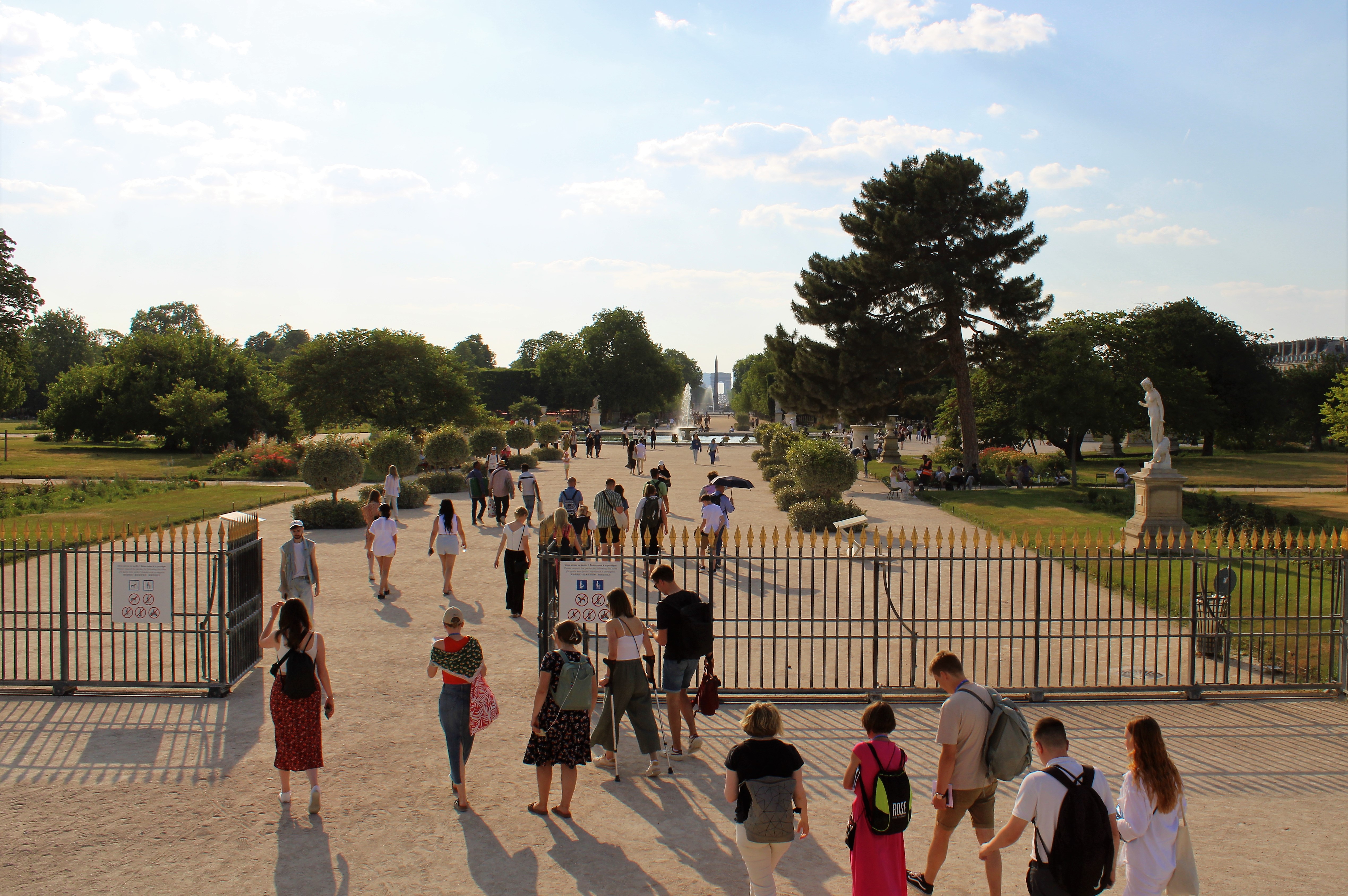
A view of the epic walk from the Louvre to the Arc de Triomphe, past the Place de la Concorde, where 1300 people were guillotined. At this time of year the sun is right over the Arc and the gentle uphill climb feels like a pilgrimage.
 pseudoisaac