Today, I witnessed the ferocious struggle for existence play out in two little dramas, both involving birds.
The first incident took place after my return from Parc Kellerman on the south side of town. A small fledgling bird (I believe it was a house sparrow) hopped about on the pavement, appearing hopelessly vulnerable in the canyon-like street with no tree or nest in sight. A carrion crow (corneille noire) watched it from a few feet away, inching closer. However, the crow kept alternating its look between me and the young bird. When I looked up, I noticed an adult sparrow scolding the crow, desperately trying to drive it away from its offspring. The crow waited for me to settle before moving in for the kill.
I consciously considered intervening and scaring the crow off, but I allowed nature to take its course. As expected, the crow lunged at the chick and began devouring it. Almost immediately, another sparrow arrived, and the two parents fiercely dive-bombed and squawked at the crow. But it was too late. The crow swallowed the fledgling whole, its neck jerking violently in those rapid vertical movements birds make when desperately devouring food.
I felt sorry for the little bird, but the carrion crows in Paris look so mangy and diseased that I believe they need all the food they can find, especially something other than garbage from a bin. Despite the intelligence of corvids, the Parisian crows seem more like flying rats. They are outclassed by the graceful, long-tailed Eurasian magpies (pie bavarde) that roam fields and trees, and generally do not have missing and discolored patches of feathers like the crows do.
The second raw natural spectacle unfolded in the Jardin des Plantes this afternoon. As I strolled there after grabbing an iced coffee (it’s hot af here), I came across two young women poking at an immobile and passive pigeon ramier sitting on the trail. They seemed convinced that it just needed some verbal encouragement and a few sharp jabs. I continued walking but later looped back. Against common sense, they were still prodding the bird, attempting to make it fly or move to the side of the trail. I am certain they exhausted and stressed the bird, which could have been suffering from heat, disease, or injury. I left them, still poking at it and interfering with what was likely a natural death.
The pigeon species in question was a pigeon ramier, a city pigeon that is larger than the common rock dove. These birds are not vocal, do not form large flocks, and make quite a bit of noise while moving about in the trees. They often perch silently on branches near people, and their population is on the rise.
All of this took place in the shadow of a statue of Lamarck, an evolutionary theorist whose ideas formed much of the intellectual milieu where Darwin formulated his theory of evolution. As you enter the Jardin des Plantes from the north, you come across his statue, usually adorned with bright white pigeon poop dribbling down his head, contrasting with the statue’s greenish copper color. Sometimes, the culprit pigeon (either a pigeon biset or pigeon ramier) sits right on top.
ABOUT THE PHOTO
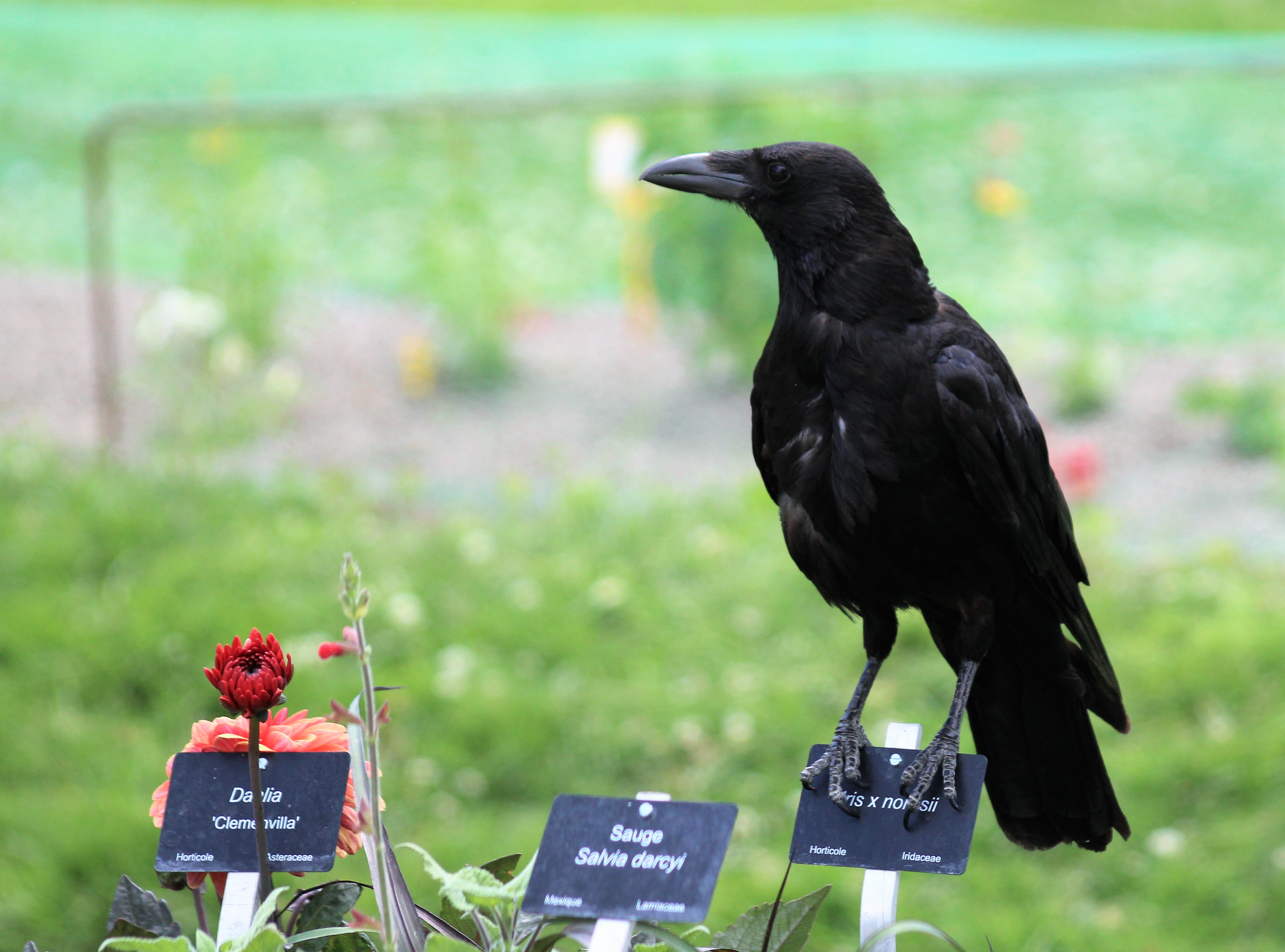
A carrion crow in the jardin des plantes on a very warm Friday, 07 July 2023.
 pseudoisaac