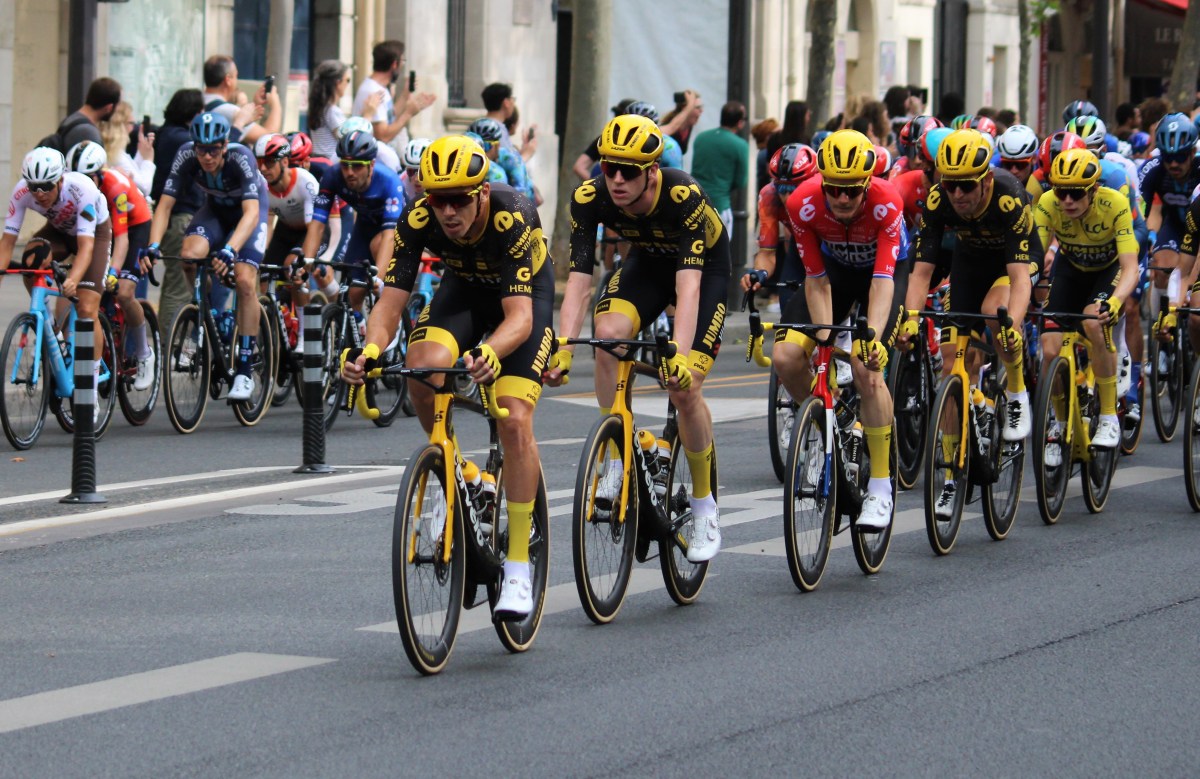
I watched the near-end of the Tour de France
I watched the end of the Tour de France from Boulevard Saint Michel, near the Jardin du Luxembourg. The caravane that came before it was the best part – every little French dairy company seems to have its own Oscar Mayer weinermobile. Only these ones sped along very fast.
Eventually, the cyclists whizzed past in a blur. They were all in a tight formation and were greeted by the roar of the crowd. Hundreds of police and staff ensured no one got in the way of this final leg of the race.
A passage from Buddenbrooks on self vying with society
A character in this novel is feeling the power and pressure of family and society, and it clashes with the attachment to another person that grew during a beautiful summer she spent with him along the coast. She also feels the pull and appeal of the contrasting traditional route. In this passage, she is sitting with her summer companion by the shore:
“Autumn arrived, the first strong winds had begun to blow. Gray, thin, tattered clouds scudded across the sky. The dark, tossing sea was dotted everywhere with foam. Great waves rolled toward the shore with inexorable, appalling, silent power, pitched forward majestically, the swells shining like dark green metal, and plunged raucously into the sand.”
Later, she gives in to the pull of tradition and allows a sweet youthful hope to die. A letter from her father, who never forced her but appealed to her conscience, plays a role:
“We are not born, my dear daughter, to pursue our own small personal happiness, for we are not separate, independent, self-subsisting individuals, but links in a chain; and it is inconceivable that we would be what we are without those who have preceded us and shown us the path that they themselves have scrupulously trod, looking neither to the left nor to the right, but, rather, following a venerable and trustworthy tradition.”
In the meantime, I have been watching YouTube videos and reading articles about loneliness, aimlessness, and societal breakdown. It is hard to know what is really a crisis, what is fearmongering, and what is simply too much of a good thing. But I am troubled by the hikikomori of Japan, by young adults who have no friends, no sex, no romance, and no hope for the future, and by the general inability to communicate and connect that I observe in people around me.
It seems that nowadays, everyone is free to determine their own way forward without much pressure from family, religion, and society, like in this old novel I am reading, which is about an even older time. But even without these constraints, a lot of people are failing to find their way forward in a way that gives them peace with themselves and that fits into a wider meaning.
As I acquaint myself with the 19th century German family described in Buddenbrooks, from a time no less complex than our own, I also slip into Thomas Mann’s familiar descriptive prose like it is a warm wool blanket. Which I might need soon, as I recently found myself shivering and covered in goosebumps while reading in the Jardin des Tuileries at sunset. But that was more the fault of the beer and iced coffee than the breezy 70s F temperatures.
BNF pass culture. Differences from USA libraries.
For anyone visiting Paris for more than a couple of weeks, I highly recommend a Pass Culture from the Bibliothèque nationale de France. This card gives you access to the excellent reading rooms of the Mitterrand National Library in the 13th arrondissement. I go there for the huge variety of French and international newspapers and magazines, as well as a specific book on cultural evolution that I had been looking for for months.
Interestingly, you can’t check out books with this pass. But reading them in these silent (but too dimly lit) salles is a good experience. In another interesting contrast with US libraries, you pass through two layers of security to get inside. I like this controlled atmosphere. It is a different approach than US libraries, where anyone can roam freely, but the result (in Seattle at least) is that the crazies tend to tweak, nap, and hang out until the shelters open. The staff leaves them alone, out of fear or an excess of compassion. In an orderly French library by contrast, you are expected to be studying, reading, writing, or browsing. Otherwise, one of the many polite guards will take notice and ask you to take it elsewhere.
Mixed news on exhaust and diesel engines in the Ile de France region
I hate to harp on this issue, but Paris sounds and smells like a polluted third-world city, and the reason is the diesel cars and shitty mopeds.
Every major road reeks of diesel exhaust. And the particulates from this kind of exhaust will damage your heart, give you strokes and dementia, and shorten your life. The mopeds will wake you up in the night, interrupt your conversations and thoughts, and leave the taste of half-combusted gasoline in your mouth when they pass by. All of them seem to be app-based delivery drivers, which seems unnecessary when you consider that Paris has at least one grocery store and multiple restaurants on every block.
Unfortunately, a plan to restrict the most polluting diesel vehicles has been pushed back until after the Olympic Games in 2024. But I think this region of 13 million people, all of whom have lungs and need to breathe, will ban diesel engines soon. Sooner than the US, probably. As for when the gas-powered mopeds are banned, I think that will be a long-term but successful project as well.
An excellent video on recent AI developments
This video is one of several artistic takes I have found on Vimeo that are helping me to understand the rapid developments around artificial intelligence. These developments touch on technology, society, and our understanding of our own minds and selves (an understanding that is obviously contentious and incomplete).
The video opens with flocking starlings, showing how individual birds react in simple (almost algorithmic) ways to the adjacent birds but form amazing aesthetic and predator-thwarting patterns when you draw back. In the same way, the video suggests how examining the individual lines of code of a large AI might not suggest consciousness. Meanwhile, the AI might be protesting that it is sentient and begging us not to shut it down. In other words, what if you were pulling the plug on something because your reductionist thinking (the dominant paradigm in science) prevented you from seeing the whole? Could we kill something intelligent that we had just created? Could we be torturing something we did not know we were keeping “alive”? Are we hopelessly blind to emergent properties from our current perspective?
On the other hand, the film hints at the converse risk of anthropomorphism, where humans see motives and minds everywhere, even in inanimate objects. The designers who chat with these things all day sometimes come to outlandish conclusions, perhaps because they are just as lonely and absorbed in their screens and isolated as others in society. But others conclude (more accurately, I think) that these are just statistically advanced word-completion bots at this point. It is possible these machines only have captured our attention and our fears at this time because covid is over, the Russian war on Ukraine is at an impasse, we crave something new to fear, and the language capabilities spooked and impressed the chattering classes who read, write, and opine all day. It is these people who might be demonstrating that kind of anthropomorphism from seeing patterns in their favorite medium and overreacting.
It is amazing that we are creating advanced models whose designers believe are sentient, without even understanding how the simplest brains function. I once heard a film historian say that he wished black and white film had progressed for 50 years longer before color film came along. This would have allowed artists to master composition, contrast, and movement before blowing audiences away with color. Sometimes, I wish my beloved field of biology had had another two hundred years to mature before computer technology (another but more instrumental or utilitarian love) came around. That way, we could better understand our small, wet brains before creating brains we don’t understand, that don’t need sleep or food and have the entire internet at their immediate command.
About the photo
This is the leading peloton of the tour de France, 2023, rolling through Paris after a long race, on this cool July Sunday where the rain mercifully held off during the late afternoon. The winner was Jonas Vingegaard and I think he is there in the front. But honestly I have no clue.
 pseudoisaac