I attended a biology conference, open to the public, showcasing recent advancements made by French scientists in the field. All studies were presented by their authors, generally a doctoral advisor/doctoral candidate duo. The conference showed me that the field of biology is alive and well in France, that my reading and listening comprehension in the language is good, that there are some cultural differences in the realm, and that my flexible study of living things has been the right course in life and is open to new turns.
My Impressions of the Place
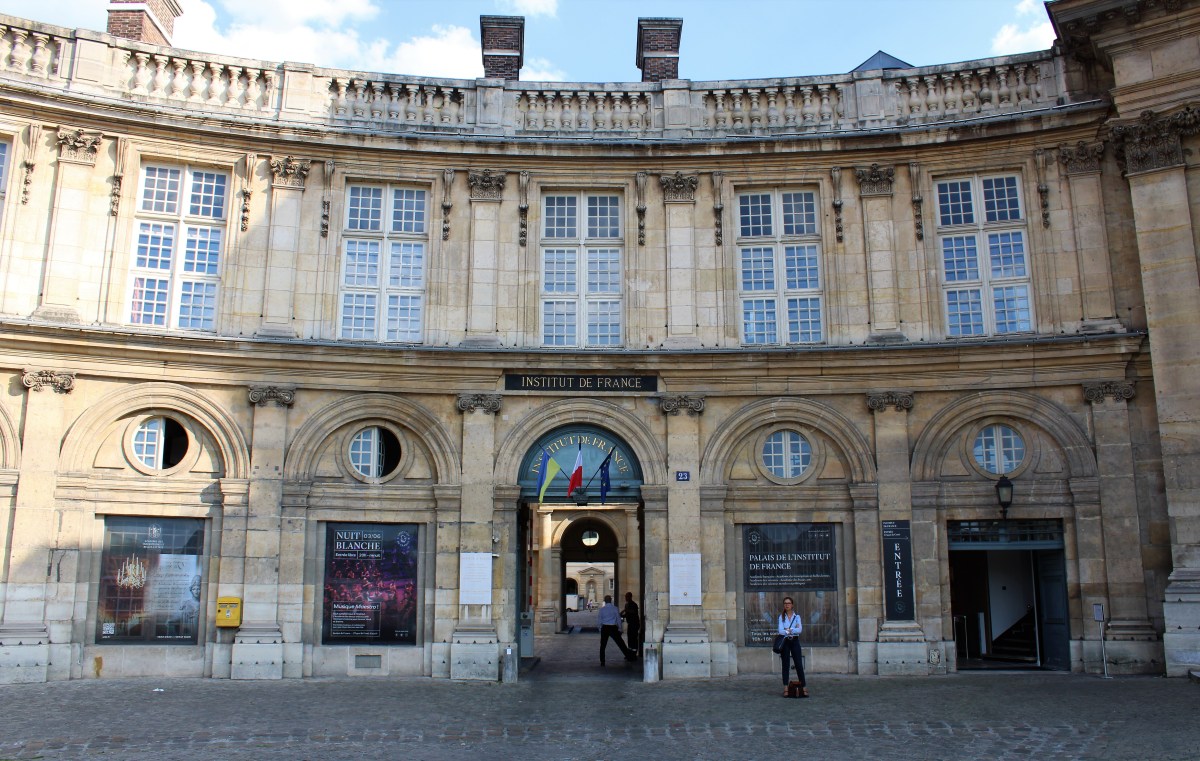
The setting was the Académie des Sciences of the Institut de France in Paris across from the Seine. The Institut goes back to the 1700s and is meant to bring together learned people in arts and sciences to perfect the disciplines, develop independent thought, and advise public powers. The Académie des Sciences, however, goes back even further, to 1666, long before the word “scientist” existed. “Elle encourage et protège l’esprit de recherche, et contribue aux progrès des sciences et de leurs applications.” The ornate hall was lined with your typical busts of esteemed naturalists and natural philosophers from the past. The motto of the Académie des Sciences, right above a drawing of an owl, is the Latin, “Invenit et perficit,” which I think means, “find and finish.”
The setting made me think of a time in the scientific revolution when science flowered in England, France, Germany, Italy, Russia, the Netherlands, and America, each developing its own flavor. Now, all is in English, the prestige journals are only a handful in number, and the internet has us communicating in a common medium, for good and ill.
This kind of event is meant to open the doors to people outside the carpeted cloisters. A very orderly conference proceeded from there, scheduled down to the minute.
Topics
A L’origine Des Poissons: Résolution D’une Enigme De L’arbre Vivant
A seemingly humble study on fishes is revealed to be important, once you look past the difficult terminology. Teleostean fish are more than 96% of living fish species, but the three branches at the root of this major class were unresolved. This study used whole-genome approaches to classify the early branches of this evolution with greater resolution. The presenter ably related her findings to the tree of life, Darwinian selection, and the origin of vertebrates. She talked about how this rapidly growing platform for genetic sequencing can be applied to other evolutionary branches that are also controversial.
At the end of her talk, a female scientist organizing this segment of the conference gave a medal and two bises, one on each cheek, to the female presenter. This is something you would never see in the US, and the kissy gesture had little variations in the subsequent presentations.
This was the pattern: a thesis adviser (directeur de recherche) introduced his or her student and then ceded the podium for the researcher to share their findings.
Un Troupeau Sans Berger: La Migration Cellulaire Collective
The next talk touched on the early evolution of the notochord, with potential applications to cancerous cell movements. This talk concluded with the male organizer and male presenter giving two curt nods after the awarding of the medal (no kissing).
Lien Entre Les Cellules Germinales Soeurs
This talk touched on the origin of multicellularity in evolution and recurrent miscarriages (“fausses couches à repetition“), and it was worthwhile to listen to the scientist directly because you can get past the difficult acronyms and abbreviations that make it seem hopelessly narrow and specialized.
Dupliquer Leurs Gènes, L’un Des Secrets Des Chauves-Souris Pour Faire Face Aux Virus
A researcher presented her findings from a study into how bats harbor viruses without succumbing to them nor suppressing and eliminating them. This coexistence has evolved over millions of years while those same viruses kill other mammals. This is of obvious interest since bats have been a reservoir for many spillover events, possibly including Ebola and COVID-19.
At the end, a male organizer awarded the medal and gave the young woman two bises.
Lien Entre Inactivation Du Chromosome X et Tumeurs Du Sein
A researcher presented findings on biomolecular control in breast cancer. Another biomolecule called XIST and its interactions is just being understood, and this is one small piece of the picture.
The woman was Italian or something and apologized incessantly for her French, which was enough to get by with but caused her to struggle with the questions. It reminded me of a talk at the University of Washington Medical School the previous spring where a 4th-year medical student presenting interesting material on ethics apologized for her shiny face. She had a hundred great facts and hard work to be proud of, but the first thing she wanted the audience to know was that she was sorry for her shiny face.
Reproduction Clonale Par Grain D’une Plante Hybride Cultivée: Une Nouvelle Perspective Pour Les Petits Riziculteurs
The last talk was on getting valuable rice hybrids to small farmers via clonal reproduction. By this point in the talks, I and much of the room were ready to quit. It was hot and stuffy and we were overtime despite the tight moderation. But the researcher skillfully went through her results, refusing to rush, and discussed their importance and I got an appreciation of an agricultural topic that I otherwise would not have known about.
Other Behavioral Notes
La Bise
I just can’t get over this kissing, it’s too funny. Imagine kissing your professor in the US. I am glad this little cultural quirk persists in France, but I have a feeling it will not be around for long as “le wokisme,” like other American cultural exports, invades the country.
Questioners
First question was from a young woman with something technical but highly relevant to the implications of the study. Another elderly man had a question for every presenter. He seemed to be a senior faculty and he was carrying forth the tradition of launching probing questions at scientists who present new ideas, forcing them to think on their feet and respond outside the script. He was every bit the eminent gray elder but perhaps not an éminence grise in the sense of a shadowy figure.
Should I have pursued endless degrees?
While watching those presenters I thought about myself: What if I was up there presenting. Should I have gone after some advanced degree?
Nah, fuck that.
It might have been wise to spend the Great Recession in study instead of work. But formal science is extremely detailed and specialized. You could spend four years studying the behavior of a single molecule in a narrow context, publish your thesis, get your degree, and then never look at that topic again.
In fact, this happened to my former colleague. For three years, he worked hard to elucidate some biochemical process. He got his PhD. One day, while we were in the lab, he described the work over the course of a few minutes. It was so boring I cannot remember what it was. At the end he said, “That is the most I have talked about my PhD topic since defending my thesis 15 years ago.” After getting the degree, he moved on to something very different (but still in science). And now, he is an executive, not doing science at all. It seems the PhD studies were just a stepping stone to something else.
In another job I often spoke with students during their master’s degree programs and when I asked them what they were up to, the answer was always, “research.” Some of them struggled to explain their research in a way anyone could understand or that seemed remotely appealing. It seemed like a slow-going, unrewarding process, done for the sake of some other goal, and without much understanding of the larger picture.
At another biotech company, I found that the people with Ph.D.s in the company’s scientific realm spent all their time doing email, meetings, and spreadsheets but little actual science, which they were not even good at because of the perverse incentives that abounded there. You can study formally for many years and then find that your actual work is unrelated. And you might find that your senior leaders do not have much respect for science, as I did at one company I worked for.
There is evidence that findings in science are becoming less impactful, that each discovery is less and less important. Perhaps an individual who loves nature and science can relax and take a step back and not put their nose to the grindstone to advance some niche field in some niche journal for some niche social rewards.
I have also found that my interests change over the years while following a theme. Although loving science and biology has remained constant, I sometimes want to delve into ecology, sometimes into psychology, and sometimes into birds. Similarly I have always loved French, but some years I look at art, some years I read novels, and some years I focus on speaking. The academic pressure to specialize goes against most people’s patterns of natural interests. Often, an autodidact can spend more time studying what interests him or her than a person who is actually involved in that field, who is engaged in minutiae around the subject in a way that can be repetitive, instrumental, and unconnected to the whole.
Statues and busts of scientific and philosophical figures (I think they would be called natural philosophers) lined the hall.
These (mostly men) each revolutionized their fields. Now, researchers make tiny findings that may be forgotten about. They gain social status through their paper count and impact factor. But true advancements are rare and may come through synthesis in the future. There is a great beauty in gnawing out a tiny twisting tunnel in the termite mound of knowledge, as a typical scientist does, with great effort and pains. But there is also beauty in stepping back and admiring the whole and making connections. And the ability to step between the two perspectives is good. And having the choice is good also.
My hero, Darwin, would have called himself a naturalist or natural philosopher. And he corresponded voluminously with French scientists and describes their input and advice in the text of On the Origin of Species. And those scientists may have presented their findings, and contemplated the “enigma of the tree of life” (énigme de l’arbre vivant) in this very hall.
A patient of mine once said biology was “above her”. But as I talked with her I tried to convey that a love of living things is inherent to almost everyone. EO Wilson spelled this out in the concept of biophilia. I think the formal study of something can get in the way of pure enjoyment. I am grateful to the scientists whose extreme specialization has filled our books and journals. But I think a general and widespread knowledge of and respect for nature would save lives on a massive scale, too, if it helped people get outside more, get their vaccines, and respect the needs of the human mind and body, none of which require education beyond high school, if that.
In casual reading on biology I revisit themes again and again, gaining deeper understanding and satisfaction without needing to go into extreme detail and elaboration. And the most profound stuff is often something I learned initially when I was 8 years old. I learned it superficially then, but with an emotional impact of art and school and family, and this brought me back to study it with effort as an adult. This poses the classic question of the art/science, intellect/emotion, banal/profound dichotomies that serve as a tool for understanding because of their tensions.
Just this morning I watched an animated video on evolution and learned something new. This helped me take joy in just looking at Darwin’s finches on Google images. These birds sparked his grand theory (though even he was wrong about some of the details of their evolution). And I thought back to a vivid photo book that introduced me to Darwin’s finches. It was dated even at the time. But it organized the knowledge of the world into subjects, and one was evolution. It so happens that an aunt and uncle gave me that book out of familial affection and encouragement. (Now, young people grow up with a feed instead of an array of subjects. I have heard that some youngsters do not search the internet. They will only swipe and tap options within the app, or do nothing at all while it entertains them. We are only beginning to appreciate the advantages of each of these approaches toward learning and infotainment.)
Fancy snacks and champagne
The forum adjourned, and we had champagne and impossibly arranged and tasty toothpick appetizers. Although some Parisian food has been a miss for me, this display was very splendid and tasty.
I spoke a word or two to a woman who commented on how well I was balancing my champagne glass on my notebook. This reflected a central challenge: uniting intellect with sociability. And this seems to be the challenge the founders of the Académie des Sciences took to in 1666, more than three centuries ago, when they sought to mix the minds of the natural philosophers and produce great scientific knowledge and advancement to bring to the public.
About the photo
An exterior entrance to the Institut de France.
 pseudoisaac