I spent four months in Paris, one of the greatest cities in the world. Recently I returned home to Seattle, which is also one of the greatest cities in the world, and I look forward to enjoying fall in the Pacific Northwest.
Three things that delighted me during my stay
First, I love the bikeability and walkability of Paris. The city is relatively small in area, and the dense network of bike paths and low-speed streets got me everywhere. The city is taking the climate transition (implying action, more apt than American ongoing crisis terminology) seriously and this means reducing the number of cars, reducing vehicle speeds, and reducing their size. Bike lanes, green space, and pedestrian squares are being added everywhere and they are very well used and appreciated. I biked over every corner of the city without constantly worrying about the real risk of being killed by a driver like I do in the US. Biking and walking along the Seine at sunset, visiting wooded Bois de Vincennes, and rolling down car-limited Rue de Rivoli were frequent favorites.
Second, the people in Paris are basically better than us. They are more put together, more considerate, thinner, less sloppy, less prone to anger and rage (and passive aggressive behavior), and they hang out in parks and cafes instead of inside idling cars like in the US. Their lives are not as isolated and dominated by cell phones. They do not eat as much ultra-processed crap food as we do. And their politics are generally reasonable, governance effective, and society is orderly. Government advocates for people and the environment rather than putting business interests first.
In social and cultural progress, Parisians are way further along than Americans in many ways. As an example, a French woman can expect to live 10 years longer than an American man. And while Seattle has a low murder rate for American cities, Paris’s murder rate is one fourth of that. To illustrate the crassness and emotional immaturity gap, yesterday in Seattle a man shouted at me, “Get outta here with your bike.” He changed his tune from shouty lion to polite lamb when I engaged him in conversation, since I unexpectedly showed him how to respond like a civilized person. In Paris, the same situation would result in a polite, “Monsieur, ici il faut tenir le velo à main.” And that would be that.
Upon my return, it only took a day for me to be dodging obese distracted drivers in megatrucks and SUVs. I will now count the days until a stranger screams, “I’LL FUCKIN KILL YOU! I’LL FUCKIN KILL YOU! I’LL FUCKIN KILL YOU!” This seems to be a regular thing for me as a guy living in America, so I doubt it will be a long wait. All this might sound like denigrating American society and culture. But what I mean is that living in the US (even a rich coastal city) has its own mix of challenges, and these are different from those you face in a rich European city.
Third was Parc Montsouris, the green gem of the 14th arrondissement. This large park with woods, waters, sculpture, grassy play and picnic areas, and endless events and activities, was only a short walk from me and I visited almost daily. I loved to watch the common birds such as European magpies and common wood pigeons. And the music performances and festivals were constantly changing during the summer.
Why I went
I wanted to hone my oral expression in French after many years of formal and independent study. I learned a lot of French while in Paris, but did not speak the language as much as I had hoped. I think this is because of the ubiquity of contactless methods of going about your day, and the widespread use of English. If you stumble across a phrase in French, the person you are talking to may simply switch to English and the rest of the conversation will stay that way.
Although my conversation does not flow like that of a native speaker, I had good dialogue with people about news and about destinations in town. American politics was a frequent topic. And I enjoyed a break from getting by in French when I joined an anglophone book club. Attended, as it turns out, by people from an array of anglophone and non anglophone countries.
Overall, I learned way more from visiting real sites of history and art, reading at the various excellent libraries as well as while sprawled out in beautiful parks like Parc Montsouris or the Jardin du Luxembourg. Two oral communication classes on current events that I took at the Alliance Francaise de Seattle helped immensely.
Three things that were unexpected
My last two months in Paris involved too much worry over job applications. I only spent an hour or so a day on this, but the slow trickle of responses and the many automated rejections unnerved me and took up excessive mental space. My remote application and interviewing efforts scored me a job offer before even returning home, however the uncertainty did add some stress. One thing I learned is that job applications have not changed much over the 23 years I have been in the workforce. The real way to win this rat race is to drop out entirely, never do a traditional job application again, and no longer be a rat.
I also surprised myself in staying put in the city. I thought in four months I would want to take a train to Amsterdam or Italy, but I drew deep satisfaction from all the free and low cost things I did in town. I felt no need to go to an expensive short term rental in a tourist area of yet another city. When you hop among travel sites, things start to look the same. I had seen so many examples of ornate architecture, sculpture, and painting that I even skipped Versailles.
When I return to France someday I will make it a “France peripherique” trip and visit the areas that tourists touch only lightly. This is in line with government efforts to spread tourists around the country so they are not pressing excessively on the same handful of places. I might make it a bicycle touring trip.
Lastly, I was surprised by the way immigration is rapidly transforming the face of France. I knew that France had huge numbers of immigrants (Muslims rapidly dwarfed the number of jews over a short time frame, for instance). But the scale of immigration is immense and growing.
During my stay, the entire population of Lampedusa, an Italian island, was outnumbered by African immigrants who arrived in one day. That island is a metaphor for all of Europe. As European birthrates drop, but mass immigration from high-fertility Africa and elsewhere increases year after year, the changes that are coming are going to be extreme. Far-right politicians are harshly shushed when they bring up “great replacement theory.” But it is not a theory, it is more of an observation. Perhaps replacement is too strong a term. And there is no conspiracy to replace indigenous Europeans. But it is also true that the native population never democratically voted for mass immigration and that the tide of immigration is irreversible and accelerating.
Leftist parties and far-right parties have both proven incapable of bringing down the numbers, even when they campaign on promises of reduced immigration. The inability to grapple with it is leading to far-right extremists and antipathy toward EU leadership in Brussels as being remote and unconcerned. Meanwhile, as in the US, white pro-immigration liberals in Europe publicly endorse immigration while privately creating white liberal enclaves where there are no immigrants to be found. And it is true that what we are seeing now in terms of immigrant numbers is just a trickle compared to what is to come. I think when I return to France in the coming years, I will find a population that does not look like me at all. Interestingly, the EU is so desperate that they are paying north African countries to stem the flow of migrants from further south. This is very similar to the US paying Central American countries to reduce the numbers of migrants getting through.
I can’t fault immigrants for doing anything to reach Europe or the US. Their lives are guaranteed to be 10 times better if they can only set foot on western soil. This summer four Nigerian men rode for 19 days on the tiny platform above a trans-ocean ship’s rudder, not knowing where it would go and having no plan or goal besides escaping Nigeria. This deep motivation in immigrants to flee no matter the cost vastly outmatches the general misgivings of the indigenous European and US populations about mass immigration. It is a bit like how the rabbit is faster than the fox because the rabbit is running for its life while the fox is just running for a meal.
A lesson or two
There is so much truth to the saying (or mantra), “Wherever you go, there you are.” I stayed the same while enjoying language and culture in a grand faraway city. Each day I read the news, got some exercise, and grabbed coffee and something to eat. My mind was on international events and learning goals of mine, such as topics in psychology and evolution. Although I visited cool places in Paris every day, I also spent a lot of time on my computer or reading books I could have read at home.
I also took on the habit of visiting the English café Shakespeare & Company and doing the New York Times crossword puzzle over a cappuccino, extra hot. Although I can do this habit in the US, it was very special to do it in Paris. The connected bookshop put on a wonderful festival honoring the 100th anniversary of the publication of Ulysses earlier in the summer.
If I take off another long stretch, I might do it in the cheapest country possible to test whether modern life is basically the same everywhere. Perhaps what is most important is simply having a neighborhood to walk, a laptop, and a few local friends to chill with on the weekends. Candidates include a Brazilian city, a Mexican city, an inexpensive Francophone country such as Senegal, or simply a grand US road trip.
Gratitude
Several crises struck while I was in Paris and I was thankful not to be touched by any of them. One was the protests over the killing of a young man from an immigrant community who did not stop for the police. As in the US, the protests were a mix of genuine outrage and crass looting of corner stores and shoe retailers.
Another crisis was a gas-related explosion near where I lived that killed two people. The rubble was striking to look at since my building was a lot like the destroyed one. I biked past it every day on my way to the central areas of town.
Lastly, the unbelievable heat all summer long had some people suffering. I am fortunate to love heat and I had an airy apartment. But as the continuing heat waves get worse, Paris will have more unpleasant or dangerous days. It was hot when I arrived, there were several heat waves during my stay, and it was hot when I left. When I returned to Seattle, it was hot there, too. Paris, however, is actively creating new cool green spaces and taking other measures to mitigate the impact of the heat.
I feel deep gratitude for my childfree lifestyle, which gave me the ability to take off for months seeking rest, change, and learning. I am grateful for a bit of personal finance knowledge that allowed me to finance my trip without going into debt. I am also grateful for the American economy, which for at least three years has guaranteed a job for anyone who wants one. Now, with a gap of only two weeks, I am hopping back into a job at a higher rate of pay than I have ever received in my life. I will quickly be saving for the next thing, which might be another trip just like this.
What it is like to be back
I love Seattle and immediately grabbed a cannabis tincture, the cheapest and most lung-friendly way to get high. I did all the things I had missed, including eating peanut butter (shockingly, almost totally absent in France) and visiting Seward Park. I saw a golden crowned kinglet and a harlequin duck (a lifetime first) on Puget Sound and breathed deep in satisfaction at the nature and landscapes I have access to now that I am back. I look forward to visits to the Olympic Mountains and the Pacific coast.
Clarity for the future
My next steps involve continuing to save and invest money while also de-centering paid employment in my life. In positive, productive tension with this goal is my plan to live a bit faster and move more boldly toward my goals. And I plan to sprinkle generous time off throughout my months and years.
Last word
I love Paris, I love Seattle, and I plan on taking more lengthy breaks from paid employment where I have time to walk, think, and learn. I have a lust for life. This four-month stay reminded me to be both deliberate and flexible in how I feed it.
About the photo
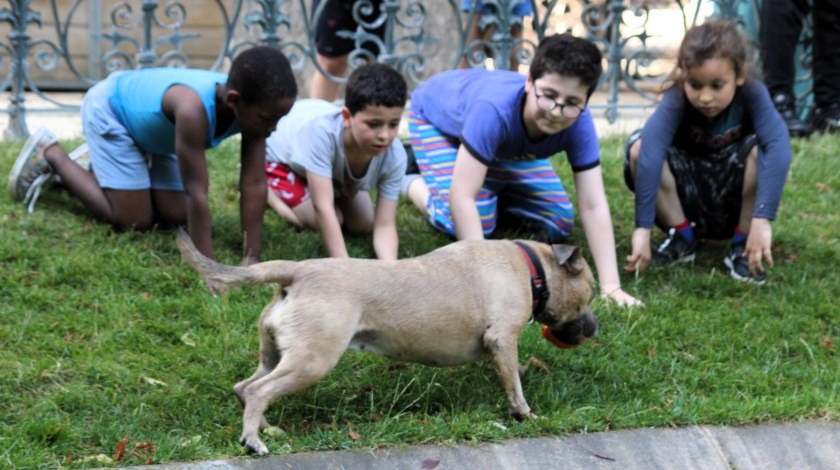
Kids playing with a dog at Square Émile-Chautemps.


 pseudoisaac