As my part of the world cools and darkens, I find ways to observe nature and people and learn constantly, enjoying every day.
TODAY’S BIKE RIDE
I hopped on my bike despite the threat of rain. In the Pacific Northwest, you must interpret the weather forecast optimistically. Weather services have a way of slapping a gloomy gray icon over the daily forecast, implying non-stop all-day rain. But when you get out there, you find that most hours of the day, no rain is coming down and it would have been a shame to stay indoors.
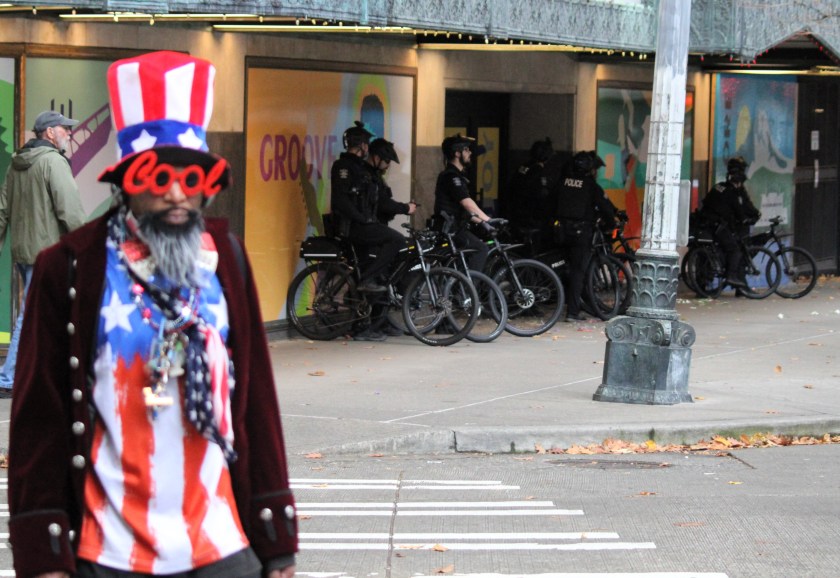
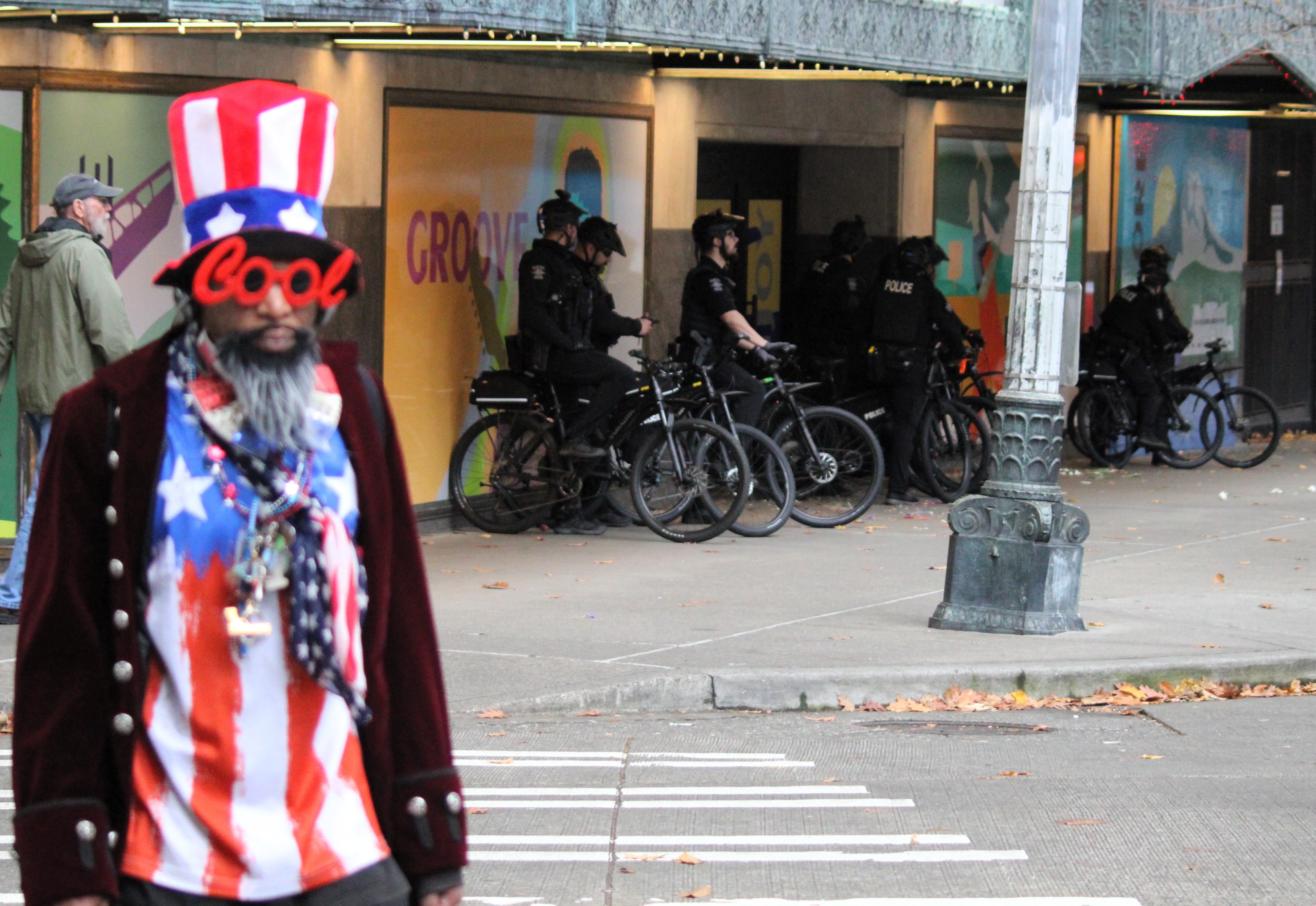
I biked a nice familiar route through Pioneer Square to Olympic Sculpture Park and then through the city center and back downtown. I came across a patriotically festooned gentleman who contrasted with the black uniforms of the police who had assembled in response to a pro-Palestine protest.
The protest was large and well-organized. A brave brigade of cyclists blocked off the always-enraged drivers. A sign read, "There are not two sides to a genocide."
I feel sorry for all the people who are suffering. And I do not want the US to fund and arm Israel, Ukraine, Taiwan, and all the other countries with intractable regional conflicts based on issues irrelevant to the typical American. If religious or ethnic fanatics in a distant desert or jungle decide to kill their neighbors with the weapons at hand, they should be aware there is no true "international community" that will fly in and solve the conflict for them.
In this respect, I guess I am questioning the Democratic party. We seem to be the rich and highly educated elites, favoring mass immigration regardless of its impact on the working class, and endless involvement in various foreign wars. Fossil fuel extraction rises each year regardless of the party in charge. I see the two parties as increasingly similar and equally inconsistent, and I think it is the wider culture that needs to change.

GRATITUDE
I am thankful for my work, which has me engaged in biology in downtown Seattle on biomolecules that have saved lives and will save many more. During lunch this week, I walked to Lake Union despite the increasing cold and watched the planes, boats, people, and birds. After work, I enjoyed the subdued vibe of a Capitol Hill cocktail bar before heading home to North Beacon Hill.
I contrast the depressed native Seattleites with the happy transplants like me who came here out of choice. I struggle to understand why some people complain so much and consider moving to a dusty and waterless desert metropolis like Phoenix. Perhaps I’m being inconsistent myself, since I am aware that a billion desperate immigrants would gladly eat shit all day, every day and never complain in my place.
The downside of going back to full-time employment is that I have less time to write, and screens dominate my time. Work involves screens, personal logistics involves screens, and entertainment involves screens. Screens are my lifestyle and that of many others. Marshall McLuhan’s notion that "the medium is the message" is distressingly apt, and so I am on the lookout for ways to reduce my screen time by using paper books and paper notetaking.
ANOTHER WOMAN-CENTRIC OPINION PIECE ON DATING AND MARRIAGE
This annoyed me. The female author (no credentials are listed) trots out a familiar case: "Men are trash. And where is my Prince Charming?"
For her article, she interviewed zero men. She profiled women who are "putting a lot of effort" into dating by passively swiping on dating apps and then sitting back in judgment of the men who message and meet up with her.
And she wondered why men do not rush to provide for a woman, satisfy all her emotional whims, compete to win her hand for a lifetime marriage contract with the state and federal governments, provide his DNA, and raise her children. It seems like yet another NYT opinion piece that is totally wrapped up in the lifestyle issues of educated American women, with ignorant disregard for differing views.
The author allows that "many men are fantastic people" and says that we should listen to the experiences of women who are attempting to find partners. But this is all I ever hear about. I would wager that none of those women have ever asked a man out in public (outside of passive dating app usage) or questioned their own long list of dealbreakers and red flags. I doubt she would trade her fantasy of being raped by a billionaire (à la Fifty Shades of Grey) for a realistic relationship, ever.
The woman profiled in the beginning of the article does not support the argument. The woman, no catch herself and at the end of her fertile years, chose to have a kid with a loser co-worker and then he left. I feel sorry for the kid.
The illustration also reveals the author’s mindset: a towering woman trying to keep multitudes of tiny men out of her house, while a ticking clock looms overhead. To me, the giant woman represents a potential male partner on a first date with her, while the innumerable little men in the illustration represent her lengthy set of until-death demands.
If these opinion havers truly want what’s best for children, they should look to evolutionary anthropology and how children were successfully raised in the past. To make it work today, this might involve legal arrangements to raise a child, irrespective of a romantic relationship, as described in this video from the reliable Big Think channel. Interestingly, a friend of mine, an intuitive thinker, suggested this to me years ago when she saw crap relationships sprouting crap environments for oops babies to grow up in.
EXCELLENT RECENT VIMEO STAFF PICKS
The Archivists
A vision of humanity preserving the words and music of a ruined civilization. A video with excellent composition, music, and message, showing how human culture can never be extinguished.
One Revolution Per Minute
A positive technological vision of a human future in space. Hard sci-fi is truly the best sci-fi. This filmmaker also created "Wanderers," which features an iconic recording of Carl Sagan’s voice. I think this future scenario is more likely than the one in "The Archivists" above, but we will not get there without effort. I also think the humans in these spectacular surroundings will find things to complain about (and reasons to skip exercising on the pictured treadmills).
Bambina ‘Anyway U Want It’
This film shows a man getting lost in a buggy sex party simulation. It reminded me of supernormal stimuli, well-described in "Manwatching" by Desmond Morris, where, for example, a goose will abandon its real egg and incubate a giant and obviously fake one instead. I think vulnerable people will be tempted to enter virtual worlds for more and more of their lifespan while the difficult work of (for example) getting to space goes to others with a more balanced psyche.
Une Belle Nuit D’Été
To tie these videos together, I would propose the above, which shows how nature, including the seemingly sweet companion dog, ultimately corrects all. To link it to the above videos: it will be nature that decides whether we get to space or enter simplistic virtual worlds.
WHAT I AM READING
If all my training in biology had only earned me the ability to read and understand a book describing the life’s work of a brain scientist speaking to me in clear scientific language in his or her own words, then that is a decent tradeoff. It has brought me much more. However, the ability to sit down and delve into literature about how evolution has shaped our subjective mental experience, along with the difficult and careful experimentation and theorizing that have illuminated the workings of our minds, is incredibly rewarding. This is the experience I have had with “The Emotional Brain” by LeDoux.
Passage from "The Emotional Brain":
This excerpt follows an insightful discussion on how brain science reveals the absence of a single, unified stress response. It explores how a stress hormone could diminish the activity of the hippocampus (and its memory formation functions) while amplifying the activity of the amygdala (and its non-conscious activation of conditioned fear behavior).
"If indeed the hippocampus is impaired and the amygdala is facilitated by stress, it would suggest the possibility that stress shifts us into a mode of operation in which we react to danger rather than think about it."
Additionally:
"Alternatively, a mild fear of heights, one that causes few problems in everyday life, might be converted into a pathological fear under the amplifying influences of stress. The stress is unrelated to the disorder that develops and is instead a condition that lowers the threshold for an anxiety disorder, making the individual vulnerable to anxiety but not dictating the nature of the disorder that will emerge. The latter is probably determined by the kinds of fears and other vulnerabilities that the person has lurking inside."
As always, I am thrilled when I find connections to acceptance and commitment therapy and relational frame theory (ACT and RFT), including on page 263 where the following is stated: “Avoidance is more complex: it involves fear conditioning plus instrument learning… Avoidance responses are arbitrary.” I am now opening the final chapter, which addresses the link between emotions and consciousness, the most difficult problem in the book so far, and the most interesting.
RECENT BIRDS
The varied thrush, a Pacific Northwest favorite, turns out to be more common than I thought. I first encountered this beautiful bird on the Oregon coast at Oswald West State Park, which is a special place for me. The bird usually resides in dark, dense forests where its plumage is not easily appreciated. However, I spotted one in the open before it got spooked.
I find that a bird in the thrush family is distinguished more by its behavior than by plumage. I discussed with a naturalist at Seward Park Audubon how learning bird calls, especially in this forested region, opens up a world of unseen bird activity. It’s wise to always look for more dimensions by which to distinguish things.
Pileated woodpeckers are also more common in Redmond than I expected, given my work there. A colleague didn’t believe that this enormous prehistoric-looking bird was a short walk from the laboratory door.
I missed the juncos and bushtits when I was abroad. Now, I miss the noisy parakeets of Parc Montsouris. I know they are doing fine despite the cold.
About the photos
Downtown Seattle on a typical Saturday afternoon. A patriotically festooned gentleman and a pro-Palestine protest.

 pseudoisaac