I took advantage of my membership and spent another excellent hour at Seattle’s Burke Museum of natural history.
The labs are on display for visitors so you can see the tools of taxonomists, ecologists, paleontologists, and others in the scientific disciplines of living things.
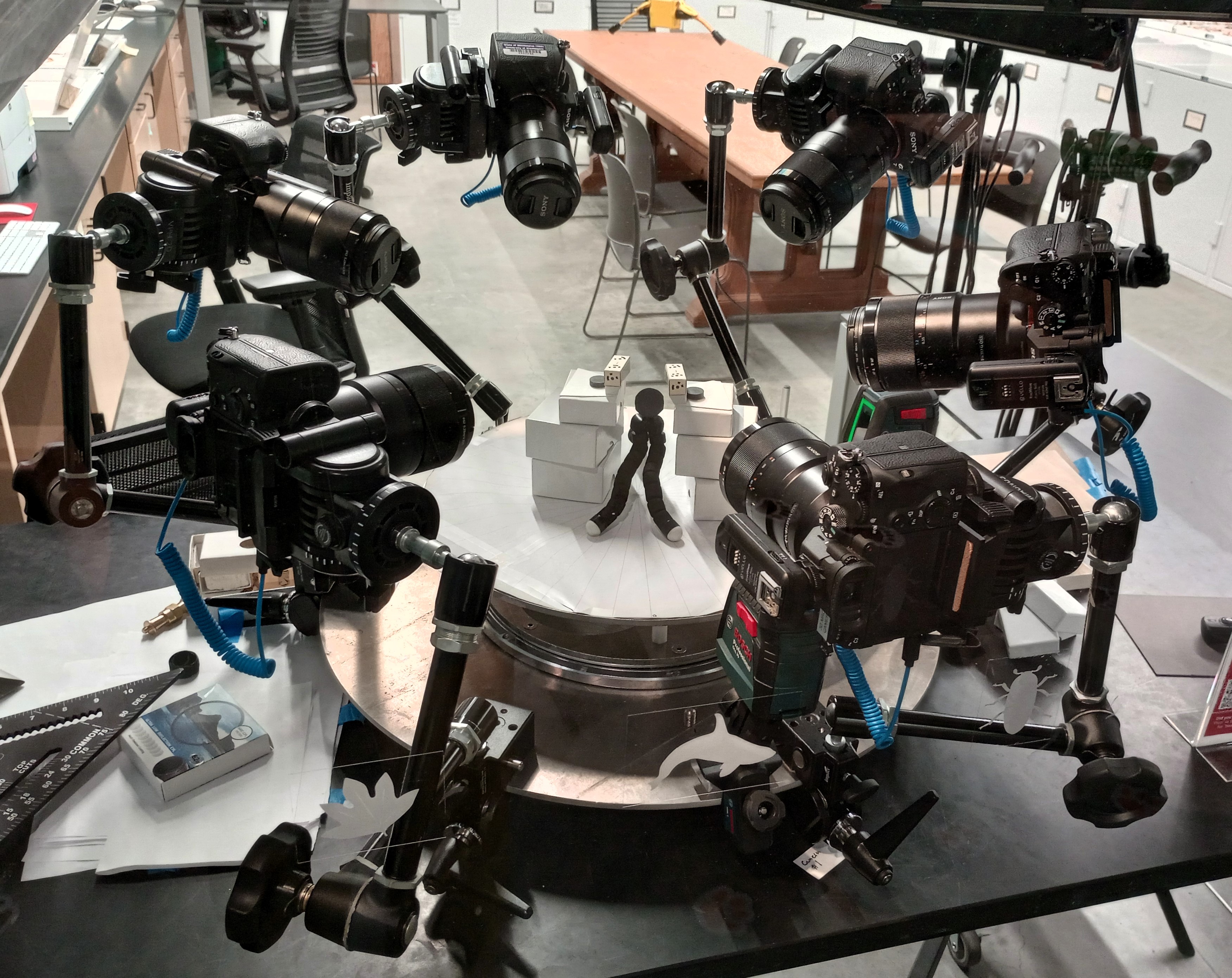
One setup caught my eye and is pictured below: this circle of cameras arranged to point at one living or dead animal specimen, as tiny as a hummingbird’s beak. It was very similar to a video exploring “simulationism” that spooked me.
The video evokes the dread some people feel at the possibility that we are living in a simulation. There are many paths that might lead to this scenario, including a well-meaning effort to preserve living things in a digital ark before our actions lead to their extinction.
I also related this to my recent read of "The Sixth Extinction" by Elizabeth Kolbert, which is a harrowing tour of mass extinction, including the current and most rapid one, which is caused by humans. The second to last chapter is about how we outcompeted, interbred with, and perhaps killed off our closest cousins in the ice age, the neanderthals. Pleistocene megafauna, bats, corals, amphibians, tropical birds, and many other species are profiled along with the heedlessness, selfishness, and sheer numbers of humans. Scientists working to stop the catastrophe help to counterbalance this bleak and inexorable narrative, but the overall message is one of an irreversible catastrophe and loss. All this evolutionary history is being replaced with homogeneity, livestock, and row crops.
The book also explores how the concept of extinction was developed, with many early scientists doubting it was even possible. As usual, they eventually accepted the fossil evidence that was right in front of them, as solid as rock. Later, we documented extinctions in real time.
Some efforts to combat the crisis look pathetic, such as digitizing an animal like the gecko in the video, or creating a "frozen zoo" of the cells of animals that died under our recent watch but where we have genetic material. But what is the alternative to these sterile frozen or digital repositories?
A quote from the final chapter goes like this:
"Right now, in the amazing moment that counts to us as the present, we are deciding, without quite meaning to, which evolutionary pathways will remain open and which will forever be closed. No other creature has ever managed this, and it will, unfortunately, be our most enduring legacy. The sixth extinction will continue to determine the course of life long after everything people have written and painted and built has been ground into dust and giant rats have – or have not – inherited the earth."
A Daniel Dennett book I recently completed about Darwinism also ended with a plea to protect biodiversity. Sadly, he also died in the past month.
Back to the museum: The job of cataloguing and classifying earth’s living things is underfunded and under-esteemed. But it is essential to help us realize the biodiversity we are destroying and help to slow down the destruction. Many of these scientists discover and describe an amazing new species just as it dies out in the wild.
On the same day I finished this book I visited Seward Park and walked the trails. There was a surprising number of people there considering the "atmospheric river" coming down over today and tomorrow and bringing moderate continuous rain. I suppose the old-growth forest is inviting enough to attract people despite the wetness. I saw a brown creeper and a northern flicker. I also love to watch the crows, who often have notched wings because of their molt this time of year. I have found that when they harass me and seem to go berserk, there is often a pale-eyed fledgling brachiating in low branches, or sitting quietly on the ground while it waits for its parents to hurry me along.
With all these grim concepts in my head contrasted with the beauty of walking in a lush Pacific Northwest peninsular park, I thought of a Japanese saying from a haiku: "Nothing in the cicada’s song indicates it is about to die." This spoke to me about being responsible for saving a creature that doesn’t know how beautiful and precious it is and does not know how close it is to oblivion.
 pseudoisaac