Releasing ashes in North Dakota

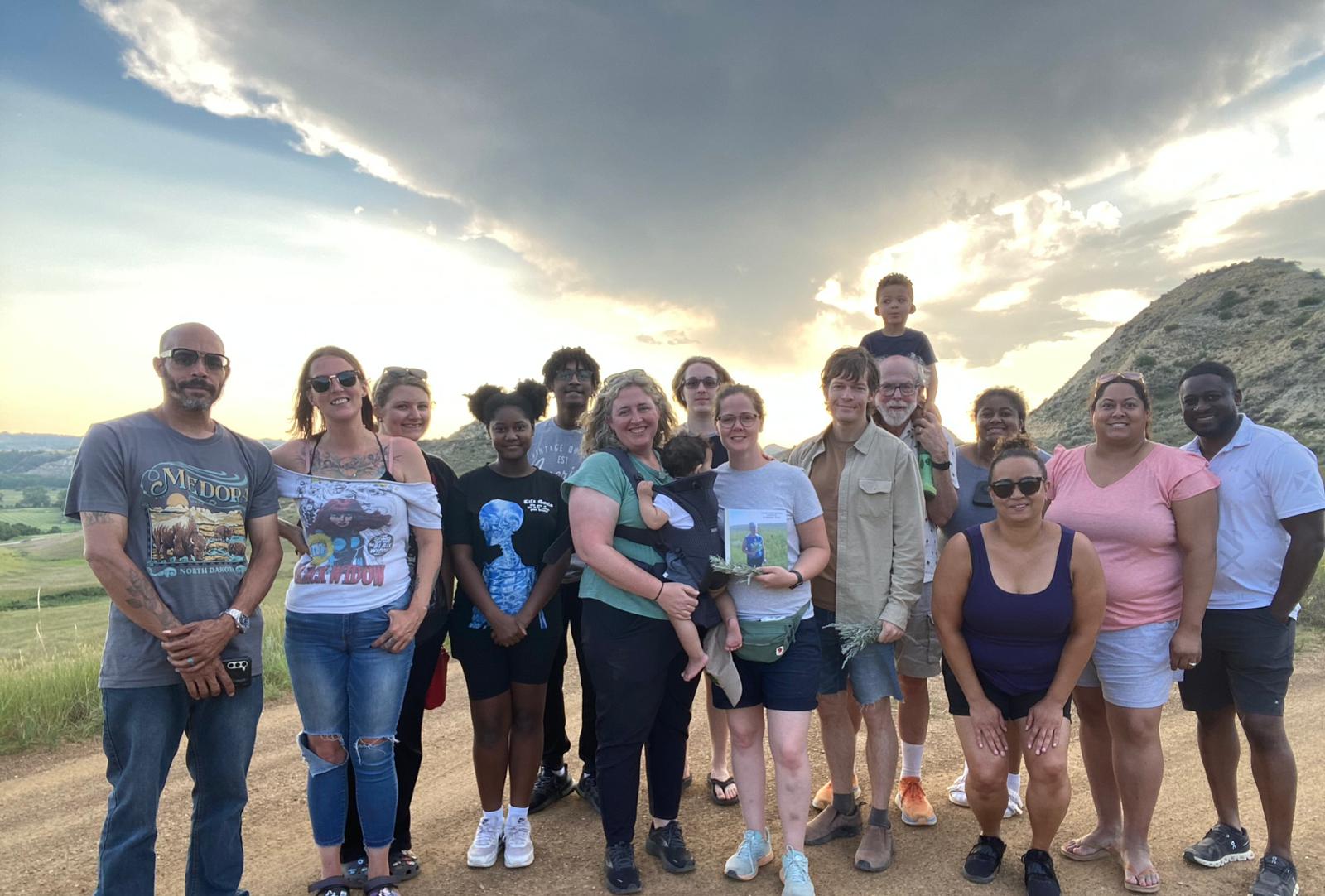
I scattered my mom’s ashes in the arid hills of North Dakota.

As my family and I stood there, my dad told half-jokingly that she was conceived at the Bible camp nearby in 1945, and thus we were bringing her existence to a full circle.

As he spoke a short but significant encomium, I held a handful of these ashes in my palm and noted they were the exact same color and consistency as the tan, sandy soils of that region, just outside Medora.

This experience capped a week where my family visited the places of her birth and schooling and their many visits to the region. We saw the vast prairies that shaped her and felt her affinity for the landscapes, which seem to have the breath of life constantly moving over them. Pronghorn, buffalo, hawks, and pheasants were everywhere. Sage was abundant but in patches, and some family members felt its scent was not as strong and vivid as in the past.

On a part of the drive we listened to the music that accompanied her final days of life in January, a mix of gentle piano. My only physical memento is a small rock from that site, just as my only memento of my grandma is a wool blanket I lie on every day. But my mom’s love of music is something I can take with me everywhere.

The rock is that same color – a familiar light tan that I hardly ever see outside of that region. It is the same color as the bed of the many fossils my grandpa dug up, including a huge dinosaur femur. He and my mom were especially close but I have no memories of him because of the grim afflictions that took them both too early. We visited the tiny decaying farmhouse where he was born. It seemed like an impoverished abode but it cradled an extraordinary mind and spirit in the person of Grandpa Elmo.

The time for a solemn ritual was past. This was a gesture of tender farewell and a week of sharing warm memories. While my mom has turned to ashes in the wind and is also sitting in an urn in a hallowed corner of the house, other branches of my family are growing and expanding. My niece is learning the language in South Korea. My brother (not the angry and abusive one) is expanding his business and hiring people. My sister is raising strong little ones who love their grandpa. One of them loves dinosaurs too.

There is nothing more universal than the personal. Family, nature, death, and the continuation of generations gave me much to think about in the subsequent days. Nothing pierced me like holding her ashes in my palm and releasing this small handful into the breeze brought on by the setting sun. As I did so, I felt Ione’s greatest gift to me, which is an abiding sense of awe.

Extinction, natural history, and simulationism

I took advantage of my membership and spent another excellent hour at Seattle’s Burke Museum of natural history.

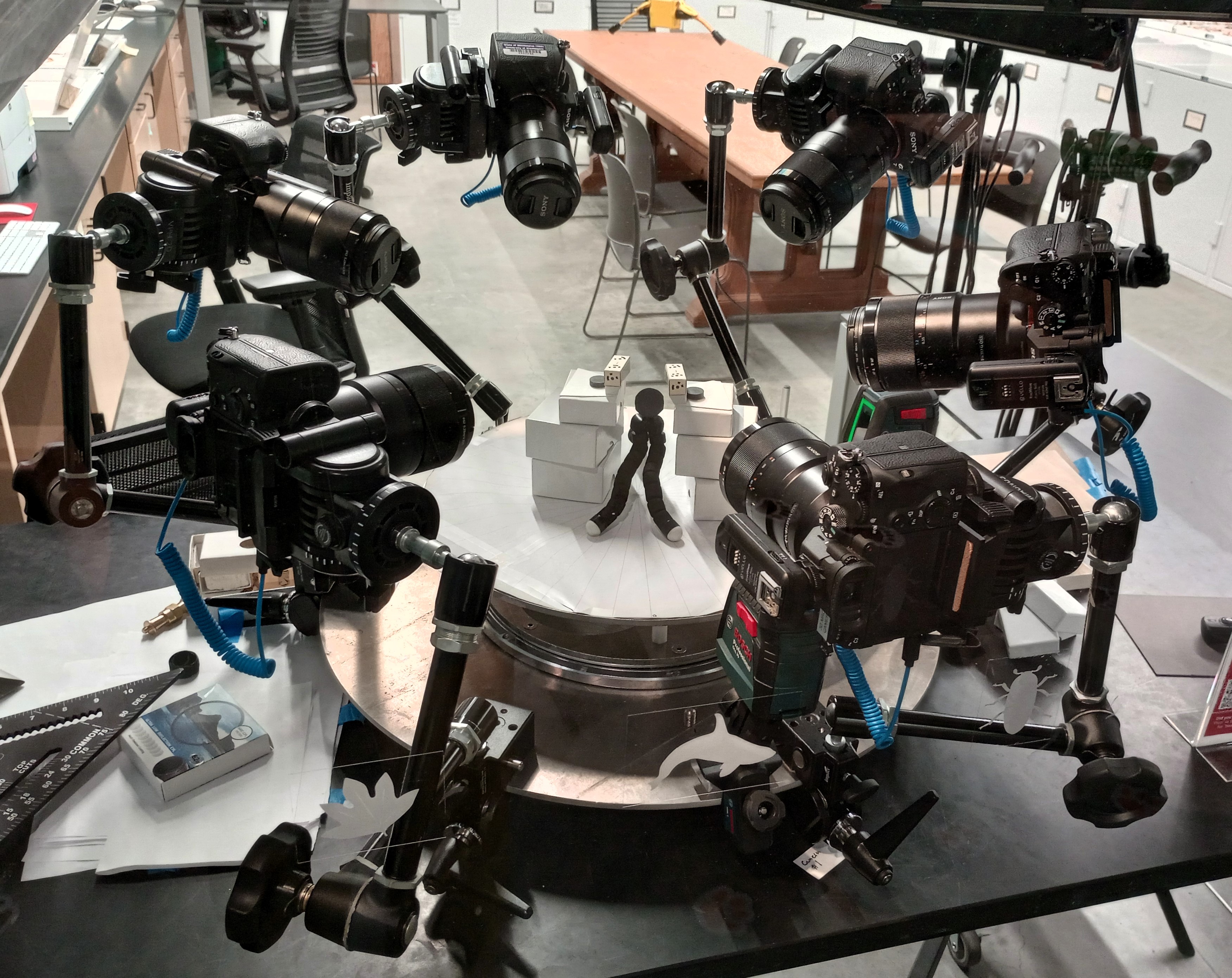
The labs are on display for visitors so you can see the tools of taxonomists, ecologists, paleontologists, and others in the scientific disciplines of living things.

One setup caught my eye and is pictured below: this circle of cameras arranged to point at one living or dead animal specimen, as tiny as a hummingbird’s beak. It was very similar to a video exploring “simulationism” that spooked me.

The video evokes the dread some people feel at the possibility that we are living in a simulation. There are many paths that might lead to this scenario, including a well-meaning effort to preserve living things in a digital ark before our actions lead to their extinction.

I also related this to my recent read of "The Sixth Extinction" by Elizabeth Kolbert, which is a harrowing tour of mass extinction, including the current and most rapid one, which is caused by humans. The second to last chapter is about how we outcompeted, interbred with, and perhaps killed off our closest cousins in the ice age, the neanderthals. Pleistocene megafauna, bats, corals, amphibians, tropical birds, and many other species are profiled along with the heedlessness, selfishness, and sheer numbers of humans. Scientists working to stop the catastrophe help to counterbalance this bleak and inexorable narrative, but the overall message is one of an irreversible catastrophe and loss. All this evolutionary history is being replaced with homogeneity, livestock, and row crops.

The book also explores how the concept of extinction was developed, with many early scientists doubting it was even possible. As usual, they eventually accepted the fossil evidence that was right in front of them, as solid as rock. Later, we documented extinctions in real time.

Some efforts to combat the crisis look pathetic, such as digitizing an animal like the gecko in the video, or creating a "frozen zoo" of the cells of animals that died under our recent watch but where we have genetic material. But what is the alternative to these sterile frozen or digital repositories?

A quote from the final chapter goes like this:

"Right now, in the amazing moment that counts to us as the present, we are deciding, without quite meaning to, which evolutionary pathways will remain open and which will forever be closed. No other creature has ever managed this, and it will, unfortunately, be our most enduring legacy. The sixth extinction will continue to determine the course of life long after everything people have written and painted and built has been ground into dust and giant rats have – or have not – inherited the earth."

A Daniel Dennett book I recently completed about Darwinism also ended with a plea to protect biodiversity. Sadly, he also died in the past month.

Back to the museum: The job of cataloguing and classifying earth’s living things is underfunded and under-esteemed. But it is essential to help us realize the biodiversity we are destroying and help to slow down the destruction. Many of these scientists discover and describe an amazing new species just as it dies out in the wild.

On the same day I finished this book I visited Seward Park and walked the trails. There was a surprising number of people there considering the "atmospheric river" coming down over today and tomorrow and bringing moderate continuous rain. I suppose the old-growth forest is inviting enough to attract people despite the wetness. I saw a brown creeper and a northern flicker. I also love to watch the crows, who often have notched wings because of their molt this time of year. I have found that when they harass me and seem to go berserk, there is often a pale-eyed fledgling brachiating in low branches, or sitting quietly on the ground while it waits for its parents to hurry me along.

With all these grim concepts in my head contrasted with the beauty of walking in a lush Pacific Northwest peninsular park, I thought of a Japanese saying from a haiku: "Nothing in the cicada’s song indicates it is about to die." This spoke to me about being responsible for saving a creature that doesn’t know how beautiful and precious it is and does not know how close it is to oblivion.

More death, loss and remembrance

Only three months after my mom died, my aunt has now passed away. Once again my dad was there for her and he described the experience as surreal.

I visited the Chicago area to say goodbye and connect with this often blond-haired branch of the family, which is spread out over the Midwest, Washington, and the east coast. This time of year, the area was lush and green and beautiful.

My aunt’s decline was lengthy and involved Parkinson’s disease, plus the grim addition of Parkinson’s dementia that made her forgetful and combative at times. Her cognition, compassion and capability were swallowed up and lost in the swirl of the waters of neurological disaster. However, although tragic, it came at the end of a long life as she was 84. This is much better than my two grandpas and my mom who died in their 50’s and 60’s. By the end in her mercifully lucid days she said very clearly that she accepted her allotted exit and was ready to die.

The ceremonies were once again peaceful and just right. I was struck by the literary language in the service pamphlet, which I am seeing with new eyes and a degree of detachment after sitting through many excruciatingly long and boring Sunday services as a kid, where I occupied myself with other books as well as crayons and markers and scratch paper.

This service’s readings and hymns evoked eternal life in the kingdom of heaven, of commending our sister to our merciful redeemer, and of clothing her with glory even as we gather to comfort each other.

Another passage asked Christ to "grant us that where this world groans in grief and pain, your holy spirit may lead us to bear witness to your light and life." And: "In holy baptism you have knit your chosen people together into one communion of saints."

The wording spoke of Christ destroying the power of death, of removing its sting, of us congregants joining the choirs of earth’s churches and the hosts of heaven in an unending hymn. In the soaring, ultimate language of eternal life, the little paper pamphlet invited us to think of how my aunt’s perishable body must put on imperishability, how her mortal body must put on immortality. It invited heavenly beings to heal the broken in heart, bind up the wounds of the afflicted, calm our troubled spirits, and dispel our doubts and fears.

I listened and read all this with new appreciation. I yearn for the deep connection to community suggested there and for the promise of eternal life, even as I reject the factual falsehoods that are repeated like an oath. And I remain allergic to the magical thinking that is the foundation of organized religion. I wonder how my funeral might look, decades from now, as formal traditions are even less common. Perhaps I need to spell out what I want in a written document (Please do it outdoors and make me into a tree or something).

I will take those passages to heart. I will do my best to "knit my chosen people together," to "dispel the doubts and fears" of others, none of which requires a god to do it for us. This is something we can and should do for each other, every day. In fact, I "bound up the wounds of the afflicted" in a minor sense when my dad had a swallowing/breathing problem and we stayed up late to get it resolved with over-the-counter fixes. No gods needed. Indeed, every day I work to destroy the power of death in tiny but progressive increments.

I related the grieving plains that spread outside Chicagoland in a vast expanse to the Badlands to the northwest where my mom’s spirit lingers. That spirit will greet us there when my immediate family visits for a week to see the places of her birth and youth.

I return always to my dad, who had visited my aunt at just the right time to ease the family into accepting hospice, transition, and death. I thank the three grown children (my cousins) who spoke at the funeral and each brought their unique flavor to their remembrances. I think of her husband, who was fiercely loyal, tenacious, and generous to the end. Perhaps he is a bit of a stubborn asshole, but only when he believe a rule he values has been violated.

The one point that brought me almost to tears was the inurnment (putting the urn in its concrete column) which was outside the church in the fresh grass during a break in the thunderstorm gathering over the plains. I noticed that my uncle’s name was engraved beside that of my departed aunt, in a poignant but sad symbol of the pairing of husband and wife of 50-plus years.

I spoke with family and looked to two cousins who might be a model for me as i approach my 40’s. One especially is a vibrant childfree woman who goes on constant adventure travel, including an upcoming bike trip to the Mesabi Trail of the north woods of Minnesota. The chain of generations has bequeathed me a somewhat chancy genetic mix, but the love and togetherness will ease whatever lies ahead, which is vastly more good than grim.

Before I headed back to Seattle my dad and I visited our old neighborhood in Chicago. He spoke constantly of his departed wife, my mom, but lately it is exclusively with love and appreciation rather than with sadness or regret.

About the photo

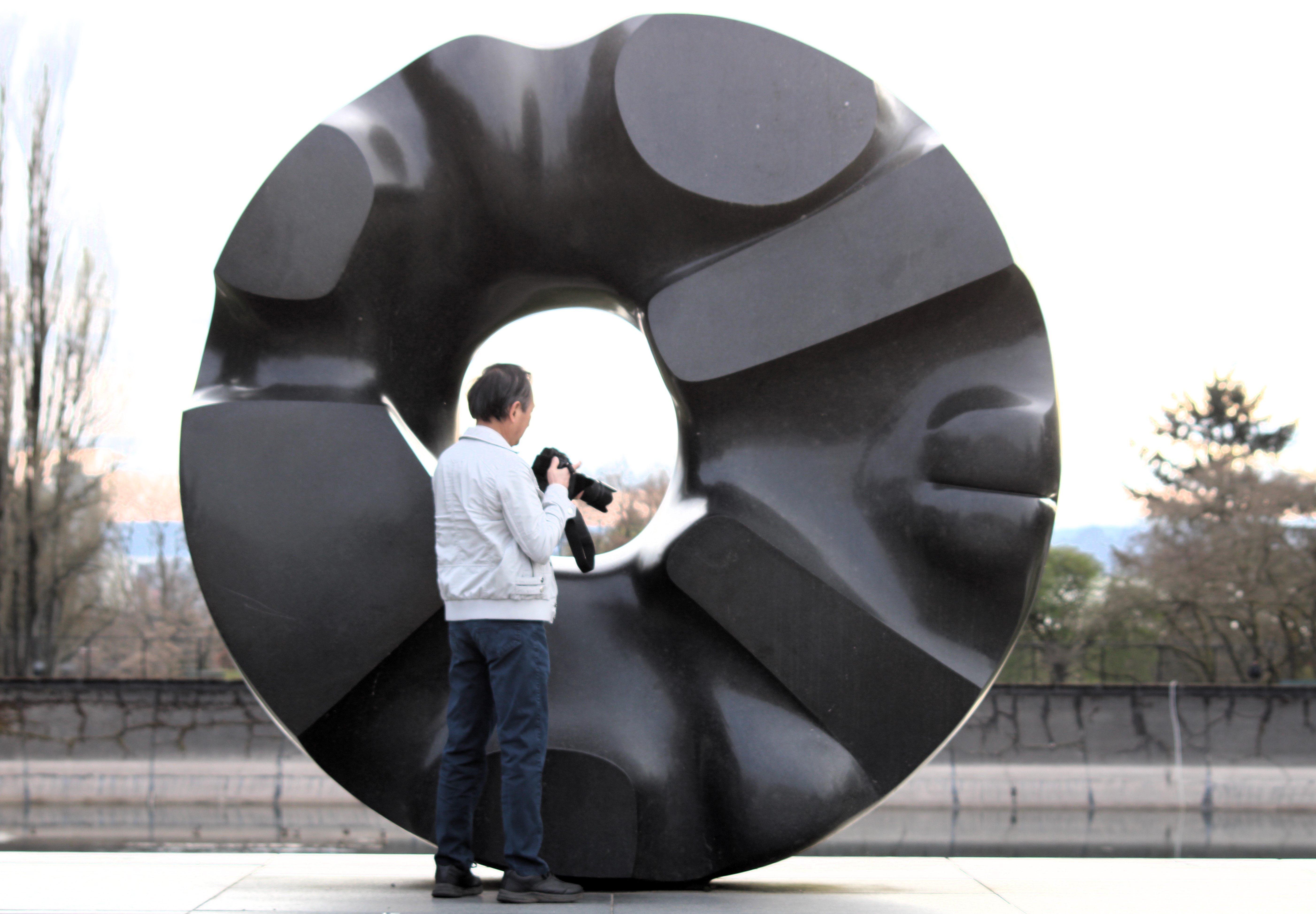
Unrelated to the text: A guy grabbing a photo at Seattle’s Sphincter outside the Asian Art Museum.

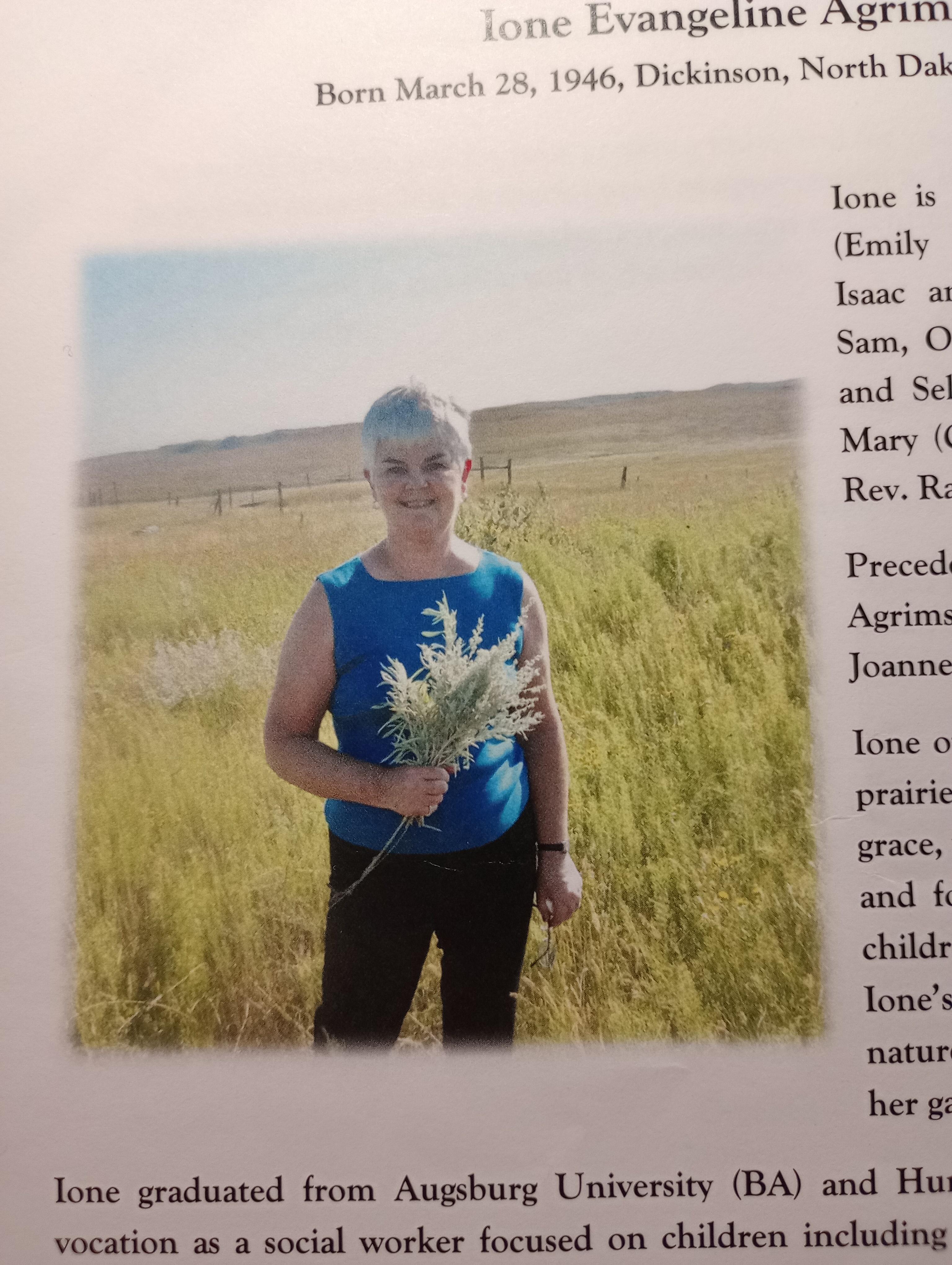
Ione

My mom died in January.

The past two and half months have been marked by family coming together to ease her passing, many friends and community members showing remembrances and appreciation, and a newfound discovery of her life before I even came along (in fact, she lived a longer part of her life without me than with me). I thumbed through baby mementos, childhood schoolwork, photos of epic road trips with friends, and cards and notes with glimpses into her esteemed social work career, which was only one aspect of her wide and rich life.

In the past weeks I emerged from a long period of sadness and gradually began to understand how this affected me in unexpected ways. In brief, I owe her many more tears than what people saw me shed at the funeral and other gatherings (to paraphrase a famous passage).

My thoughts are with my dad, who is very open and emotional (a crier, as he put it), and with my siblings. Each had the particularities of their bond with her stripped away in certain ways as grim dementia took hold over the past 12 years. My dad has a thousand friends and even more warm acquaintances, along with a large family, yet he speaks openly of his loneliness and the long evenings and the void where Ione was. My siblings are raising children of their own who will not have Grandma around anymore, and some of their memories of my mom will be spotty or absent. I used to wish I had known my maternal grandpa, because people tell me I would have liked him. Now, another elder in the chain has dropped away.

I sense more than ever the natural affinities she imparted to me – for flowers, plants, natural settings, birds, and all living things. She was capable of great peace and quietness even while ordering the swirling world around her of kids, career, a spouse with a demanding job, and her endless personal pursuits of gardening, piano, baking, reading, and putting on our family gatherings without fail.

When I cozy up with a book with Rachmaninoff playing, I think of her. When I take an extra moment to take in birdsong or sunshine, especially in a grassy setting, I think of her. I marvel at how she passed her sense of awe to me but not a trace of religious faith, which was huge for her but mostly empty for me. I marvel at how she took the time to care for herself and for gaggles of demanding children at home and at work. I wonder where she got her curious affection for hippos.

At Seward Park, my old-forest core in Seattle, I sat on a bench at the top of the Seqsebad trail dedicated to someone else’s departed loved one, also a nature lover. I leaned my head  back and let the gentle January rain stream down my cheek and do the crying for me. When I want to revisit the mood of these dark months I put on Chopin’s 14th Nocturne because it seems to capture the emotional journey, and Mom would have liked it. She loved Barber’s adagio also, but this is terribly maudlin.

At the funeral, which 400 people attended, visitors heard the amazing singing voice of my sister-in-law and her band, and had a chance to take home some of the many purple flowers present. Some clippings adorned windows and tabletops in the same way my mom kept fresh cut flowers around the house. One flower clipping was turned by a crafty friend into an enduring form under glass.

The ceremony was Lutheran in accordance with my parents’ deep and lifelong faith, work, and community. I sometimes discount the effect of ceremony until I see its impact for myself, and this ceremony got the emotions flowing. It was held in a grand church and some words in the service stood out: “Holy Spirit, author and give of life, the comforter of all who sorrow, our sure confidence and everlasting hope, we worship you.” And: “We thank you for giving her to us to know and to live as a companion in our pilgrimage on earth. In your boundless compassion, console us who mourn.” I yearn for a comforter of all who sorrow and a source of boundless compassion, but I believe we have to comfort each other and show compassion for ourselves. My mom was the author of my life and my first and best comforter. She was my example, along with my dad, of how to practice these much-needed virtues in everyday life.

My mom’s life is now in the past. The future holds a burial of her ashes, which are now in a hallowed corner of my dad’s living room, surrounded by sweetly glowing purple, Ione’s favorite color. As a family, we are planning a road trip to the prairies of North Dakota that she so loved. My mom had a deep recognition of herself as a woman of the Dakota prairies. We will scatter a few of her ashes there, among the pale green sage. She used to break the leaves of the prairie sage for me to bring out its evocative scent.

Letter to Seattle Department of Transportation regarding most recent pedestrian killing

Over Christmas yet another pedestrian was killed by a driver in Seattle. Because of the holiday, there was minimal news coverage. I felt compelled to write to the city transportation department because I recall trying to cross this highway-like urban road last year and finding that it was impossible (I had to find another way around as the area was designed exclusively for cars). As I was writing, news appeared of a cyclist that a driver killed on the other side of town.

It seems the issue is pervasive and it’s getting worse. I hope the letter does not sound angry or embittered. But I can’t help feel that way since SDOT is truly standing in the way of so many goals of residents of this region: safety, a low-carbon economy, low cost housing (since much of our city is asphalt exclusively for driving and parking), improving air quality, and simply being a better place to live.

Writing alone makes me feel ineffective, so the next step is to sign up for direct action with Seattle Neighborhood Greenways and Beacon Hill Safe Streets. Anything, anything to combat the all-cars, all-the-time culture here.

Interestingly, SDOT makes it hard to contact them. The five community outreach specialists on the site are profiled without providing contact information. And the contact numbers for the department seem to be only service-related. This is a department that just does not care. When people die on streets they designed, they shrug. Perhaps they need to be defunded (but for real this time) since all they do with their massive budget is highway megaprojects and paving over and repaving of scarce city land.

The futile letter

Dear SDOT,

I am writing to express my deep concern and urgency regarding the recent tragic killing that occurred on Aurora Avenue North and Lynn Avenue, where a driver killed a 73 year-old woman. This incident, which took place in the early evening, points to the unsafe design of this intersection and the surrounding car-centric road infrastructure.

It is disheartening to note that the driver involved in the incident was released without any apparent accountability, creating an atmosphere that seems to diminish the gravity of such violent deaths. In addition, SDOT’s website and Twitter feed seem to have no mention of this woman’s death. In order to address these ongoing killings, SDOT must take proactive steps to prevent similar tragedies in the future.

Basic urban design principles emphasize the creation of safe and accessible spaces for all residents. Unfortunately, the current state of Aurora Avenue North and Lynn Avenue falls short of these principles. The road exhibits several safety hazards, including multiple high-speed lanes, a lack of safe pedestrian crossings, and a highway-like design that is incompatible with the urban environment.

Furthermore, it is alarming to observe the increasing pedestrian death toll in Seattle, with SDOT appearing indifferent to this growing crisis. As a concerned Seattle resident, I urge the Seattle Department of Transportation to prioritize the redesign of Aurora Avenue North and Lynn Avenue to enhance the safety of pedestrians and all road users. If this most recent killing will not motivate a redesign, SDOT should publish specifics about exactly how many people must be killed before they will act.

I plan to contact my representative on the city council as well as the mayor and my state representatives, who together have oversight over SDOT’s funding and priorities, to bring attention to this matter and request their support in ensuring the swift and effective implementation of safety measures at this intersection and elsewhere on Aurora Avenue.

I implore you to take immediate action to address the unsafe design at Aurora Avenue North. It is our collective responsibility to create a city that prioritizes the basic safety of residents, but we cannot do it with SDOT’s car-centric design standing in the way.

Thank you for your attention to this matter, and I look forward to witnessing SDOT taking these killing seriously and taking action to reverse the trend.

Sincerely,
Isaac R. Oadkill

About the photo

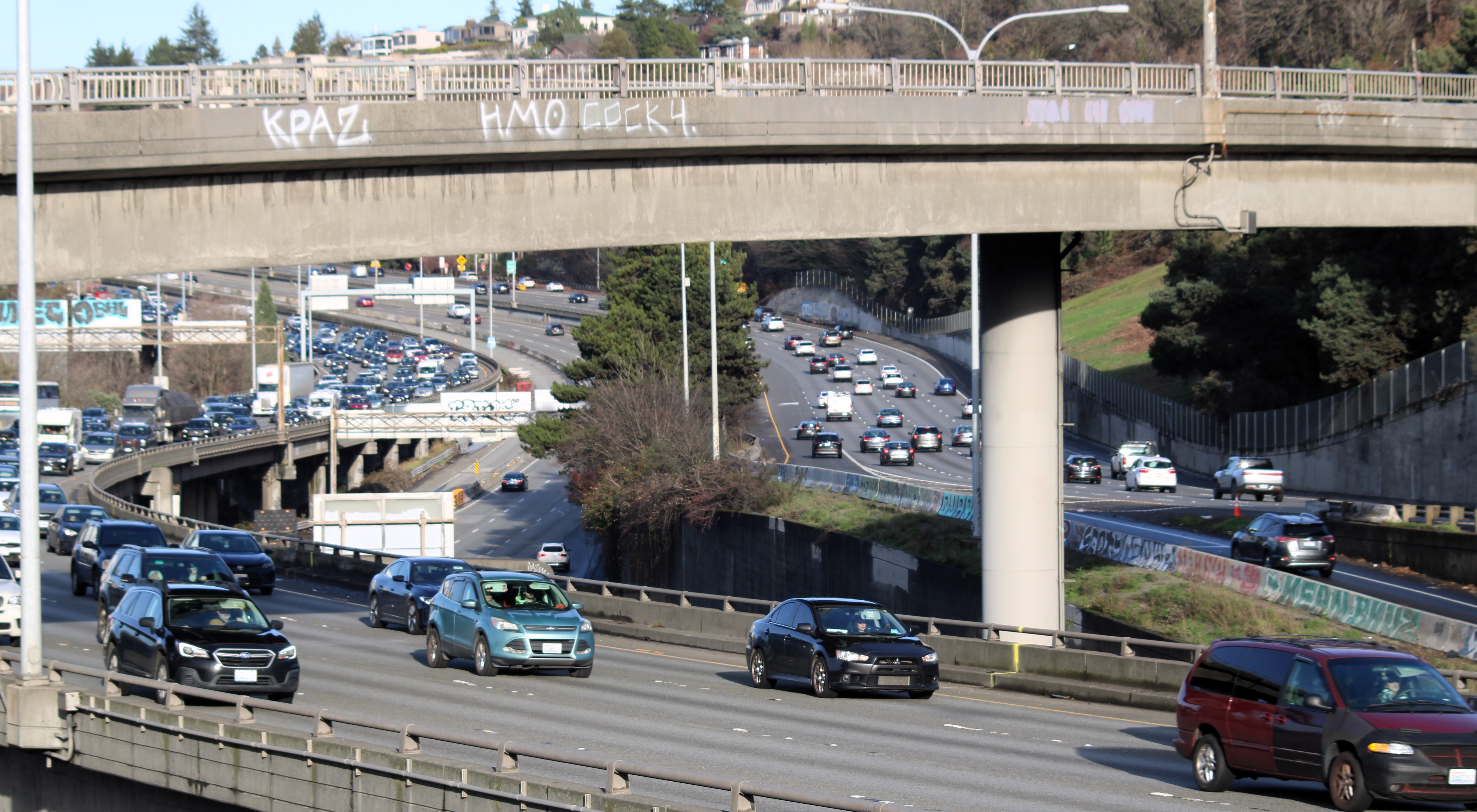
SDOT’s vision for the future of Seattle. The department has already transformed large parts of the city into what you see here. Given enough time and money, they could make the whole city look this way.

Staying Active in November

I visited the Burke Museum of Natural History for only the second time and admired the fossils and taxidermied creatures.

On a walk nearby, I noted the golden-crowned kinglets that seem to be more abundant and bold than I remember. This might be because they are migrants passing through while feeding constantly on a diet of whatever bugs they can catch.

I watched a Baroque ensemble perform at the University of Washington. The theme was Venetian composers. If I understand correctly, Baroque generally entails ornate art forms, and this was ornate music. I noticed that the guy on the recorder (the flute-like thing) was the most lively of the five performers because his hands and fingers moved constantly as the instrument itself went up and down and from side to side. One instrument was a viola da gamba, which I saw for the first time. I am grateful for music because it requires no effortful understanding to enjoy it, yet effortful appreciation helps you enjoy it more. And people who pursue music as a discipline are often generously sharing their creations, unlike in some other disciplines.

An audiobook called "God, Human, Animal, Machine" by Meghan O’Gieblyn has captured my close attention during my overly long commute. The author writes about trends that have occupied me lately, such as anthropomorphism toward robots and chatbots, large language models, and general artificial intelligence. She seems to have a drive to reconcile conflicting concepts in her mind, and she presents an excellent elaboration of the way her thinking has changed over time.

She grapples with the rapid changes in technology, science, and culture while comparing it to the distant past, including concepts picked up during a religious upbringing. In this sense, she is like me. Somehow, this book came out before the widespread explosion of large language models at the end of 2022 and that is continuing fast now, in November 2023. I hope to hear her thoughts on this recent proliferation of chat bots and AI tools.

O’Gieblyn in “God, Human, Animal, Machine” discusses the focus on emergence that has been taken up by scientists and also by technologists as a remedy to excessive reductionism; or to taking up the work where reductionism slows and fails to give further meaningful, unifying answers. It turns out technologists also have noted emergence and have sought to make emergence happen. The technologists have lurched forward with several successes. It turns out the book in my hand discusses the same thing.

This relates to the book "What is Life," which I had the joy of reading this afternoon over an espresso drink in an artsy cafe in the University District that was very peaceful. The author is interviewed in this video. The book suggests biology will get "weirder" as it is looked on increasingly in information processing terms. Biology might go from mechanistic (like Newtonian physics) to mind-bendingly weird (like relativity and quantum mechanics).

At work, I realized I have an opportunity to exercise much more autonomy and self-management in my role. It will require more team building, creativity, and mental effort than I am accustomed to, which might be a good thing, as long as it does not wipe me out weekly and prevent me from active learning, fitness, a social life, and engagement elsewhere. As ever, I am seeking balance.

Sunday evening was cool and damp, but no rain was coming down. I visited colleagues and warmed up my hands with a hot chai while catching up with them. One is four months older than me and has a birthday coming up. I am trying to take responsibility for being a social host and showing him a good time for our shared experiences and his many small kindnesses.

About the photo

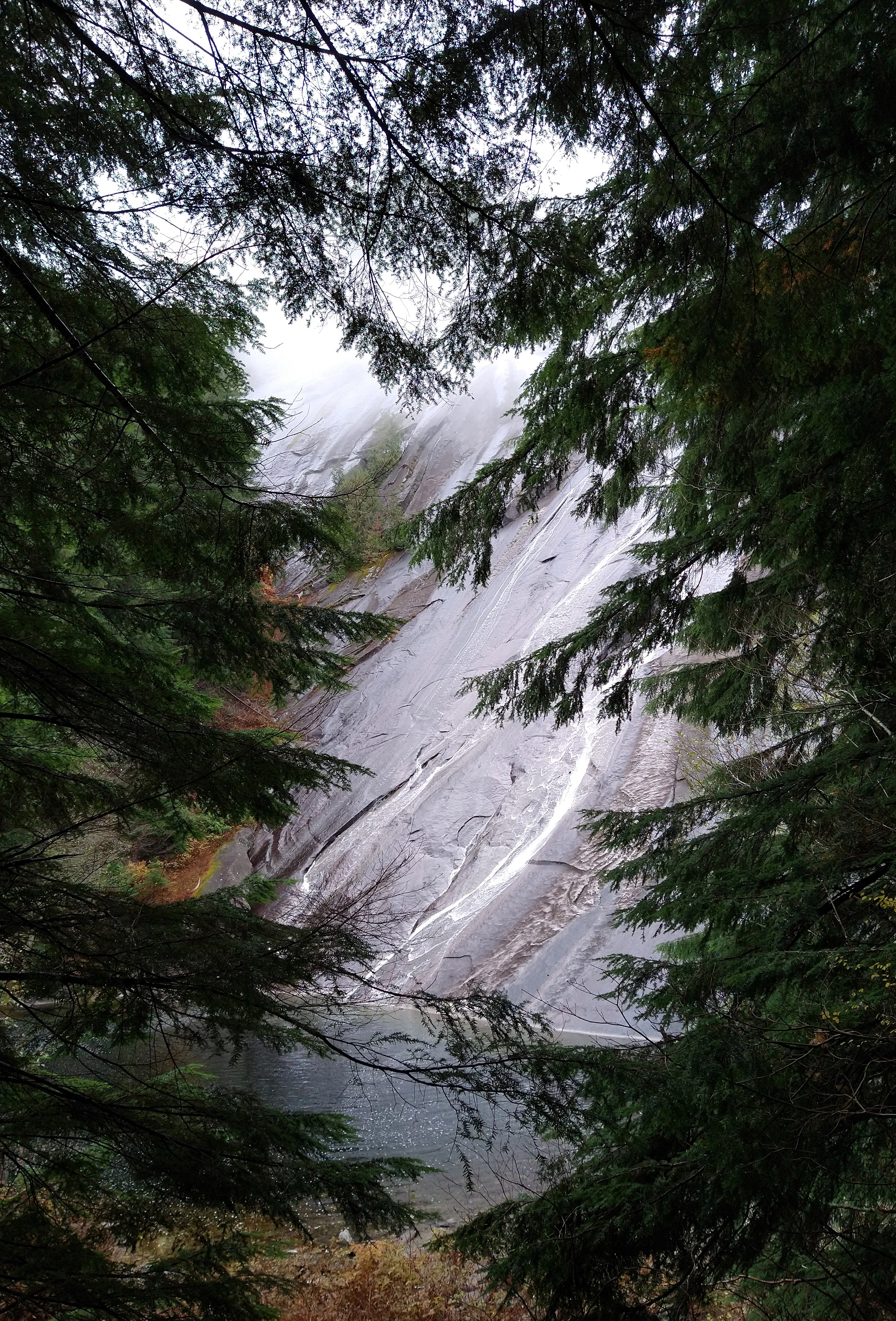
The magnificent and unique Otter Falls.

A Russian computer guy that I was hiking with here discussed consciousness, AI, and the current state of entities where biological and technological parts are integrated. On the same day, I talked to an Indian computer guy who held forth about how humans were placed here by aliens and were genetically modified by these aliens and perhaps by other forces. He vividly described the architecture of an ancient people as an argument for these alien origins. People have very interesting ideas. Rather than taking a firm stance, I thought of ways to refute the alien hypothesis, which I can’t for now. Although far-fetched, the hypothesis that humans are genetically modified aliens remains valid and open to refutation.

November in Seattle

As my part of the world cools and darkens, I find ways to observe nature and people and learn constantly, enjoying every day.

TODAY’S BIKE RIDE

I hopped on my bike despite the threat of rain. In the Pacific Northwest, you must interpret the weather forecast optimistically. Weather services have a way of slapping a gloomy gray icon over the daily forecast, implying non-stop all-day rain. But when you get out there, you find that most hours of the day, no rain is coming down and it would have been a shame to stay indoors.

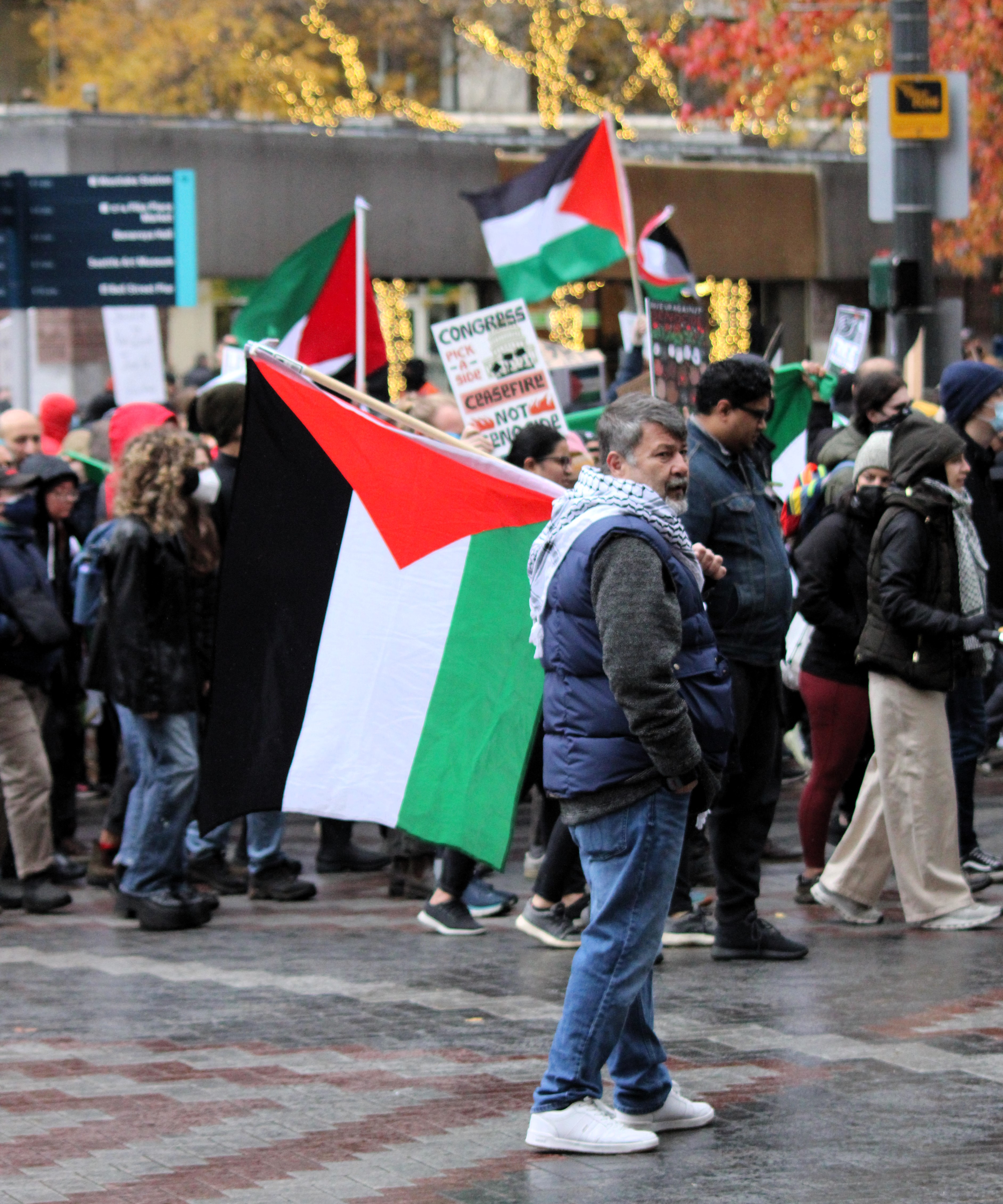
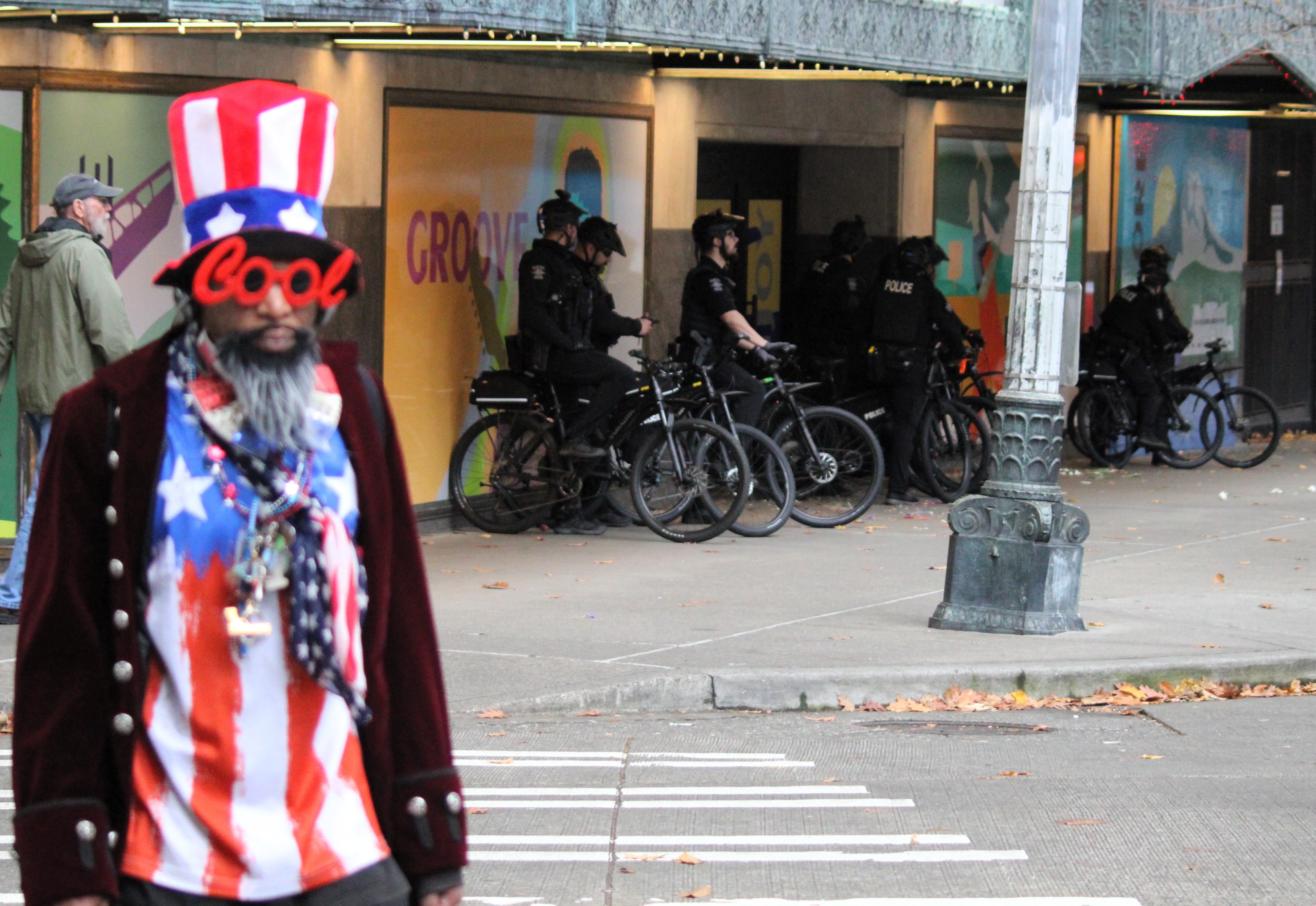
I biked a nice familiar route through Pioneer Square to Olympic Sculpture Park and then through the city center and back downtown. I came across a patriotically festooned gentleman who contrasted with the black uniforms of the police who had assembled in response to a pro-Palestine protest.

The protest was large and well-organized. A brave brigade of cyclists blocked off the always-enraged drivers. A sign read, "There are not two sides to a genocide."

I feel sorry for all the people who are suffering. And I do not want the US to fund and arm Israel, Ukraine, Taiwan, and all the other countries with intractable regional conflicts based on issues irrelevant to the typical American. If religious or ethnic fanatics in a distant desert or jungle decide to kill their neighbors with the weapons at hand, they should be aware there is no true "international community" that will fly in and solve the conflict for them.

In this respect, I guess I am questioning the Democratic party. We seem to be the rich and highly educated elites, favoring mass immigration regardless of its impact on the working class, and endless involvement in various foreign wars. Fossil fuel extraction rises each year regardless of the party in charge. I see the two parties as increasingly similar and equally inconsistent, and I think it is the wider culture that needs to change.

GRATITUDE

I am thankful for my work, which has me engaged in biology in downtown Seattle on biomolecules that have saved lives and will save many more. During lunch this week, I walked to Lake Union despite the increasing cold and watched the planes, boats, people, and birds. After work, I enjoyed the subdued vibe of a Capitol Hill cocktail bar before heading home to North Beacon Hill.

I contrast the depressed native Seattleites with the happy transplants like me who came here out of choice. I struggle to understand why some people complain so much and consider moving to a dusty and waterless desert metropolis like Phoenix. Perhaps I’m being inconsistent myself, since I am aware that a billion desperate immigrants would gladly eat shit all day, every day and never complain in my place.

The downside of going back to full-time employment is that I have less time to write, and screens dominate my time. Work involves screens, personal logistics involves screens, and entertainment involves screens. Screens are my lifestyle and that of many others. Marshall McLuhan’s notion that "the medium is the message" is distressingly apt, and so I am on the lookout for ways to reduce my screen time by using paper books and paper notetaking.

ANOTHER WOMAN-CENTRIC OPINION PIECE ON DATING AND MARRIAGE

This annoyed me. The female author (no credentials are listed) trots out a familiar case: "Men are trash. And where is my Prince Charming?"

For her article, she interviewed zero men. She profiled women who are "putting a lot of effort" into dating by passively swiping on dating apps and then sitting back in judgment of the men who message and meet up with her.

And she wondered why men do not rush to provide for a woman, satisfy all her emotional whims, compete to win her hand for a lifetime marriage contract with the state and federal governments, provide his DNA, and raise her children. It seems like yet another NYT opinion piece that is totally wrapped up in the lifestyle issues of educated American women, with ignorant disregard for differing views.

The author allows that "many men are fantastic people" and says that we should listen to the experiences of women who are attempting to find partners. But this is all I ever hear about. I would wager that none of those women have ever asked a man out in public (outside of passive dating app usage) or questioned their own long list of dealbreakers and red flags. I doubt she would trade her fantasy of being raped by a billionaire (à la Fifty Shades of Grey) for a realistic relationship, ever.

The woman profiled in the beginning of the article does not support the argument. The woman, no catch herself and at the end of her fertile years, chose to have a kid with a loser co-worker and then he left. I feel sorry for the kid.

The illustration also reveals the author’s mindset: a towering woman trying to keep multitudes of tiny men out of her house, while a ticking clock looms overhead. To me, the giant woman represents a potential male partner on a first date with her, while the innumerable little men in the illustration represent her lengthy set of until-death demands.

If these opinion havers truly want what’s best for children, they should look to evolutionary anthropology and how children were successfully raised in the past. To make it work today, this might involve legal arrangements to raise a child, irrespective of a romantic relationship, as described in this video from the reliable Big Think channel. Interestingly, a friend of mine, an intuitive thinker, suggested this to me years ago when she saw crap relationships sprouting crap environments for oops babies to grow up in.

EXCELLENT RECENT VIMEO STAFF PICKS

The Archivists

A vision of humanity preserving the words and music of a ruined civilization. A video with excellent composition, music, and message, showing how human culture can never be extinguished.

One Revolution Per Minute

A positive technological vision of a human future in space. Hard sci-fi is truly the best sci-fi. This filmmaker also created "Wanderers," which features an iconic recording of Carl Sagan’s voice. I think this future scenario is more likely than the one in "The Archivists" above, but we will not get there without effort. I also think the humans in these spectacular surroundings will find things to complain about (and reasons to skip exercising on the pictured treadmills).

Bambina ‘Anyway U Want It’

This film shows a man getting lost in a buggy sex party simulation. It reminded me of supernormal stimuli, well-described in "Manwatching" by Desmond Morris, where, for example, a goose will abandon its real egg and incubate a giant and obviously fake one instead. I think vulnerable people will be tempted to enter virtual worlds for more and more of their lifespan while the difficult work of (for example) getting to space goes to others with a more balanced psyche.

Une Belle Nuit D’Été

To tie these videos together, I would propose the above, which shows how nature, including the seemingly sweet companion dog, ultimately corrects all. To link it to the above videos: it will be nature that decides whether we get to space or enter simplistic virtual worlds.

WHAT I AM READING

If all my training in biology had only earned me the ability to read and understand a book describing the life’s work of a brain scientist speaking to me in clear scientific language in his or her own words, then that is a decent tradeoff. It has brought me much more. However, the ability to sit down and delve into literature about how evolution has shaped our subjective mental experience, along with the difficult and careful experimentation and theorizing that have illuminated the workings of our minds, is incredibly rewarding. This is the experience I have had with “The Emotional Brain” by LeDoux.

Passage from "The Emotional Brain":

This excerpt follows an insightful discussion on how brain science reveals the absence of a single, unified stress response. It explores how a stress hormone could diminish the activity of the hippocampus (and its memory formation functions) while amplifying the activity of the amygdala (and its non-conscious activation of conditioned fear behavior).

"If indeed the hippocampus is impaired and the amygdala is facilitated by stress, it would suggest the possibility that stress shifts us into a mode of operation in which we react to danger rather than think about it."

Additionally:

"Alternatively, a mild fear of heights, one that causes few problems in everyday life, might be converted into a pathological fear under the amplifying influences of stress. The stress is unrelated to the disorder that develops and is instead a condition that lowers the threshold for an anxiety disorder, making the individual vulnerable to anxiety but not dictating the nature of the disorder that will emerge. The latter is probably determined by the kinds of fears and other vulnerabilities that the person has lurking inside."

As always, I am thrilled when I find connections to acceptance and commitment therapy and relational frame theory (ACT and RFT), including on page 263 where the following is stated: “Avoidance is more complex: it involves fear conditioning plus instrument learning… Avoidance responses are arbitrary.” I am now opening the final chapter, which addresses the link between emotions and consciousness, the most difficult problem in the book so far, and the most interesting.

RECENT BIRDS

The varied thrush, a Pacific Northwest favorite, turns out to be more common than I thought. I first encountered this beautiful bird on the Oregon coast at Oswald West State Park, which is a special place for me. The bird usually resides in dark, dense forests where its plumage is not easily appreciated. However, I spotted one in the open before it got spooked.

I find that a bird in the thrush family is distinguished more by its behavior than by plumage. I discussed with a naturalist at Seward Park Audubon how learning bird calls, especially in this forested region, opens up a world of unseen bird activity. It’s wise to always look for more dimensions by which to distinguish things.

Pileated woodpeckers are also more common in Redmond than I expected, given my work there. A colleague didn’t believe that this enormous prehistoric-looking bird was a short walk from the laboratory door.

I missed the juncos and bushtits when I was abroad. Now, I miss the noisy parakeets of Parc Montsouris. I know they are doing fine despite the cold.

About the photos

Downtown Seattle on a typical Saturday afternoon. A patriotically festooned gentleman and a pro-Palestine protest.

Picking up life in Seattle where I left off…

…by going to a movie with a friend:

The recent Scorcese film is incredible. It did not feel like three and a half hours because the "genre" changed over the course of the film, and certain characters were only revealed to be bad guys over time, in stomach-churning betrayals and bursts of ugly violence. Robert De Niro’s role echoed his sliminess in Goodfellas, where he seemed like a man of the people who welcomed the protagonist into his fold, only to reveal himself as a methodical killer. The $22 IMAX ticket hurt, but I remain committed to moviegoing for the AAA titles (which reminds me, I still need to see Oppenheimer…).

…by going birding:

In Redmond, WA last week, I came across an American bittern foraging out in the open. The bird kept its bill pointed diagonally upward, in a behavior that keeps it camouflaged in its cattail pond habitat. Then it got spooked and flew off. I think it was passing through as a migrant. As much as I like marshes and cattail ponds, I had never seen an American bittern before this week. It was unexpectedly large.

I visited Seward Park and looked at the works of Hannah Salia, a talented painter who captures nature scenes (many influenced by specific places in the park) and references classical mythology in the accompanying poems and titles. Right up my alley. The staff there provided hot tea for me to clutch with both hands while I watched the belted kingfisher preside over a nearby small bay on the increasingly cold mornings here.

…and by enjoying a hot espresso drink at Olympia and Realfine:

These coffee shops in Columbia City and Capitol Hill are an oasis. If you can put up with a little cold, you have the patio to yourself to read your book or just watch the many different types of people go by. A quad cappuccino, extra hot, with lovingly poured milk art, is a beautiful thing.

Changes in friends and former colleagues:

A friend made an astonishing personal transformation by losing 50 pounds and quitting drinking over the summer. She said the thing that prompted her to change was turning 40. It’s amazing to see the results. Another friend looks a bit depressed and tired heading into winter. He complains of aches and pains and suggested we can’t play tennis until spring, despite the cold but clear weather. It’s hard to guess at a person’s mental state, but I am struck at how the months and years bring optimism and positive change to some but depression and declining health and fitness to others. In conversation, I asked a hairstylist what was a common topic people bring up when sitting in her chair, and she said that many, many people remark on the way time flies past them.

Reflecting on news events

Depraved violence has broken out in several places in the world. It seems far away for now, but it could happen here too. My dad has close friends in Jerusalem and is wrenched by the developments even as he cherishes spending mornings with his grandkids. I hate how the American news media filters events through a tired way of thinking and insists that people choose a side.

As gruesome as the videos are, I still have a habit of occasionally visiting kaotic.com and seeing the worst, most recent depravity humans are capable of. In a vague way that I can’t formally justify, I think watching gore videos is a way of refusing to avert your eyes from the truth. I don’t think everyone should watch these videos. But they should be accessible. I think some people might clarify or change their political views if they saw them. As a side note, the worst of the worst videos come from amateur criminals in Latin America as well as traffic violence. Many of the killings are of the same nature as in the Scorcese movie – brutal, petty, improvised, and done in a field.

Currently reading The Emotional Brain by Joseph LeDoux.

This book is difficult, more so than his "The Deep History of Ourselves" or even "Anxious." But I am reading it closely and actively with a red pen in hand because I think it is very important and interesting. Important because we are creating something close to a synthetic brain without even understanding how our own minds work. And interesting because I am seeing how psychology concepts introduced to me many years ago, such as classical and instrumental conditioning, are contributing mechanisms of so much emotional disorder and avoidance and suffering. This reminds me, in turn, of infinite arbitrary mental relations described in "Get Out of Your Mind and Into Your Life" and the wisdom of ACT and Jon Kabat-Zinn and of occasionally turning off the mental word machine and simply experiencing awareness directly, and observing verbal relations and thoughts rather than being caught up in them. My most recent meditation habit in this vein is non dual meditation, and I follow along with this quaint but perfect ten year old YouTube meditation again and again.

About the photo:

I biked past these drug enjoyers on 12th Avenue South on Sunday. I doubt it’s fun to nod off on a public sidewalk for an hour with your ass in the air. Then again, they don’t do it because it’s fun but because of an addiction. For all the unsightliness of public drug addiction, it is drivers who are the real threat to my life. Today the driver who almost hit me was a guy in a minivan with windows frosted over so he could hardly see. When he slammed on his brakes, he flung his hands up as if to say, “Not my fault, I can’t see anything!” A recent Seattle sticker that read, “Drivers are more dangerous than homeless people” rings true.

Returning to Seattle after four months in Paris

I spent four months in Paris, one of the greatest cities in the world. Recently I returned home to Seattle, which is also one of the greatest cities in the world, and I look forward to enjoying fall in the Pacific Northwest.

Three things that delighted me during my stay

First, I love the bikeability and walkability of Paris. The city is relatively small in area, and the dense network of bike paths and low-speed streets got me everywhere. The city is taking the climate transition (implying action, more apt than American ongoing crisis terminology) seriously and this means reducing the number of cars, reducing vehicle speeds, and reducing their size. Bike lanes, green space, and pedestrian squares are being added everywhere and they are very well used and appreciated. I biked over every corner of the city without constantly worrying about the real risk of being killed by a driver like I do in the US. Biking and walking along the Seine at sunset, visiting wooded Bois de Vincennes, and rolling down car-limited Rue de Rivoli were frequent favorites.

Second, the people in Paris are basically better than us. They are more put together, more considerate, thinner, less sloppy, less prone to anger and rage (and passive aggressive behavior), and they hang out in parks and cafes instead of inside idling cars like in the US. Their lives are not as isolated and dominated by cell phones. They do not eat as much ultra-processed crap food as we do. And their politics are generally reasonable, governance effective, and society is orderly. Government advocates for people and the environment rather than putting business interests first.

In social and cultural progress, Parisians are way further along than Americans in many ways. As an example, a French woman can expect to live 10 years longer than an American man. And while Seattle has a low murder rate for American cities, Paris’s murder rate is one fourth of that. To illustrate the crassness and emotional immaturity gap, yesterday in Seattle a man shouted at me, “Get outta here with your bike.” He changed his tune from shouty lion to polite lamb when I engaged him in conversation, since I unexpectedly showed him how to respond like a civilized person. In Paris, the same situation would result in a polite, “Monsieur, ici il faut tenir le velo à main.” And that would be that.

Upon my return, it only took a day for me to be dodging obese distracted drivers in megatrucks and SUVs. I will now count the days until a stranger screams, “I’LL FUCKIN KILL YOU! I’LL FUCKIN KILL YOU! I’LL FUCKIN KILL YOU!” This seems to be a regular thing for me as a guy living in America, so I doubt it will be a long wait. All this might sound like denigrating American society and culture. But what I mean is that living in the US (even a rich coastal city) has its own mix of challenges, and these are different from those you face in a rich European city.

Third was Parc Montsouris, the green gem of the 14th arrondissement. This large park with woods, waters, sculpture, grassy play and picnic areas, and endless events and activities, was only a short walk from me and I visited almost daily. I loved to watch the common birds such as European magpies and common wood pigeons. And the music performances and festivals were constantly changing during the summer.

Why I went

I wanted to hone my oral expression in French after many years of formal and independent study. I learned a lot of French while in Paris, but did not speak the language as much as I had hoped. I think this is because of the ubiquity of contactless methods of going about your day, and the widespread use of English. If you stumble across a phrase in French, the person you are talking to may simply switch to English and the rest of the conversation will stay that way.

Although my conversation does not flow like that of a native speaker, I had good dialogue with people about news and about destinations in town. American politics was a frequent topic. And I enjoyed a break from getting by in French when I joined an anglophone book club. Attended, as it turns out, by people from an array of anglophone and non anglophone countries.

Overall, I learned way more from visiting real sites of history and art, reading at the various excellent libraries as well as while sprawled out in beautiful parks like Parc Montsouris or the Jardin du Luxembourg. Two oral communication classes on current events that I took at the Alliance Francaise de Seattle helped immensely.

Three things that were unexpected

My last two months in Paris involved too much worry over job applications. I only spent an hour or so a day on this, but the slow trickle of responses and the many automated rejections unnerved me and took up excessive mental space. My remote application and interviewing efforts scored me a job offer before even returning home, however the uncertainty did add some stress. One thing I learned is that job applications have not changed much over the 23 years I have been in the workforce. The real way to win this rat race is to drop out entirely, never do a traditional job application again, and no longer be a rat.

I also surprised myself in staying put in the city. I thought in four months I would want to take a train to Amsterdam or Italy, but I drew deep satisfaction from all the free and low cost things I did in town. I felt no need to go to an expensive short term rental in a tourist area of yet another city. When you hop among travel sites, things start to look the same. I had seen so many examples of ornate architecture, sculpture, and painting that I even skipped Versailles.

When I return to France someday I will make it a “France peripherique” trip and visit the areas that tourists touch only lightly. This is in line with government efforts to spread tourists around the country so they are not pressing excessively on the same handful of places. I might make it a bicycle touring trip.

Lastly, I was surprised by the way immigration is rapidly transforming the face of France. I knew that France had huge numbers of immigrants (Muslims rapidly dwarfed the number of jews over a short time frame, for instance). But the scale of immigration is immense and growing.

During my stay, the entire population of Lampedusa, an Italian island, was outnumbered by African immigrants who arrived in one day. That island is a metaphor for all of Europe. As European birthrates drop, but mass immigration from high-fertility Africa and elsewhere increases year after year, the changes that are coming are going to be extreme. Far-right politicians are harshly shushed when they bring up “great replacement theory.” But it is not a theory, it is more of an observation. Perhaps replacement is too strong a term. And there is no conspiracy to replace indigenous Europeans. But it is also true that the native population never democratically voted for mass immigration and that the tide of immigration is irreversible and accelerating.

Leftist parties and far-right parties have both proven incapable of bringing down the numbers, even when they campaign on promises of reduced immigration. The inability to grapple with it is leading to far-right extremists and antipathy toward EU leadership in Brussels as being remote and unconcerned. Meanwhile, as in the US, white pro-immigration liberals in Europe publicly endorse immigration while privately creating white liberal enclaves where there are no immigrants to be found. And it is true that what we are seeing now in terms of immigrant numbers is just a trickle compared to what is to come. I think when I return to France in the coming years, I will find a population that does not look like me at all. Interestingly, the EU is so desperate that they are paying north African countries to stem the flow of migrants from further south. This is very similar to the US paying Central American countries to reduce the numbers of migrants getting through.

I can’t fault immigrants for doing anything to reach Europe or the US. Their lives are guaranteed to be 10 times better if they can only set foot on western soil. This summer four Nigerian men rode for 19 days on the tiny platform above a trans-ocean ship’s rudder, not knowing where it would go and having no plan or goal besides escaping Nigeria. This deep motivation in immigrants to flee no matter the cost vastly outmatches the general misgivings of the indigenous European and US populations about mass immigration. It is a bit like how the rabbit is faster than the fox because the rabbit is running for its life while the fox is just running for a meal.

A lesson or two

There is so much truth to the saying (or mantra), “Wherever you go, there you are.” I stayed the same while enjoying language and culture in a grand faraway city. Each day I read the news, got some exercise, and grabbed coffee and something to eat. My mind was on international events and learning goals of mine, such as topics in psychology and evolution. Although I visited cool places in Paris every day, I also spent a lot of time on my computer or reading books I could have read at home.

I also took on the habit of visiting the English café Shakespeare & Company and doing the New York Times crossword puzzle over a cappuccino, extra hot. Although I can do this habit in the US, it was very special to do it in Paris. The connected bookshop put on a wonderful festival honoring the 100th anniversary of the publication of Ulysses earlier in the summer.

If I take off another long stretch, I might do it in the cheapest country possible to test whether modern life is basically the same everywhere. Perhaps what is most important is simply having a neighborhood to walk, a laptop, and a few local friends to chill with on the weekends. Candidates include a Brazilian city, a Mexican city, an inexpensive Francophone country such as Senegal, or simply a grand US road trip.

Gratitude

Several crises struck while I was in Paris and I was thankful not to be touched by any of them. One was the protests over the killing of a young man from an immigrant community who did not stop for the police. As in the US, the protests were a mix of genuine outrage and crass looting of corner stores and shoe retailers.

Another crisis was a gas-related explosion near where I lived that killed two people. The rubble was striking to look at since my building was a lot like the destroyed one. I biked past it every day on my way to the central areas of town.

Lastly, the unbelievable heat all summer long had some people suffering. I am fortunate to love heat and I had an airy apartment. But as the continuing heat waves get worse, Paris will have more unpleasant or dangerous days. It was hot when I arrived, there were several heat waves during my stay, and it was hot when I left. When I returned to Seattle, it was hot there, too. Paris, however, is actively creating new cool green spaces and taking other measures to mitigate the impact of the heat.

I feel deep gratitude for my childfree lifestyle, which gave me the ability to take off for months seeking rest, change, and learning. I am grateful for a bit of personal finance knowledge that allowed me to finance my trip without going into debt. I am also grateful for the American economy, which for at least three years has guaranteed a job for anyone who wants one. Now, with a gap of only two weeks, I am hopping back into a job at a higher rate of pay than I have ever received in my life. I will quickly be saving for the next thing, which might be another trip just like this.

What it is like to be back

I love Seattle and immediately grabbed a cannabis tincture, the cheapest and most lung-friendly way to get high. I did all the things I had missed, including eating peanut butter (shockingly, almost totally absent in France) and visiting Seward Park. I saw a golden crowned kinglet and a harlequin duck (a lifetime first) on Puget Sound and breathed deep in satisfaction at the nature and landscapes I have access to now that I am back. I look forward to visits to the Olympic Mountains and the Pacific coast.

Clarity for the future

My next steps involve continuing to save and invest money while also de-centering paid employment in my life. In positive, productive tension with this goal is my plan to live a bit faster and move more boldly toward my goals. And I plan to sprinkle generous time off throughout my months and years.

Last word

I love Paris, I love Seattle, and I plan on taking more lengthy breaks from paid employment where I have time to walk, think, and learn. I have a lust for life. This four-month stay reminded me to be both deliberate and flexible in how I feed it.

About the photo

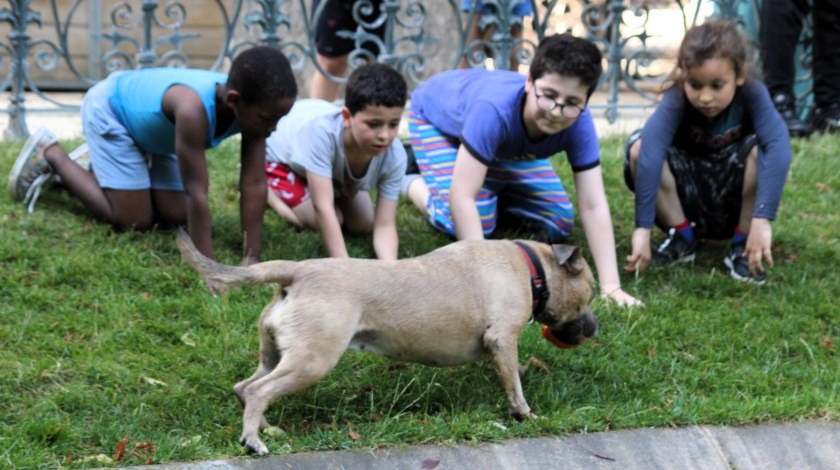
Kids playing with a dog at Square Émile-Chautemps.
A visit to the Cimetière du Père-Lachaise and Montmartre

I visited Père Lachaise Cemetery.

The day was warm and dry, and the only signs of fall were brown crinkly leaves and chestnut seeds whose husks were opening in the dry air. I knew of the cemetery’s history as the resting place of many human remains, including those of venerable figures such as Chopin. I thought it was fitting to visit this tomb since I listen to his Preludes almost every day.

Recent articles had profiled how nature and wildlife rebounded in this cemetery, especially during the pandemic. A French language classmate shared an article about this in the spring. And here I was, to see the carrion crows and the large native pigeons. In fact, I badly startled a mixed group of these birds when I stepped past one tomb.

This place is beautiful. There are endless tombs, some of them tidy and some in a state of elegant decay. It is a nice mix of nature, history, memory, and tribute.

A visit to Montmartre

I biked from there to Montmartre. I headed up to the famous hilltop. On the way there, sections of Boulevard de Belleville looked like Cairo, Egypt, with all the immigrant men and women. Soon it will look like Lagos, Nigeria, thanks to ever-accelerating mass migration.

The famous Basilique du Sacré-Cœur looms over the city. Walking up the stairs with my bike made me feel like a pilgrim. On the way up, and at the top, and throughout, I found the crowds were unbelievable. Do the crowds ever abate? I think the answer is no. As much as I hate the sight of my Seattle parks being empty of people most days, it is also strange when you can hardly move because of the huge numbers. It is hard to move left, right, or forward when every park and street is like a 24/7 festival. August was not quiet despite people being off on vacation. September, with the return to school, is also not quiet. Paris is thick with people at all days and times. Which gives the city vibrancy but also makes you want to escape.

Amélie

A busker at a gate to the basilica did a tune from Amélie with his guitar. I biked past the Café des Deux Moulins featured in the film but saw that it and its patio seating were overflowing and skipped it. I had the idea I was going to visit during a quiet time in September and get a kir like the poet in the film. Unless I return sometime at early morning opening, this will not happen because of the endless dense crowds.

I had watched the movie dozens of times on DVD when there was such a thing as DVD special features. These showed the color enhancements and technical tricks applied to make the Parisian sights and moments look magical. The sights in the movie are not real, but they captured the enchantment of the city.

TikTok ice cream shop.

The next day I read an article about a Paris ice cream shop right along my route that day that was overrun with teenage girl TikTokers. The shop was run by an international duo who worked in restaurants and understood how to make their shop social media-ready. People swarmed the location, and some metal cups went missing. The owners and regulars felt overwhelmed and edged out. I can relate to the desire not to be in someone’s video that will be published online. The visitors felt disappointed that filming for TikTok/Instagram content was banned.

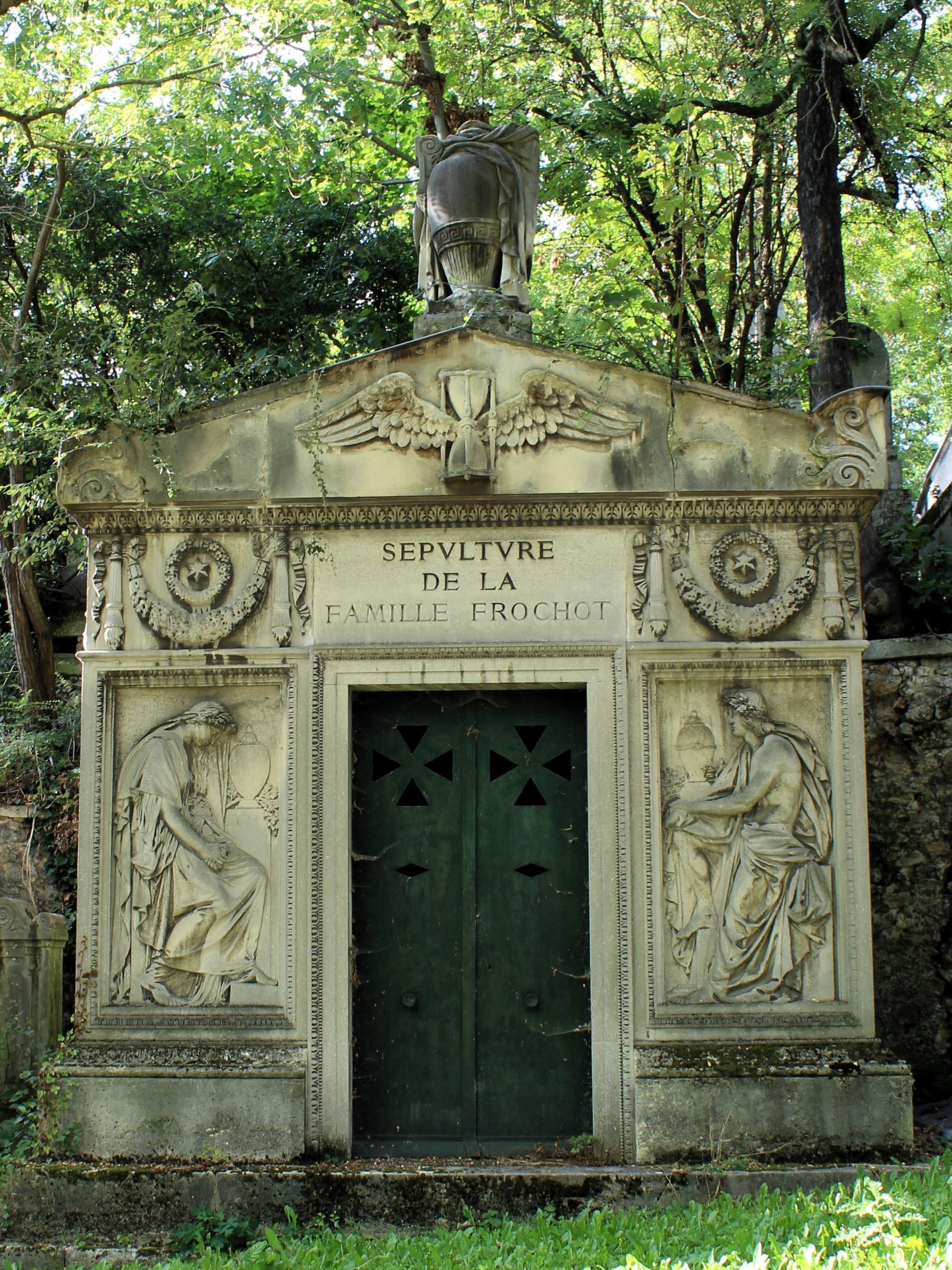
Frochot family mausoleum

Meanwhile, in the cemetery, the mausoleum of the Frochot family sat in albeit elegant decay. At night, it gets as cold as the ambient air, and in the recent hot summer, it got baking hot. Carrion crows and pigeons ramiers come and go, and in their brains, there is more complex and meaningful sentience than anything in the dusty and possibly forgotten human remains inside the concrete tomb.

On those steps of the basilica on Friday, a thousand people were meeting with their expectations of the place, each shaped by representations in film and media, which were themselves shaped by the physical places and by the minds of the creators themselves. The mix of memories and expectations and realities is a hallucinogenic swirl, rising up in eddies, being replicated and iterated upon, and endlessly reinterpreted and remade. All of this occurs within human minds, on artistic media, and in the world itself.

I won’t get a chance to drink that kir, but I will treasure the moment in film, and maybe grab one when I return to Seattle in two weeks.

About the photo

An impressive tomb from the Cimetière du Père Lachaise.