Confusion, disappointment, and grim resolve

My alarm clock is set to play the news. I woke up on Wednesday morning to the shocking fact that Donald Trump had won the presidency. I wanted to roll over and go back to sleep and try waking up again. That morning was awful.

This outcome is an absolute joke. I am so disappointed in the people around me. I still don’t understand the explanations that pundits and the news media have offered for their own failure to predict this. Maybe the problem is inherent in trying to explain the kind of irrational backlash movement that Trump represents.

I don’t think the Trump debacle will affect my life much in the next four years. Other people will be affected, though. I haven’t forgotten about the 500 000 dead Iraqis George W. Bush and the neocons are responsible for. I haven’t forgotten the face of Terri Schiavo.

I will not despair. Four years from now a rising star in the Democratic party will be elected and we will see this for what it was: a paroxysm in the national temper, a flare-up, a fluke. The next president might even be Minnesota’s own Amy Klobuchar.

In the meantime I will take care of those around me. I will resolve to avoid sinking into the politics of grievance that motivated so many voters this year, on both sides. I will continue feathering the liberal enclaves where I choose to live. Finally, I’ll try to be more skeptical of the conventional wisdom, so that I will never again have such a bad morning as I did this week.

Voting today by mail

I am voting today by absentee ballot. Minnesota allows absentee voting without requiring any excuse such as being out of state or in the hospital.

I should have submitted the ballot two weeks ago when I first got the form. The reason: to put this whole election behind me.

For a brief period I was actually concerned that Trump could win. Now, that looks impossible. I also look back at the short Bernie Sanders insurgency. Social media made him seem like an actual movement, when he was not. This was exacerbated by journalists who equate Twitter with the nation as a whole. The Vermont senator who did not talk to any of his colleagues, did not caucus with anyone, and promised free everything could have lost the election for Democrats to Trump.

Still, I wonder at times what the difference would be. I learned recently that 80 percent of the federal budget is already earmarked before the national Congress even convenes each year. It is tied up in untouchable legacy programs such as Medicare and Social Security and national debt interest payments.

In addition, I wonder at the significance of little symbols of party affiliation when everyone’s behavior seems to be the same. For example, what is the difference between two car commuters, one of whom has a Republican bumper sticker and one of whom has a Democrat bumper sticker? When it comes to environmental outcomes especially, the difference vanishes.

This is a problem for me. In 2012 I voted for Jill Stein when I knew Minnesota would go for Obama. But I recently found out about her equivocating on vaccines and radiofrequency exposure. I wish we had a Green party in the US that was strong on environmental issues but did not pander to the anti-science crowd.

I firmly believe in being politically active. I think people can have an impact. For example, I’ve seen the way neighborhood groups and preservationists in Minneapolis and Saint Paul have obstructed density and transit improvements. But perhaps I should look at politics as only one tool. Other hopeful tools might include technological change, cultural shifts and my own personal affiliations.

Cutting out feeds

I enjoy eliminating clutter, so I thought I would do the same for my media consumption. I want to screen out information that does not contribute to decision making or self-improvement. I also want to make sure that when I am seeking learning or entertainment, I do so deliberately instead of mindlessly, so that I can enjoy it.

I uninstalled the mobile Facebook app and now check in once a day on the desktop site to see any notifications. I send two or three interesting articles to my Kindle instead of browsing Feedly endlessly. I reduced my browser bookmarks bar. And I avoid hitting the refresh button on any of these sites and apps.

The impulse to declutter came when I noticed that all these websites are converging on the same bottomless page format – a feed. In addition each feed is personalized because of my own selections and the company’s algorithms. Accordingly each feed was presenting me with the same content. Reddit, Feedly, Facebook, Pinterest, Stack Exchange, Youtube, and the Google articles that appear below the mobile search bar were all giving me the same stuff. Even my podcasts are about those same topics. Thanks to the site and app design there is no reason to leave; all you have to do to chase the next hit is keep scrolling or keep tapping the right arrow.

There may be disadvantages to decluttering that I haven’t yet noticed. And cutting things out is an imprecise approach. It would be better to take Jacob Fisker’s advice (from Early Retirement Extreme) and instead of cutting things out, engage with the same information but at a higher level of abstraction. The problem is that I don’t quite know how to do this and in the book he did not elaborate. It’s easier to eliminate large swaths of clutter and then selectively re-acquire things when a need arises.

Emerald ash borer

I went for a nice walk along the Minnehaha Creek with my mom recently. Walks are pleasant for her despite her dementia because each moment is embedded in a context. She does not become restless about where she is supposed to be or what she is supposed to be doing, which is a common anxiety for her lately.

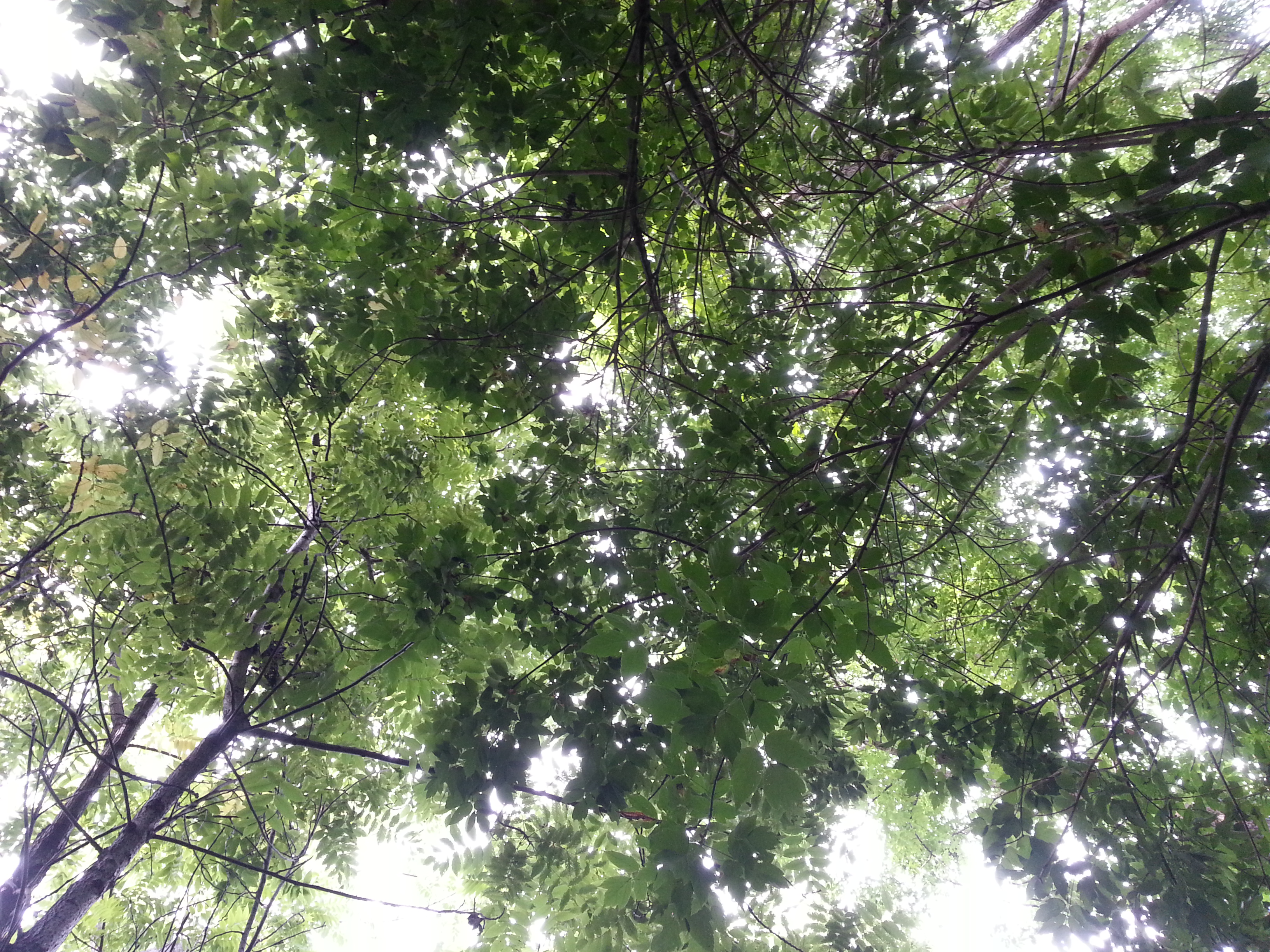
Fall colors are at their peak around here. Along the creek and elsewhere bright yellow tends to dominate because of the ash trees. Once you recognize their distinctive gnarly bark, you see ashes everywhere. Then they become easy to overlook.

I overlooked something important recently when a coworker suddenly quit. She gave her two weeks notice and all, but it was jarring to realize someone I spent thirty hours a week with would simply not be around anymore.

My nerves strike somewhat predictably, whenever there is a degree of anticipation involved. When the time came to hug and say goodbye, my heart was pounding. She and I shared a bond, but I never told her she was important to me, and I didn’t make enough of an effort to learn about her life.

Maybe after an event like that I can finally start learning the lessons of the immediate past: that every day is an opportunity to connect; that there is no comfortable future where you have all the time you need to tend to true relationships; that the time to be there for others is now.

Those ash trees are threatened by the emerald ash borer. A decade hence, 90% of them may be wiped out. Not just the thick yellow canopies, but the crunchy brown leaves under your feet, and the curious bunches of long flat seeds, and the unmistakable bark, could be gone.

All those parts of the tree that you can currently see and touch any time you want could be just a figment and a memory. This provides all the more reason to take that walk along the creek with a loved one whenever you can.

Gratitude for walkability

I recently visited my original car dealership to replace my airbag because of a recall. I wanted to avoid the gruesome scenario of shrapnel launching into one of my neck arteries and causing me to bleed out on the spot after a minor collision, which actually happened to people.

The estimate was a three hour wait. The technician offered to have someone drive me to the nearby mall or library to hang out, but I said I’d walk, thinking a walk in an unfamiliar area is always pleasant, right? Wrong.

This dealership was on the south side of interstate 494. I trudged through six-lane intersections, impossible construction sites, over turf and through giant parking lots to get to a Starbucks for a drink and then to the library on York Avenue where I passed the time.

The overall feeling of the walk was of rawness and exposure and danger. I inhaled a lot of exhaust fumes and got grit in my eyes kicked up by the high traffic speeds. The drab and sparse sights included a Fuddrucker’s and several gas stations and a highway.

I made a game of counting the drivers in the stalled traffic on France Avenue who were looking down at their phones. Three in a row was a frequent tally.

I also noticed something funny: a light turns from green to red. The first driver does not move because she is looking down at her phone. The person behind her does not honk because he, too, is looking down at his phone. And the person behind them does not honk because she, too, is looking down at her phone. So overall, everyone was too distracted to even get road rage. Maybe that’s a good thing..?

Walkscore.com bore out my impression: that area of Bloomington and Edina has a score of 34, car dependent. My own neighborhood: 70, very walkable! (Plus a bike score of 81)

My personal lesson is to be grateful for what I have: sidewalks, shops, the river, trails, a regional park and reasonable traffic speeds. Recent pedestrian deaths in Saint Paul show that we have to do better, but what we have is a good start. It is a worthy basis to build upon, it is something to be thankful for.

Another Duluth birding trip – for cheap!

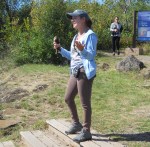
I visited Hawk Ridge again. We are now a week or two away from the peak migration numbers. This weekend, under favorable conditions, tens of thousands of broad-winged hawks may pass overhead in giant kettles.

I was there on a quiet day, but I saw a banded hawk up close and a northern harrier and we got an excellent view of a peregrine falcon coming in to swoop at the fake owl near the observatory. That falcon alone was the sighting of the trip. You only get glimpses of such a bird elsewhere as it dashes between buildings or trees. A flock of about 60 American white pelicans was also a new sight for me.

I always learn something new from the naturalists. And I went on an intense hike in the attached nature reserve through many downed aspens and flooded ravines.

In retrospect I realized it was a very frugal trip:

$2.10 for coffee for the road

$1.50 for the Sunday paper for reading and starting a campfire

$2 for a jug of water

$5 for a raffle ticket to support Hawk Ridge and win a jacket

$6 for firewood

$2.50 for a sugary Starbucks canned drink (turned out to be delicious)

$1.75 for parking at Canal Park

$2 for another coffee in downtown Duluth

$20 for a night camping at the excellent Snowflake Nordic Ski Center (if you go, choose site 10 or 11)

$23 for gas to get there and back

Total: $66

I chose a tent this time instead of the hammock. I am developing a clearer sense of the advantages and disadvantages of each shelter/sleep system.

Killing at Myre-Big Island State Park

Of all the recent brainless killings in the region, this one was personal for me because I identified with the victim, a Minnesota state park lover. As I visit state, city and regional parks this is a recurring fear of mine:

https://www.mprnews.org/story/2016/08/25/national-guard-accused-state-park-death

http://www.twincities.com/2016/09/02/man-allegedly-shot-to-death-by-guardsman-in-state-park-is-idd/

http://bringmethenews.com/2016/09/01/police-identify-man-shot-twice-in-head-at-mn-state-park/

The victim, 23 year-old Spencer Daniel Brown, was shot twice in the head by National Guard veteran David Michael Easter through the rolled-up window of a locked car door. His foot was on the brake and the car was in reverse when he was killed.

The wife of the suspect said her husband confronted the victim but that she didn’t know why. She heard the victim tell Easter to stop shining his light in his eyes. Then the young man was executed.

The details gave me chills because I’ve been in this situation before. When birding or camping solo on public land someone sees me and wants to let me know that they don’t like the look of me and that I’m not welcome there. They begin predictably at the base of the continuum of aggression, by staring. When I ignore this baboon-like hostility display, they escalate by snarling something half-intelligible such as, “The fuck’r you doin’ there, fucker?”

Recognizing this mix of aggression, suicidality and conceal-and-carry, I withdraw at this time to preserve my own life.

But it looks like the victim was doing exactly that. He was trying to escape. After killing him, David Michael Easter returned to his (you guessed it) pickup truck and called the police, claiming he shot in self-defense.

If he hadn’t killed this young park-goer, he would have eventually used the .45 caliber pistol to kill another driver in some mundane road rage incident. Or, give him 20 to 30 years and he would have shot himself in the head at some point in middle age.

It’s regrettable that because of all the armed people out there ready to explode with anger, you must withdraw at the first sign of aggression. There is no point in trying to “win” an encounter with an armed moron. Even if you have every right to be there, just disengage. Preserve your life and leave so that you can hike and camp and go birding another day.

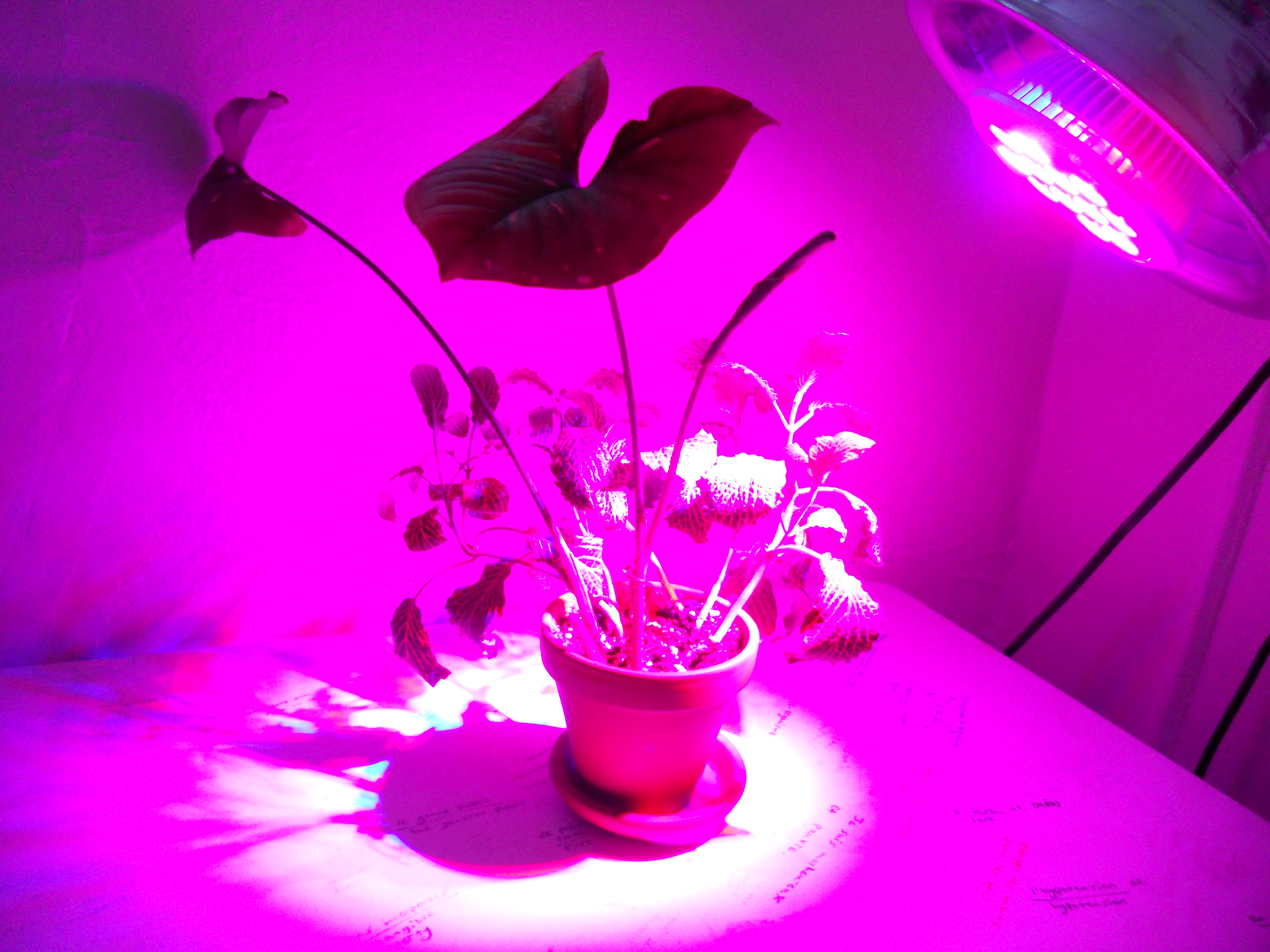
Included: I bought an LED grow light based on the claim that it can keep my houseplants perky throughout the winter. I am skeptical of this but am willing to try.

Turning away from running for fitness

​For the past four years I have run less and less, but felt fitter than ever.

From the year 2000 until 2012 I ran a lot, often every day. I thought of it as the ideal way to attain fitness. I even thought it was part of who I was. I enjoyed setting goals and having running destinations and exploring natural areas I would not otherwise reach. I remained as skinny as ever and I’m sure I benefited mentally from an intense daily workout.

However, in 2012 I got access to a gym and began to think about fitness more deliberately. I realized that while running guarantees a baseline level of fitness, adding miles to your route does not bring concomitant benefits. You simply maintain a skinny, androgynous physique, without increasing strength or ability, and while adding wear and tear to your joints.

I also think back and marvel at my cross-country running days. I recall how vomiting at the finish line of a 5 km race was seen as a mark of grit and intensity, and was not treated as a sign of a teenager’s body revolting under that kind of treatment. I wonder how many of my teammates had or developed eating disorders in that culture, a culture that rewarded mindless tenacity and self-control, instead of finesse, skill and consideration.

Nowadays I strive for a comprehensive fitness plan, of which running is only one important part among several. I run to be fit for the things I enjoy. I try to run only on grass and non-paved trails. I will run intervals in open fields and on hills. Nowadays I don’t measure a workout solely in miles, but in how it helps me meet my larger goals.

Book review: “How Music Got Free”

How Music Got Free: The End of an Industry, the Turn of the Century, and the Patient Zero of Piracy by Stephen Witt​

I got the ebook when I heard an interview with the author on a music podcast I like. The hosts were marveling at how the FBI was seeking out sophisticated cyber pirates, when in fact the music industry was being gulled by a manufacturing plant employee smuggling CD’s behind his belt buckle.

The book starts unexpectedly in Germany where some experts (now extremely wealthy experts) in psychoacoustics were developing the mp3. Through exhaustive and painstaking work they had shrunk and optimized audio files to make them storable even on the slow computers of the day.

The author follows a fascinating small town North Carolina man who smuggled the pre-release CD’s that fed the growing filesharing culture of the late 90’s and early 00’s.

The author portrays the music industry executives as clueless and slow to react to the rapidly changing times. When they finally did react, they went after people like impoverished single mother Jammie Thomas-Rasset, seeking huge punitive awards for sharing fewer than fifty songs.

I enjoy it when a book or article describes a trend in the larger world, and I see events and attitudes in my own life are recapitulated there:

– At the age of 14 I paid $18 for The Slim Shady LP. This was when hip-hop was dominant, quality was not a priority of the music industry, and they could charge whatever they wanted.

– In high school and college I created a vast collection of music through Soulseek and Kazaa. The dorm networks were the key. I honed my tastes, dove deep into music, and found out what I really loved.

– Now, almost twenty years after buying that first CD, I have music on demand through one paid streaming service and a multitude of free ones. I no longer do anything illegal, but I also have no idea how the artists get paid.

The timeline of music in my own life coincides with the changes the book describes. I’d recommend it. Some passages I highlighted:

"Despite all this, Apple’s rise to market dominance in the 2000s relied, at least initially, on acting almost like a money launderer for the spoils of Napster. If music piracy was the ’90s equivalent of experimentation with illegal drugs, then Apple had invented the vaporizer."

"From a holistic perspective, then, the digital system produced far less waste and gave consumers what they wanted far more quickly. The only problem was that it didn’t make nearly as much money."

"Lobbying from media industries had pushed commercial copyright statutes from their original 14-year terms to protections that could last for hundreds of years. This had diminished the public domain and left the majority of cultural products in the hands of just a few multinational corporations."

"Nullification was the prerogative of juries, while accepting a preponderance of evidence, to override laws they saw as unjust. This was the real reason for Chow’s not guilty verdict, and probably Cassim’s too."

"Not long ago the home audio experience had meant scratched-up vinyl on a cheap turntable, and the mobile experience had meant an AM transistor radio at the beach. The mp3 certainly sounded better than either of those. Most listeners didn’t care about quality, and the obsession with perfect sound forever was an early indicator that the music industry didn’t understand its customers."

My very first rape accusation

In Minnehaha Regional Park: woman in her late thirties confronts some black teenagers, accusing them of flashing their penises at her as they walked by. Then she starts with the belligerent nigger talk. They move on, confused and trying not to get involved. Then she starts following me, asking if I was in the military. Finally she screams that I raped her to a bunch of passersby.

Eight to ten people congregate, some of them filming me, hoping to get the rapist on camera to show to the police and upload to Youtube.

But the woman’s credibility is undermined by her not having dropped her Starbucks drink from one hand or handbag from the other despite the violent assault. Also, saying “nigger” a lot doesn’t help your credibility, so the righteous and upright people lost interest and dispersed.