Sincerity, genuineness, etc.

I was thinking about how warm and fuzzy I felt when someone called me "genuine" recently. I appreciated that. Yet like anyone I question my own motives and regret the perception, however unjustified, that other people I care about have somehow ceased to believe in me.

At the same time I happened to look up the word "maudlin" when I came across it somewhere. I ought to post the definition above my countertop so I can read it every day: maudlin. Adjective. Given to tearful or weepy sentimentality, often alcohol-induced.

Bingo.

Sentimentality, my most guilt-ridden but least consequential indulgence. It’s this stupid goddamn fall weather that makes me feel this way.

Yet these feelings can be somewhat productive as I consider a particular anniversary coming around when I think of a special person who taught me maturity, restraint, and a willingness to give other people second chances. Third and fourth chances, for that matter, just as I have graciously been given third and fourth chances.

This person taught me not to project inner turmoil onto others. To recognize faulty, irrational thinking and unproductive thought cycles and to regulate the peaks and troughs of mood. I am grateful for that.

Then I think of how I am ready to admit that I have not always been a good person. Again, the stupid fucking fall weather makes me sentimental for the past and, oddly, sentimental for events even as I experience them.

As for setting things right with people from the past, do I have to do that? Yes. No. Not necessarily. I am not in an AA program, after all.

Every day is a new chance to be a good person. If you live out the day supporting and validating others, being productive, and showing grit even if you are inwardly frustrated, then you have helped set things right with new people. You don’t have to give yourself over to guilt and regret, the very worst emotions in life. Why regret anything at the age of 26? Let’s save that for some cantankerous later stage of life when I can brood and reminisce in a comfortable worn plaid easy chair with my coffee in one hand and my Kindle in the other. And maybe my 20th pet rat sleeping in my shirt. Maybe he will be Razar II, after my very first rat.

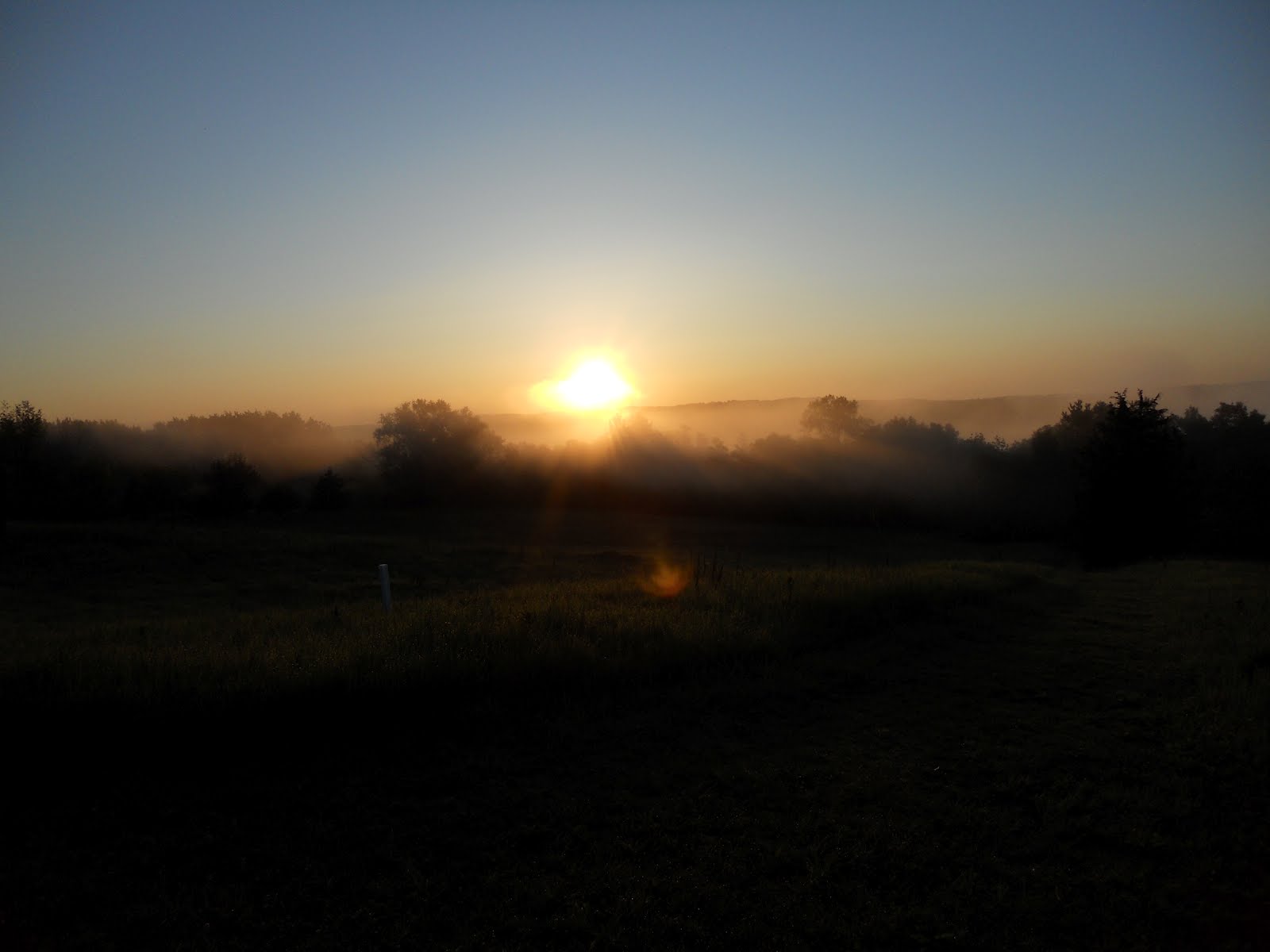
Included: Afton State Park in early June. Sun dawning resplendent over the peculiar landscape of that region of southeast Minnesota. It was just as the meadowlarks started to come out.

I LOVE NERDS !!1

At the Minnesota Ornithologists’ Union booth at the State Fair my fellow booth person was so into birds it was silly. Silly as balls. He was a gay homosexual who in addition to shopping for drapes (probably) loved to hike all the major wildlife areas in the metro. He could distinguish ten different nondescript fall warblers from thirty feet away while I would just be all, "DURR THEY’RE LITTLE BROWN JOBS." All kinds of people stopped by, including kids who loved birds, parents who loved birds, and people who knew absolutely nothing about birds but were still eager and enthusiastic to learn more. They came with photos of a mystery bird (it was obviously a green heron) and stories of birds that had haunted their yard ever since they chopped down the bird’s favorite tree. They came with backgrounds in hunting or in healthcare or in ornithology, and were all just naturally curious.

Then at Hawk Ridge in Duluth I chatted with birders who were positively tanned to hell from counting hawks for two months straight. They showed such excitement over merlins, sharp-shinned hawks, peregrine falcons, Cooper’s hawks, kestrels, etc. that I felt like they were my people and I had finally found them.

Included: those beautiful, beautiful people (though at the time they were swarming with bird parasites) and me at Snowflake in Duluth.

Fall weather creeping in

A glorious run in Theodore Wirth park today. The temperature was 70 or 75 F, the air was dry, and I basically had the place to myself. Although it still feels pretty warm, I could see many leaves were already changing to yellow, and a lot of the underbrush is drying up and turning brown. The growing season is apparently over. The wildlife was silent or had absconded, except for traces such as a decapitated mouse I found in the middle of the trail. Maybe an owl took its head off the previous night. I broke in a new pair of running shoes, stopped to look at a small creek, listened to a neat podcast. It was perfect.

I feel silly admitting that this run was inspired when I picked up a copy of "Trail Runner" magazine. These lifestyle magazines draw you in with glossy pictures and make you feel like part of the "trail running community" as if there were such a thing. Then they hawk space-age shoes and other gear. If I donned all the recommended gear I would be carrying an extra 20 pounds and would probably get struck by lightning. But I like the magazine anyway, and it makes me want to run more. I am grateful for that.

I took it easy on the dirt trail and thought about the fall season. This is the season where I feel most acutely the passage of time. I can’t help but be sentimental.

This has always been the season that brings the school year. It necessitates adapting to the cold and finding all that stashed winter clothing of mine. Taking my comforter out of my closet and sleeping in a warm mummy-like shell and breathing the cold air of my bedroom. I think about Thanksgiving and Christmas and the cross-country ski trails and whether we will get enough snow. I think about the full moon over the snow. Hawkwatching at Hawk Ridge in temperatures fifteen degrees cooler than here in Minneapolis. Listening for great horned owls on evening hikes. The late-afternoon sunset. The changes in my body: cravings for sugary foods and hot, fatty dishes with cheese and pasta and potatoes. Pulling on thermal underwear in the morning. Taking extraordinary measures just to keep the blood flowing to my hands and feet. The Leonid meteor shower.

It’s a good time to think about the changing seasons and how best to welcome autumn. I definitely will want to be outside every day to take notice of all the little changes.

Mentorship

What’s my problem?

I have many, actually, but I figured out a major one: as an adolescent and young adult I never established a mentor/mentee relationship with an adult.

There were plenty of teachers, professors and professionals I looked up to but I was just too distant or uninvolved with them, even when one or two of them deliberately reached out to me.

I used a "flaw-O-matic" as if they were used cars, where a single perceived flaw made ignoring them seem justified. "He’s too religious," "Her research is murky and inconsequential," "He doesn’t like me anyway."

Perhaps contributing to this tendency of mine is the fact that someone I love a great deal, a very important and influential person in my life, has a severe flaw (in my eyes) that adds a harmful element of contradiction to my admiration for him. Looking up to a person who nonetheless has beliefs antithetical to my own may have confused me during my transition to adulthood, when beliefs and worldviews became ever more important to me.

I am unjustifiably suspicious sometimes, too, even while recognizing that there are so many great educators and professionals out there. Some of them I have simply admired from afar, not revealing in conversation that I had googled them, read their published papers, read news articles that quoted them, asked others what they thought of them, put in extra effort to impress them, etc.

Yet mentorship is so important. It is how you set your course, how you determine who you want to be.

Acknowledging all this, I resolve to be more deliberate about seeking guidance from an older adult or two whom I respect. I take my familiar yellow legal pad, which is the seeding-ground of my ideas and promises, before me. I write down my plan and date it in black ink.

Later I can look at it and say, undeniably, that I wrote that and made a promise to myself on that day, undeniably because I can read it there. I write it down, and I follow it.

Three blind men

I had a parable-like experience but it had no lesson and no obvious meaning. If I were a pastor I would write a sermon about it:

I walked up to my apartment building and found two men struggling to get a huge couch through the front entrance and up the stairs. One of them shouted, "A little help here?!" I assumed he was talking to me so I rushed to help.

They were going about it all wrong so when the couch inevitably got stuck I told them they should rotate the thing so that it had a chance of getting around the first corner of several. They didn’t seem to take my advice or acknowledge it. Another guy walked over to help. This third man had a white cane. He tried to help, too, but the whole endeavor was going nowhere. My suspicions grew.

Finally an older lady walked up and whispered to me, "All three of them are blind." She then gave them the same advice I did about rotating the couch, but she was more explicit about how they had to do it. Eventually they got it in.

I knew there were two institutes for blind people a block from me where advocacy and training goes on for people who cannot see. They often practice walking around in my neighborhood, very considerately wearing the sunglasses and white cane that reduce the chance of misunderstandings. But I had no way of knowing that the two men struggling with the couch were blind. When I see them around the building, of course, I will know to offer assistance if appropriate. But this particular instance was unexpected.

Again, it was a "three blind men" parable but with no clear moral. Except perhaps to be ready for the unexpected.

Cashier at Target

When I was in line at Target for some household items the lady in front of me was making small talk with the cashier, a man. She asked if he had any kids. He was smiling, saying how he had one daughter, and she was turning 18 in three weeks. He said he couldn’t wait to “have her outta my hair.” He said he already knew the three words he was going to say to her (I didn’t want to know what they were). He said that once she was 18 he would never have to see her and never have to pay a child support payment again.

I was disgusted. When I turned 18, my parents were driving me to college, paying my cell phone bill, paying for me to fly to visit them, etc. Their devotion to me had undergone no change just because I was an adult. Rather they continued supporting me in ways consistent with the trend of “emerging adulthood” in which the major transitions of early adulthood are spread throughout the third decade of life instead of being more compressed in the early and mid-twenties as they were in the past. My parents still support me in some ways and always will.

So why do some parents, mostly men, feel virtually no obligation to their children while others are completely devoted and responsible? Why do some people act like they are a turtle burying an egg, while others nurture and support their offspring like a mother duck? Why are some parents like maple trees, throwing their whirlybirds into the wind, while other plants produce a single giant seed with a decent chance of survival?

Even if my cashier was immature and ignorant 18 years ago, couldn’t he have taken the next two decades to grow up? Wasn’t there time to change and become friends with his daughter?

I wanted to say, “It’s too bad she couldn’t have had a better father than you.” But of course I didn’t because I knew I was making several assumptions. Maybe the daughter really was a she-devil. Maybe I was taking him as a symbol of a societal problem and imputing other attributes to him in a way that wasn’t fair. Maybe he is pushed and pulled by societal factors that don’t affect me. Maybe his own father was little more than a sperm donor, too.

But looking at other people it’s obvious that there is a huge gap in the depth and duration of parental investment among people in this country. I am really lucky my own parents were determined to be a strong link in the chain of generations.

Some recent reading

Sun 22 Jul 2012

I read “Alone Together: Why We Expect More from Technology and Less from Each Other” by Sherry Turkle, a sociologist of technology at MIT. I read it entirely on my Kindle, a device I love.

The subtitle pretty much sums up the book. It is very well-researched and never goes more than a page without material from actual interviews and studies. I appreciate that. The trends she points out are real: people learning to depend not on others, but on technology instead. And because of her vantage point inside the epicenter of robotics research – the MIT campus – she revealed to me how close robotic companions really are. I had not thought about how advanced robots are, but apparently consumer robots will be all over the place soon enough.

I agree with her that people are disconnected and adrift in some ways. But at the same time, people use the internet more and more to gratify the most ancient social impulses. The most popular sites are ones where people can check in and look at recent pictures of friends and relatives, and join discussions and commentaries on things that matter to them. So far most people are not hooked up to screens in dark rooms 24 hours a day, and I doubt that time will ever come. The author betrays again and again the belief that a phone call is better than an email, a walk in the park is better than a movie at home, an hour reading a book is better than an hour of web browsing, and so on. In addition, innocent comments from children are sometimes the cue for a long brooding commentary about how young children think about technology differently since they were born into it. But more often the children are simply committing the errors in thought that are common in their developmental stage. Piaget, who also studied children’s statements, is cited in the book and was shown by later research to have made some of the same mistakes of over-analyzing child-like thought.

I also am irritated by the constant use of “we” as in, “We pour our personal information out online. We edit and revise our online profiles” (not an actual quote). “We” is not a real group and by it the author seems to mean the highly educated lawyers, academics, professionals and their children that she quotes throughout the book. She also uses an anecdote about her hospitalization to discuss how sad it would be if the “human touch” were lost. But again she is showing privilege blindness. She is a respected professor at MIT in the city (Boston) with perhaps the best hospitals in the country. If robotic health services are near, they will benefit the people who don’t have access to health care in the first place. Poor people who need basic services are not as concerned about the human touch. What they need is real treatment, whether it is human or robotic.

In addition the author has extreme ethical misgivings about entrusting the care of the elderly to robots. But it seems to me that every one of these problems was already addressed when as a society Americans began to pay people to care for their grandparents in nursing homes and assisted living facilities instead of caring for them at home. The ethical problems of paying a person for elder care are virtually the same as the ethical problems of assigning robots to do elder care.

I also agree with the author that the promise of the internet has to some extent not been realized and that a “connection” is not the same as a relationship. I would highly recommend this book. I am grateful to anyone who encourages me to be deliberate and skeptical in the way I use technology. I only criticize certain points because it got me thinking so hard.

I picked up “The Letters of Ernest Hemingway, 1907-1922” because I want to have better and more correspondence. I saw that my grandma, with her failing memory, was comforted by reading and re-reading letters from my grandpa (dead for 24 years). Some day when I am old and infirm I doubt I will enjoy clicking through old emails as a way of reminiscing. I want actual letters and postcards from loved ones. And to get them I have to first send them out myself.

I had no idea the old brute, as he was called, had killed himself. In fact he blew out his brain with a shotgun. I have only read one short story by him and would like to continue with him by reading “The Sun Also Rises.” I am not sure whether I will like his writing but his letters as a young man are certainly entertaining. I realize his incredible biography is part of his appeal. There is a picture of him on the cover as a dashing 18 year-old in uniform.

I got “On the Road” by Jack Kerouac, also for my Kindle. I was not impressed. I could not read the whole thing, especially when I realized the story included not one, but two trips west, followed by a trip to Mexico. Maybe as a teenager I would have taken this book as gospel, as an inspiring promise of the possibilities of this great continent. But now it seems to me to be a gushing, stream-of-consciousness account of several unsympathetic characters, including the author. Sal’s adventures seemed somewhat hollow for reasons I can’t quite explain.

However, I worry that my reaction to the book was influenced by a sharply critical comment I read somewhere that went, “The cruelest thing you can do to Kerouac is to re-read him at 30 years old.” I fear that this may have made me overly critical of the book. The same thing happened with the band “My Morning Jacket.” I listened to an album of theirs and thought, “These guys are great! Why didn’t someone tell me about them!?” Then I read a review from a trusted rock critic who totally trashed them for reasons I couldn’t quite understand. He seemed to deny their very legitimacy as a band. And sure enough, when I listened to the album again, I did not like it as much. In both cases a critic may have undermined my enjoyment of art. A funny thing.

Fortunately if I want to read Beat literature, there are plenty of other authors to try.

Lastly, I just started “The Mysteries of Pittsburgh” by Michael Chabon because it was recommended in a list of novels for the emerging adult. Again it is on my Kindle. I discovered that as long as I do not log into the wifi, I can take as long as I need to finish a book even though the lending period from the library has ended. I like it so far. After all, I need a book that ridicules my overwrought wistfulness and sentimentality.

Journal Fri 16 Dec 2011

We have an excellent movie critic in the town in the person of Colin Covert. I stopped in Dunn Bros after leaving work this morning and read the Star Tribune while having my poppy seed muffin and coffee and warming up near the gas stove they have in the middle of the room. I walked in quite cold in the hands but left with sweat forming on my back.

Anyway in the review I read, Covert described Robert Downey Jr as Sherlock Holmes as “projecting both condescension and charm.” But when he encountered a rare equal such as Professor Moriarty, he became careful and methodical, “stepping up his game,” to use a phrase I do not like. (Perhaps distasteful phrases persist because of their usefulness, not their appeal.)

I confess I wish I could “project both condescension and charm” as Holmes does, and get away with it. But you have to be really smart and talented to do so, like Dr House from the TV show, who is based on Sherlock Holmes.

But then again, these are two fictional characters. In real life you cannot get away with it. In real life people notice when you are insincere or when you look down on them or are sloppy with feelings. Condescension actually negates charm, turns people against you, blocks them off from you. Doors close, you become isolated, et cetera. It is fun to watch such a confident, rogue genius on TV. But I will resist the temptation to emulate them because I know the people I really admire, actual people such as Charles Darwin, were modest, self-doubting and careful. These qualities are important in any scientific, medical or criminal investigator.

My gym has re-opened

Finally. And there was much rejoicing. By me. At the opening we had pizza and beer with the staff. When I signed my lease, it included free access to a gym. Then they took away the gym without lowering the rent. Now the gym is back and I am going to get some MONSTER TRAPS. I also want to be able to do that thing where you make grotesque ripples across your pecs at will.

But seriously, I have been thin all my life and it would be nice to have some muscles for once. I like fitness in general because it is the one area in my life where specific efforts are rewarded with specific results. Progress is natural and occurs in discrete parts. You do what the experts say and you get rewarded. You can even choose among experts and their varied advice. You can mix and match advice, using skepticism and critical thinking. Using previous knowledge, you can evaluate the evidence and decide whether to rely on the lore of fitness or the high-quality, controlled trials with an experimental design. You can trust a former elite athlete who later wrote a book (not ideal), or you can trust the research coming out of universities and exercise scientists. You can choose exercises that fit your life and your special concerns about your heart or your lower back, your endurance, your weight problem, et cetera.

Personally I just want to be fit enough to continue doing the things I already like to do, especially biking, camping, urban exploring, tree climbing, ultimate frisbee, and so on. And it wouldn’t hurt to balance out any excess right arm strength that may have resulted from my, um, lifestyle.

I have even been using the elliptical, a machine I previously thought was only for ladies. It shows you your wattage. I find I can comfortably put out 170 W for ten minutes or so. Watching the wattage fluctuate with effort is not discouraging like watching the "calories burned" meter. Putting out ten minutes of effort only to realize you have "burned" a handful of peanuts is not a fun realization.

Engaging with people as individuals

I made buttons with a bunch of people for the effort to defeat the anti-gay marriage amendment and voter ID amendment this November. They are to be distributed at the Pride Festival next weekend. I was with several people who don’t fit neatly into boxes: there was no telling whether they were gay, lesbian, straight, closeted, or in any of the varying stages of trans-sexuality.

And I thought about how, when people’s roles are fluid and not conventionally defined, you have to engage them as individuals. Your interaction with them is thereby enriched. "Scripts" are abandoned and new possibilities emerge, often beyond expectation.

There is a lot to learn from having a decent conversation with someone who is different from you. Yet people sometimes let their curiosity lead them into rudeness by, for instance, asking a foreigner, "What are you?" and giving them the uncomfortable impression that their features are being studied. In the same vein it is not okay to walk up to a person and say "Hola!" just because he or she appears Hispanic.

The people at this little button-making workshop were very different, but we were all similar in the belief that the right to vote and the right to marry are connected, and both of these issues are on the ballot in the upcoming state constitutional vote this November.