I used to watch beheadings out of morbid interest. Now, I cry over sad spousal testimony.

I remark on an emotional evolution in me. I have become less reactive and more responsive. I am ambivalent about gory videos.

Watching human carnage on BestGore.com

I used to consume the worst of the worst gore on this site. Almost daily (but not obsessively) I would watch the latest atrocities in graphic detail on my laptop. I watched beheadings by the Islamic State, chainsaw executions by Mexican cartels, mob lynchings in Africa, and sloppy live dismemberments by Brazilians in the forests on the edge of poor jungle towns.

It must have given me a thrill, as much as my stomach sometimes churned. But I also thought I was confronting a hidden truth of humanity head on, a truth that was often glossed over in traditional media. I may have always had an interest in the dark corners of the internet. I recall going to the Wikipedia page about “shock sites” and visiting every single one when I was far too young to be doing so.

The curation and comments on bestgore.com also had an ideological bent. The man who ran the site had a consistent anti-government voice. He had been prosecuted in Canadian courts for no other reason than that he embarrassed the state by exposing the sick serial killers and rapists that operated within the borders. This included Luka Magnotta. He had fringe views against state control. He was racist and misogynistic and eventually left to live in isolation in the Caribbean.

He opposed police brutality and excessive state powers long before the Black Lives Matter movement arose and made the same arguments. Many videos were of police killings of civilians. I would sometimes compare news media coverage of the police killing with the graphic video on the site and see that the media omitted or obscured key facts that were evident in the video.

The gore website runner opposed censorship of all kinds, including the sudden and total process of de-platforming, where his advertisers withdrew, his hosting service no longer allowed the content, and the search engines cut him off.

The comments section was something else. Mostly racist, dumb and voyeuristic, but also a community that critiqued the videos and sometimes shared stories and images of their own self harm and gory accidents. I felt that although I would never want to meet these people, they were right to face awful aspects of life head on, without removing bits of the truth before it can reach the next person.

The commenters ranked videos in brutality. They pointed out, correctly, that the routine violence in Mexico and Central America was worse and occurred on a much larger scale than the geographically limited and temporary Islamic State uprising from the mid-2010s.

The popular press would never display the true brutality that’s out there. Dozens of faceless editors and gatekeepers and third parties intervene to prevent the end user from seeing the full picture. On bestgore.com, you could watch a 15 minute video of Guatemalan drug dealers flaying the facial skin of an enemy and torturing him with boiling water and knives to the eyeballs and throat before killing him. The New York Times might call this “drug-related violence.” Which does not exactly capture the experience of the victim. The readers and viewers of the popular press would rather look away or think about issues abstractly.

One journalist did try to understand the site’s users but gave an insightful but incomplete picture. A true ethnography conducted by a sociologist might have done it justice.

Video testimony of a Ukrainian woman whose husband was killed

I never shed a tear when watching all this. I would watch with detachment and note how fucked up some of humanity is.

But today I opened a few YouTube tabs and found myself unexpectedly crying when I watched this woman describe finding out her husband was dead in a town outside Kyiv, Ukraine.

She said her husband was missing for a couple of days. She searched. She went to a humanitarian facility and they pointed to two bodies. As she neared, she recognized his clothes. The body was that of her husband. He had been tortured and killed by Russian troops as they retreated. She said his face was mutilated and his body was cold.

She wept as she offered to show the journalists his grave, dug three feet deep in an improvised muddy spot, “so the dogs won’t get him.”

I cried and cried over this woman and her story. In my other tabs were dumb movie previews and personal development topics. I went for a walk to get away from it and the tears kept welling up. The rest of the Ukraine video included civilians who were shot while riding bikes or lined up in suburban locales with their hands bound.

I am glad for my inner changes and glad I once watched those awful videos

Thanks to some work and study, I am a more emotionally responsive person. I no longer view my emotions or those of others as a burden. At the same time, I am less emotionally reactive. I don’t feel pushed and pulled by external events like I used to be.

I think if bestgore.com still operated, I would visit occasionally to check out the worst of the worst. I don’t want to look away. But videos there focused on graphic detail of the atrocities themselves. The victims who underwent unspeakable tortures were almost all male. The more impactful and wrenching video would have been an interview with a survivor (typically a woman) who did not undergo torture and execution. Yet one’s heart goes out to her, not him.

Now, when rfi.fr mentions “violence in Congo’s east,” I have an image of what this means. Sometimes it means a public “necklacing” where a mob places a burning tire around a victim’s neck. Or it means an entire village is bludgeoned and massacred with garden tools. I don’t just skip past this mundane language.

The Ukraine video also had images of a man on a bike who was killed and left there in the street. This one was piercingly sad for me because I related to it. I thought of myself on a bike, killed while going about my day. The news outlet published the video of his back but not his face. Would it have motivated more international outrage if they had shown his gray, dead face? If I were the victim, would I want my dead, contorted face published, if it meant more intervention from abroad? Or would I consider it exploitation and indecent journalistic liberties with a corpse?

I thought of a Ukrainian music group I saw perform in Portland. I even sat next to one of them on a plane before their show. They started as street performers in Kyiv. I wondered where the six of them went. Would I tolerate seeing their dead bodies in a gory video that provokes outrage? Or just in a sanitized version that provokes concern?

I think if more Americans watched videos of Central American violence, they would be more receptive to asylum requests from migrants fleeing gang violence (not a traditional asylum category).

I think if people watched videos of the carnage that follows the daily car wrecks you read about in the news, they would advocate for lower speed limits and safer design of roadways. They would also be less likely to drive while drunk.

If bestgore.com was still operating, the videos might have prompted more decisive action to stop the carnage. Perhaps people could see what’s going on without so many filters.

I don’t want to ever look away and deny what’s happening out there. I feel I’m still looking at the truth head-on without leering at it. Some people will experience legitimate trauma from this kind of content. Perhaps they should still watch it and make an effort to understand their response.

Infant genital cutting and innate human fears

I oppose genital cutting of infants in the absence of medical need because it is a cultural practice that violates the universal human rights to autonomy and bodily integrity. These are reasons enough to oppose this barbaric and disgusting custom.

But these are relatively abstract ethical values. They make you think but they don’t engage the emotions. A parent can easily disregard a seemingly remote value such as “autonomy” when a team of nurses and doctors pressures them to believe that circumcision is “just something you do” to a baby boy.

Recently I came across yet another to reason to oppose it, a reason that gets at the heart of what’s human and that struck me as piercingly sad: cutting the genitals of an infant violates two of the five innate fears that all humans share.

Five basic fears

An article puts the science in clear terms: all humans have a fear of extinction (ceasing to exist), mutilation, loss of autonomy, separation, and ego-death.

Infant genital cutting violates and triggers two of these fears: mutilation and loss of autonomy.

“Mutilation—the fear of losing any part of our precious bodily structure; the thought of having our body’s boundaries invaded, or of losing the integrity of any organ, body part, or natural function.

Loss of Autonomy—the fear of being immobilized, paralyzed, restricted, enveloped, overwhelmed, entrapped, imprisoned, smothered, or otherwise controlled by circumstances beyond our control.”

Search online for the Circumstraint Board (pictured) and tell me if an infant strapped into this device would feel a loss of autonomy on some unconscious level. And of course, this device is designed for routine mutilation.

What led me to google innate fears

I was watching the excellent, compassionate and wise Thaïs Gibson in an effort to understand patterns in my past. She mentioned matter-of-factly that there is only a small number of biological fears.

I wanted to understand my attachment style in relationships. Based on my past I think I lean moderately toward dismissive avoidant. Interestingly, a person with this attachment style values autonomy and independence and sometimes zealously defends that independence, to the point of cutting off relationships that might threaten it, in reality or in the imagination. She also said that people with a dismissive avoidant attachment style can be living in a fight-or-flight mode throughout much of their lives.

I looked back and pictured myself strapped down to a board like the Circumstraint, tiny, helpless, and then having part of my penis cut off needlessly, and then requiring weeks of healing, and then developing scar tissue that would last for a lifetime. I had in fact just emerged from days in an incubator thanks to my mom’s gestational diabetes and was a weak and vulnerable life form that was not ready for further cutting, bleeding and pain.

This early experience would contribute to the sense that you cannot rely on others. It would trigger the fear of a loss of autonomy and of mutilation. This in turn would lead to a dismissive avoidant attachment style, where you fight to defend autonomy. And then to a strident defense of autonomy as a biomedical ethical principle.

But it all goes back to the small infant fearing mutilation and loss of control over what is done to one’s body, like any human would.

More reasons to oppose genital cutting of infant boys

· It is not your body to cut

· Infants regularly die from this

· Many procedures are botched (google “botched circumcision” and prepare to be shocked by penile amputations, extremely tight cuts, and doctors who hide and deny their streak of crimes)

· The rate of infant circumcision is declining everywhere and so circumcised boys will soon be in the minority in the US and globally

· The custom was popularized in the US as a way to destroy sexual pleasure because masturbation was considered evil

· It reduces sexual sensation

· Anyone is legally allowed to circumcise an infant boy in the US regardless of medical training, which indicates its cultural nature as opposed to medical

· Circumcised men experience more sexual dysfunction than intact men

· The shocking practice of oral suction circumcision by Jewish witch doctors is tolerated in New York City and New Jersey and has led to infant deaths from fulminant herpes virus infections

· Just take a look at the Circumstraint and picture your baby boy strapped into it for an unneeded genital cutting ritual

Today’s mindfulness class

Each week I participate in a free mindfulness class run by an anxiety clinic. It’s a wholesome practice and it’s part of my commitment to mental wellness and knowledge and mastery of the mind. I also do it because I started it and simply because I said so. I follow a mindfulness app run by a neuroscientist (this helped break down my skepticism of this whole realm) and my aspiration is for my practice not to be totally solo.

I like the idea of a “depth year” where you go deeper into your existing interests and pursuits while ignoring the many new things that pop up. For me this means re-reading old but treasured books I own, declining new physical and digital acquisitions and subscriptions, and overall doing a smaller number of highly valued activities more regularly.

A difficult emotion exercise

After a 20 minute meditation focusing on the breath we started a guided meditation where we confronted a difficult situation or feeling. Everyone walks around with some problem dogging their steps in their daily life like a shadow. When you sit in stillness with your eyes closed, it’s suddenly right in front of you, showing itself in new ways.

Upon prompting I thought about a problem I’ve been avoiding. My thoughts about it are painful not because of the thing in itself, but because of my mind’s recriminations toward me for avoiding it. And my mind’s automatic, mostly baseless, implication of the “kind of person I am” for avoiding this thing that I think I should be confronting. So much hurt and self-blame flows not from what you have done, but from what you think what you have done says about who you are, and about your identity.

During the meditation our guide gently instructed us to place a compassionate hand on ourselves. Perhaps a hand over the heart. Or two hands over our shoulders. I hesitated. I decided to skip that. No one would know, after all, since our eyes are all closed. But I gave in and put a hand over my heart in a physical gesture of compassion toward myself.

And it felt good. I immediately felt the warmth through my shirt. Then a feeling of its significance followed the physical sensation. The thought that I miss touch occurred to me. Then emotion about this lack followed. Then more thoughts about my ambivalent attitude toward touch (I would never let a priest or religious figure touch me in some dumb ceremony, and I tend to avoid demonstrative displays with family. Yet something is missing).

The next part was also uncomfortable: saying “I love you” to yourself. The guide did not make us say it out loud (I might have balked). But still. This discomfort made me grapple with the idea that I lack self-esteem, which I always thought I had in abundance. But I tend to “cite” points that show I have not lived up to this or that exacting standard that I “should” be meeting effortlessly.

All in all this was a whopper of a mindfulness exercise and I think I would not have been impacted so much if we three (me, the guide, and one other consistent participant) had not created a circle of trust and habituation that led us to explore emotion and psyche in a space like this.

Poem about tending a garden

The guide shared a poem written by a monk about tending a garden he had inherited where some trees were dying and some were thriving. The dying ones did not destroy the garden, but in a way enhanced it. Tending the garden closely and effortfully had its rewards. And letting growth run rampant and lead to a state of elegant decay also had its rewards.

We talked and related this to ourselves and our own lives where we tend to a garden of our own experiences, some of them running riot and some being chopped down or shaped effortfully. The overall garden changes, sometimes for the better and sometimes for the worse, and sometimes in ways that can’t be called good or bad. And its overall quality does not depend on an individual tree or even on the gardener.

The author of the poem, sadly, had recently died.

Other participant

There is another guy who has been there every time. I do observe him and I wonder what brought him there. I sometimes see him stroking his thighs and stretching a lot, perhaps as a self-soothing behavior. He has a tendency to ramble instead of bringing his comments to a crisp close. But his comments are cogent and appropriate and today he disclosed a lack of “authenticity” when he extended compassion to himself. Which was a specific and personal way of putting it. Interestingly, seeing his fidgeting helps me to practice stillness and avoid moving about like that in a way that suggests discomfort or a desire to be elsewhere. But we seldom talk about diagnostic labels. We are there as part of a shared pursuit looking at core problems of the mind head on.

The guide

Our guide is a smart young woman with dark hair, bangs and a ponytail. The bangs are not tidy and one or two wisps of hair are often askew across her forehead. She has a gentle voice and gentle eyes (I’ve never seen her full face because we’re all masked). I noticed that the poems she shares are hand written in her notebook instead of being read from a phone. Today she wore more color instead of her all black like usual (I sometimes suspect a person who wears all black, every day, is going through a phase and is therefore impressionable). She is thin and sits cross legged or neutrally in a chair with stillness and poise. She guides us with subtlety and attentiveness. I believe she has an advanced degree in psychology and must do some interning before practicing independently.

Where do I get a woman like this? I think I follow the traditionally female pattern of being quite taken with (falling for) someone of the opposite gender who displays elan and effectiveness within their domain. This might be because of repeated exposure to this person in a fairly intimate setting.

My show and tell item: a photo from my walk there this morning

I walked two miles from my North Beacon Hill neighborhood to downtown Seattle to join the group today. I saw many things, including a huge dead rat in the middle of the sidewalk with its tail halfway bitten off, a crow bowing its head like a knight to prompt its companion to preen it on the middle of its upper back, and a blazing sun turning to moderate rain and back again.

But the thing that caught my eye was a sticker on the bridge over the highway that said, “YOU ARE THINKING ABOUT THIS RIGHT NOW.”

The sticker was correct, I was thinking about it. I thought of the hundreds or thousands of people who walked by that sticker and thought of it, just as the sticker said. I shared this photo to continue some of the discussion we had had on how even an inanimate object can command one’s attention and hold it, especially if you do not practice awareness. An object can do this and so can an event, a careless word, a crazy shouting homeless person, a thought, memory, feeling or sensation. Attention can be scattered, diffused and misdirected without the choice of any one self. Awareness of where attention is directed and of thought itself brings one back.

More Seattle fun

I love this city. I moved here at the beginning of February. Each day since, I have found some small joy that reinforces my conviction that I made the right choice.

Art crawl in the Georgetown arts district

Each month the many galleries and studios in this compact brick industrial area open their doors and let you see how they make great stuff.

An artist named Nicola Beeson created the below bird/lettering/flower piece. It seems like it was crafted to go after my heart, with a barn owl and everything.

I checked out the studios and also caught a performance. A Tacoma heavy shoegaze (?) band played and I took in the vibes while enjoying the smiles I can now see thanks to the lifting of the mask mandate.

Active nature restoration

On my first visit to the city as a tourist I stumbled across lovely Expedia Beach and biked through it. When I moved here I reached it on foot and was stunned at what I saw. It’s so goddamn nice. This beach was profiled today as part of a trend of actively restoring nature:

“For cities, restored nature helps increase equitable access to parks, something they can’t address as aggressively as they would like without private support. Coastal parks help make waterfronts less susceptible to rising water and storm surges.”

And:

“The same change is expected at the Expedia campus. As perennials and beehives slowly establish themselves, the environment will begin to stabilize, and a large section of the campus will become self-maintaining, if not self-sustaining.”

In Seattle I stumble into beautiful places a lot.

Dynamic weather

I keep waiting for the vile weather people warned me about. But almost every day has been nice. I am accustomed to the stagnant, polluted, lingering gray of a certain large Oregon city. But in Seattle, as a running partner explained to me, the weather coming in over Puget Sound changes fast. Even rainy gray days are punctuated by occasional sun. And I am often out there to catch it.

The one recent exception was when an “atmospheric river” arrived and dropped moderate rain for many hours. And I had to drive in it. But this week another atmospheric river was forecast, and the NWS weather page looked gloomy and gray, but the days were pleasant and mostly dry. There is some kind of disconnect between the wet forecast and the dry days I am seeing.

Birding and enjoying nature in Seward Park

Some nature observations

Sadly one of those turtles I found sunning themselves in shallow water turned out to be dead. Others of its kind are doing OK and I see them on sunny days.

A hundred or more coots are gathered in a dense flock every day offshore.

Several great blue herons stand much of the day on a dock. Some of them spook when a bald eagle comes by.

Varied thrushes, Anna’s hummingbirds, spotted towhees, and a number of mergansers, goldeneyes and grebes are there every day. Today I saw a grebe with a huge catfish that I think will satisfy him for the day (if he managed to swallow it).

A group of elusive (to me) otters lives there and I will keep my eye out for them and see them eventually.

A visual and emotional association with music

I was watching those herons the other day while reading my book and listening to my little bluetooth speaker. There was a moment when one of the great birds squawked (a very hoarse, deep, guttural call). It was raising the alarm that a bald eagle was swooping in too close.

I looked up and realized that several other herons were perched in a doug fir nearby. I had not noticed them because the dense firs looked almost black against the sky and hid the herons. The huge birds left their branches and circled and swooped until the eagle left. I looked up at this spectacle just as Rachmaninoff’s piano concerto #2 was swelling darkly and intensely and then taking an airy and light turn. And it happened just as I looked up after a long period with my head down, face in the book.

And I thought to myself how this moment was perfect and could not be replicated. Yet there are many more to come, and they seem to happen every day in this new city, where I am engaged with life and very happy.

I’m giving up on “A Little Life” by Hanya Yanagihara

When do you put a novel down, and when do you continue despite not liking it?

I put down “A Little Life” after reading one quarter of it. I picked it up after I found it highly recommended by New York Times readers and critics in a best-of list.

The blurb that drew me in went like this:

“At the core of this gutting novel about four male college friends is a heart-wrenching question: Can a person ever recover from unspeakable trauma? The story focuses most intensely on Jude, a lawyer who has suffered a string of horrific events.”

I should have taken the blurb seriously. Why would I sign up to be “gutted?”

I slogged through the first parts that introduced child molestation and hinted at more child molestation, rape and torture to follow. I then found out what else was in store from an article:

“Trauma theory finds its exemplary novelistic incarnation in Hanya Yanagihara’s “A Little Life” (2015), which centers on one of the most accursed characters to ever darken a page. Jude, evidently named for the patron saint of lost causes, was abandoned as an infant. He endures—among other horrors—rape by priests; forced prostitution as a boy; torture and attempted murder by a man who kidnaps him; battery and attempted murder by a lover; the amputation of both legs. He is a man of ambiguous race, without desires, near-mute where his history is concerned—“post-sexual, post-racial, post-identity, post-past,” a friend teases him. “The post-man, Jude the Postman.” The reader completes the list: Jude the Post-Traumatic.”

For me, the article the above quote came from was more worthwhile than the book. It criticized the “trauma plot”:

“The trauma plot flattens, distorts, reduces character to symptom, and, in turn, instructs and insists upon its moral authority. The solace of its simplicity comes at no little cost. It disregards what we know and asks that we forget it, too—forget about the pleasures of not knowing, about the unscripted dimensions of suffering, about the odd angularities of personality, and, above all, about the allure and necessity of a well-placed sea urchin.”

Again, why read this? I look back on another novel focused on abuse and victimization, “The God of Small Things,” which featured child molestation, but also police torture, incest, spousal abuse, inter-cast violence, murder, and so on. But that novel had the virtue of being much shorter.

About the photo

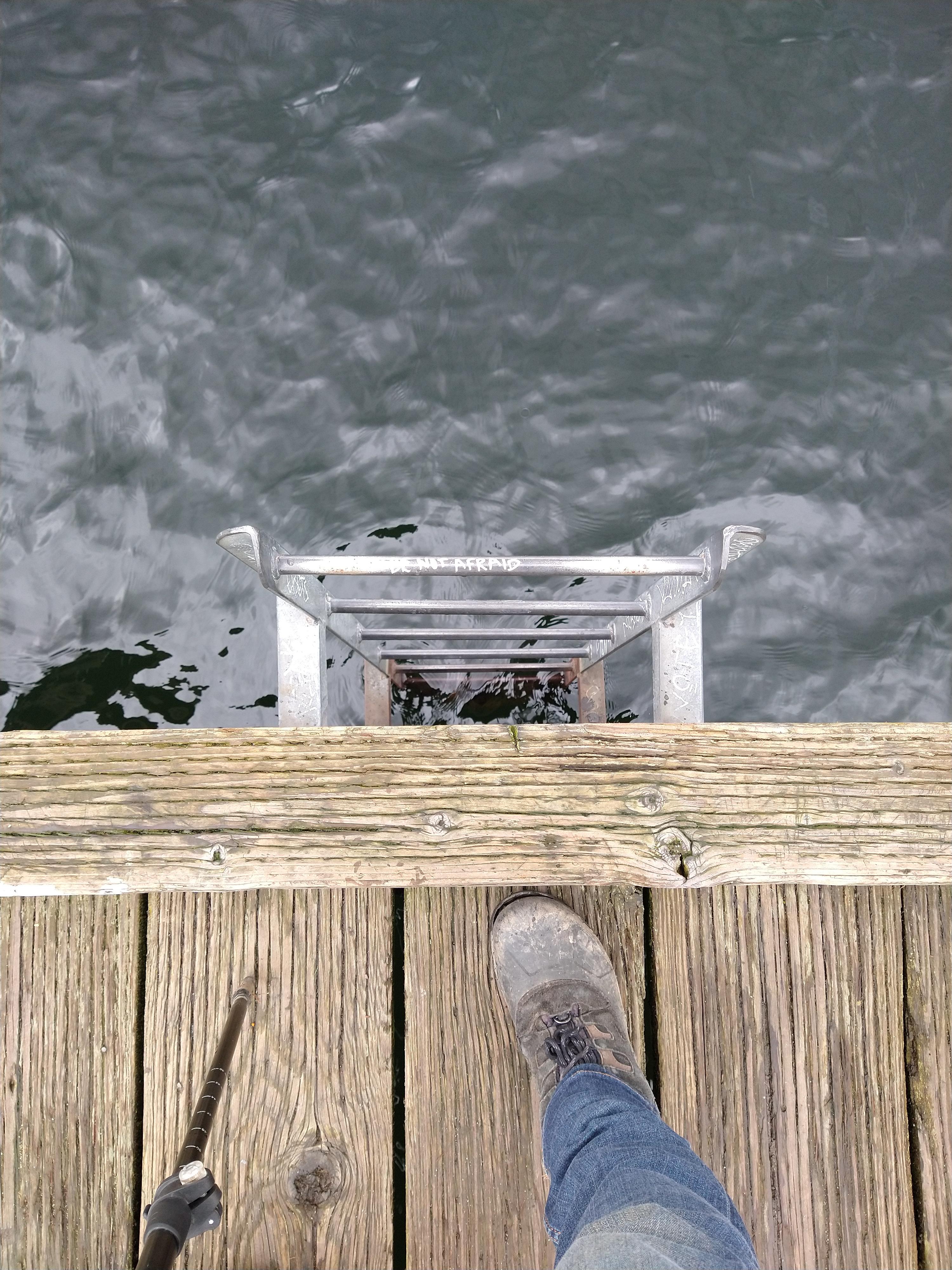
“Be not afraid” written on a ladder on a dock on Lake Washington, Seattle

Seattle anxiety specialists meditation class

I joined a mindfulness meditation group put on by an anxiety clinic. The clinic itself seems to be overwhelmed with demand for psychotherapy. But this free weekly class only has one or two participants. This suggests an underutilized path to getting the help and connection that people need so badly nowadays.

The leader

The leader is a smart, gentle psychology intern. She welcomes you in and offers tea. She reminds me of the hosts of the Anxiety Slayer podcast: calm and methodical, and ready to bring precise tools to bear in cutting off the head of anxiety and hacking at the limbs.

We sit. We walk. We hear a poem.

For the practice we sit through a guided meditation. This might involve a body scan, a visualization or a sustained focus on the breath. It lasts 20-30 minutes.

We get up and do a walking meditation and quietly pace in a circle around the room.

We sit again for a loving-kindness meditation and send thoughts of peace and compassion to a loved one, and then extend that to ourselves and to the world. Sometimes in life you yourself are the person you extend the least compassion to.

I brought my own cloth square to sit on. I like to follow Job Kabat-Zinn’s advice to get on the floor at least once a day.

The leader reads a poem, something for us to contemplate after so much wordlessness. I can’t call it silence, because the windows are open to Seattle’s Third Avenue, where crazed mentally ill drug addicts, sirens and deadly shootings are frequent. The class is free, but somehow I have access to it and those badly suffering people do not.

We have several minutes at the end to voice our own thoughts and reactions

I always share my gratitude up front and at the end to the organizer.

Covid has been going on for so long and I never want to use Zoom again. When I attend an in-person group like this that’s been on hold, I thank the organizer for helping people get what they need: connection, exchange, shared experiences.

I am there to help with my social anxiety. When we discuss, I avoid the temptation to soothe my own anxious brain by filling each moment with more talk. When there is a pause, I take a deep breath and let others think, speak, or do nothing at all.

My desire to make my meditation practice NOT a solo pursuit

I read, write, walk nature paths, and look at birds. I do not need any more solitary pursuits. As I try to better understand the mind, I want others alongside me to hasten my learning and share discoveries. It’s possibly I can even help them.

The monkey brain versus the elevated perspective

There is an automatic, wandering part of the mind that goes elsewhere, follows tangents, generates stories and frequently dominates one’s experience. I shared my appreciation for the Buddhists’ humorous name for this: they sometimes call it “monkey brain.”

I like this label, and I also like the elevated perspective outlined in the book, “Get Out of Your Mind and Into Your Life” and “Why Buddhism is True”: the human mind is extremely powerful and sophisticated, but its automatic verbal relations can lead to suffering if we don’t practice awareness of this thought machinery. I have great respect for the automatic categorizing, predicting, explaining, comparing, worrying and judging. But I want to be aware of these processes and judge from a critical distance whether those processes are useful. Meditation helps me do that.

The evolutionary perspective gives you deep appreciation for the power of the human mind and an equal appreciation for how it can be turned on itself with maladaptive results. Acceptance and Commitment Therapy takes evolution into account and links it to the best of the meditative traditions.

Physical discomfort from sitting

When sitting for half an hour, physical discomfort can arise. When this comes up, you have a choice on how to respond. Consciousness itself does not get anxious or tired or pained. This points to the inherent choice and freedom of consciousness. Viktor Frankl described how the inner choice of how to react is there even when in impossible circumstances. A small thing such as my leg slowly going numb while sitting leads me to reflect on this kind of supreme freedom, one of many pearls that can come up in a half hour of practice.

Labeling psychological content

The most useful and powerful thing I have learned is simply to label psychological content. When I sit for half an hour, it’s amazing what the mind serves up. I travel back in time to distant regrets. I travel forward in time and plan my day, my week, my life. All automatically and before realizing it. I find I can now label a thought, a feeling, a sensation, and a memory, whereas previously this kind of experience would fog over me in a diffuse cloud without awareness.

I especially like the nature metaphors: I like when the leader suggests we sit by the stream of thought and watch the leaves drifting past, without grasping after them or assuming they say something true about us. I picture sitting in a deep forest next to a small stream and watching these leaves with writing on them. One might be a painful memory from work, another might be a regret over my latest online dating rejection, another might be a worry about a call I need to make, and another might be a painful self-judgement about why it’s so difficult for me to make a simple call. I watch each leaf and I slowly develop the skill of cognitive defusion, where I employ the detachment I so value elsewhere in life by acknowledging the thought without being the thought.

I love ACT and pursuing a practice

It led me to meditation and a values-driven life. It instructed me in moving toward valued goals with thoughts, memories and feelings of failure, conflict, disappointment and pain. It has helped me confront my life’s central pattern of avoidance, to stop reinforcing this pattern and to replace it with a deliberately chosen path.

Everything I need for my meditation practice is in “Wherever You Go, There You Are” by Jon Kabat-Zinn.

Everything I need to abandon the futile war with psychological pain and recommit to a values-driven life is in “Get Out of Your Mind and Into Your Life” by Hayes and Smith.

Groups like this mindfulness class provide the third, vital, social component: connecting with people in real life who are making similar discoveries and who speak the language of meditation, mindfulness, and ACT.

About the photo

Coots gathering in large numbers in Lake Washington. Lately they are out there every day in the hundreds, bobbing, diving and squabbling.

Birding and enjoying nature in Seward Park, Seattle

Seward Park is a large forested peninsula jutting out into Washington Lake on the southeast side of Seattle. It has excellent paved and unpaved trails and views of Mount Rainier and downtown. In February I spent many hours birding, walking, running and enjoying the park.

I first saw this park at night when I went for a run around the paved outer trail. It was cold and clear and I had no idea what else was in there. I returned in the daytime and felt awestruck by this place. Every visit since has been like this, where I see it in a new light and discover something that’s neat.

Primeval forest

The inner part of the park is old-growth forest that was spared from clear cutting. The trails that snake through it feel like the rainforest of the Olympic Peninsula. Someone told me that some of the oldest trees in Seattle are here. Seattle has a 300 year old tree but it is on the other side of town.

I especially enjoy looking at the cedars. There is something about the flared legs of these trees, the linear papery grooves in the bark, and the symmetry of the young branches that’s really pleasing to the eye. They seem ancient in a way that other trees do not, even the handsome Douglas firs. When I recently read the earliest recorded epic poem, I noticed the text referred incessantly to “the land of cedars” when the author could have said, “forest” or “wilderness” or similar. Two mentions go like this:

“I have not established my name stamped on

bricks as my destiny decreed; therefore I will go to the

country where the cedar is felled.”

And:

“They gazed at the mountain of

cedars, the dwelling-place of the gods and the throne of Ishtar. The hugeness of the cedar rose in front of the mountain, its

shade was beautiful, full of comfort; mountain and glade were green with brushwood.”

I was struck with this fixation on cedars and I think the author was like me in that he liked and respected this type of tree.

The rotten trees in the old-growth forest are left to stand. The pileated woodpeckers ravage them with their large chiseled beaks. I hear and see these birds and feel gratitude that they excavate tree cavities for owls and other critters who can’t make their own.

I think fondly of Forest Park in Portland. This park is the largest forested park in a US city. I spent many hours there and loved it but I did notice patterns of ecological diminishment from having been clear cut so many decades ago. The process of succession is a very long process and some scars are slow to fade.

Nurse logs

A nurse log is a fallen tree trunk that now harbors life as it decays. The oldest, hugest, most rotten ones give the most life. They are the place where you can see life on life on life: a fern frond jutting out from a mossy bed attached to a substrate of lichen, with a tree sapling growing there as well.

A park naturalist mentioned them in a recent blog post. I think a nurse log is both an example of the ruthless, chaotic struggle for existence and a work of art. The canopy above is also full of contorted tree limbs, broken branches and trunks, weighed down by damp clumps of moss, all in a long fight for light and space.

Fern die-off

Although I am awestruck with what I see, some of it is in fact degraded and diminished. For the past several years, large patches of sword fern have been dying off. This is the plant that makes the Pacific Northwest forest floor instantly recognizable. But some are dying, and the cause is not yet known.

Turtle half-submerged

I found what I think was a western pond turtle half-submerged in the sand. I think it was getting oxygen and sun on a recent sunny (but still pretty cold) day before burrowing back under. Just its nose protruded. And its back was dry.

On this day I was sitting with my face toward the sun and my eyes closed. It was one of those cherished clear days with a dark blue sky that was cold and gentle. I was soaking it all up, quietly. Like so many pandemic days, I had not spoken to anyone yet despite running errands. Everything seems to be contactless, frictionless, wordless. Yet the human connection I craved came by chance when a friendly man came up and commented on me enjoying the sun. He seemed to want natural history info after noticing my binoculars. I showed him the turtle and we shared a small moment of discovery. He thanked me genuinely and his wife smiled warmly.

Meditating on the gravel beach

The gravel beach on the north shore is pristine and expansive. I tend to sit there and watch the ducks and cormorants. When you watch a pair of birds long enough their personality seems to come out. Recently I sat there on my blanket observing hooded mergansers. They bobbed and bumbled about, preening and dunking their heads. Then two female common mergansers sailed in from the nearby shore. They were actively hunting. They dipped their heads underwater while skimming the water to look for prey to dive after. Compared to the hooded mergansers, they looked like adept hunters in profile with their brown erect wedge shaped crest, their coordinated movement and their quick, deliberate motion across the still water near shore.

Cold plunge

After reading Wintering I felt inspired and finally jumped in some cold-ass water in Lake Washington. It was not that bad. The only way I could make myself do it was to combine it with a run to get my blood pumping. I felt good. If I can do this in February, I can do it any month. I could have skipped it that day because of the clouds and sprinkles, but I did it anyway. I might make it a weekly tradition, to be followed by the last half of my run and a cortado, extra hot.

Benches memorializing nature lovers

Several benches memorialize nature loves involved with the park. One of them said, “Helen Seaborn. Nature lover, children’s hospital volunteer.” Another said, “Julie Walwick. Love surrounds you and all who stop here.”

I would be happy if at the end of a long life, people remembered me as a nature lover and a volunteer. I would also be happy to leave behind a nice note like the second one.

One of these benches is high in the main trail in the woods. It’s an extremely quiet place and it’s easy to invoke the ghostly presence of the deceased people who loved the park. They were born, lived, visited the park and walked among the cedars, and died while those cedars still stood. The same is true for me. The cedars will still be there long after I am gone. Memories mingle in a place like this and I feel close to the people who helped me love nature in the first place.

Not good: off-leash dogs

Most dog owners leash their dogs. But some let their dogs run amok in the sensitive forest and on the beach. This is not cool.

Recent bird sightings

  • Varied Thrush

  • Bald Eagle

  • Wren

  • Dark Eyed Junco

  • Anna’s Hummingbird

  • Common Merganser

  • Black Scoter

  • Pileated Woodpecker

  • Fox Sparrow

  • Double-Crested Cormorant

  • American Wigeon

  • Brown Creeper

  • Black Capped Chickadee

  • Chestnut Backed Chickadee

  • Spotted Towhee

Last word

I look forward to seeing this magnificent park in spring, summer and fall.

About the photo

A western pond turtle (I think) half-submerged on a sunny, cold February afternoon.

UW Strings Competition

I checked out a strings competition at the University of Washington School of Music. The students performed to get a chance to join the UW Symphony Orchestra as a concert soloist.

I followed with total attention (easy to do when you just puffed on a potent cannabis vape pen) as the individual violinists and violists spun a web of charm. They each stepped up and to piano accompaniment sailed the small audience through wave after wave of emotion.

All were very good

The five students were very talented. They looked good in their subdued black and gray, with an occasional flash of color. Each had a close harmony and dynamic connection with the accompanist that seems faster than is really possible, as if it extends beyond real-time interaction and reflects the pairing of two minds through a long course of training that led them to inhabit a shared nonverbal sphere of the intellect, a state of mind the two can enter together at will and produce something amazing for we, the observers on the outside of this sphere, to enjoy and marvel at.

One of my personal favorite demonstrations of skill and sympathetic energies is the way the performer fluidly lowers the bow from a raised finishing position in the air after it is lifted from the strings for the final note to cede to the piano accompanist. In this moment the performer slows the arm there without quite stopping and then gently lowers it and collects him or herself for the next bout.

One performer heightened the effect because of the style she brought

The last performer, a violist, stepped up and walked to the front of the stage while her piano accompanist took his seat. She paused in position with her head slightly bowed, just as the others had. Then she allowed several seconds to pass while all eyes were on her, waiting for her to begin. Just at the moment when I began to think something was wrong, that perhaps she was going to choke or ask for some kind of delay or alteration to the plan, she waited three beats more. And then, instead of turning her head around to the accompanist to make eye contact and give him the go-ahead as the other performers had, she turned her head only 30 degrees to the right, and nodded slightly. He began.

Her style heightened the effect of the clever, complex concerto movement. Midway through, one of her bowstrings broke in the clash of gentle and forceful strokes playing out on the instrument and in the hearts of the audience. The loose string caught the light and waved about conspicuously above and in front of her for a couple of minutes. The flailing white fiber seemed to highlight the skill involved and helped me see the quick, precise movements of the bow that are hard for my untrained eye to catch.

At the next piano interlude, she plucked off the broken string and let it fall to the floor.

I love Seattle

After two years of covid and three years of living in a certain large Oregon city, with its relative impoverishment in fine arts, I was deeply susceptible to these works of skill, passion and intellect, and I was eager and ready to get some culture in Seattle. I’ve been visiting the UW School of Music regularly and I look forward to the next symphony performance in the big hall.

About the photo

It is a colorful crab carapace fragment from Alki Beach.

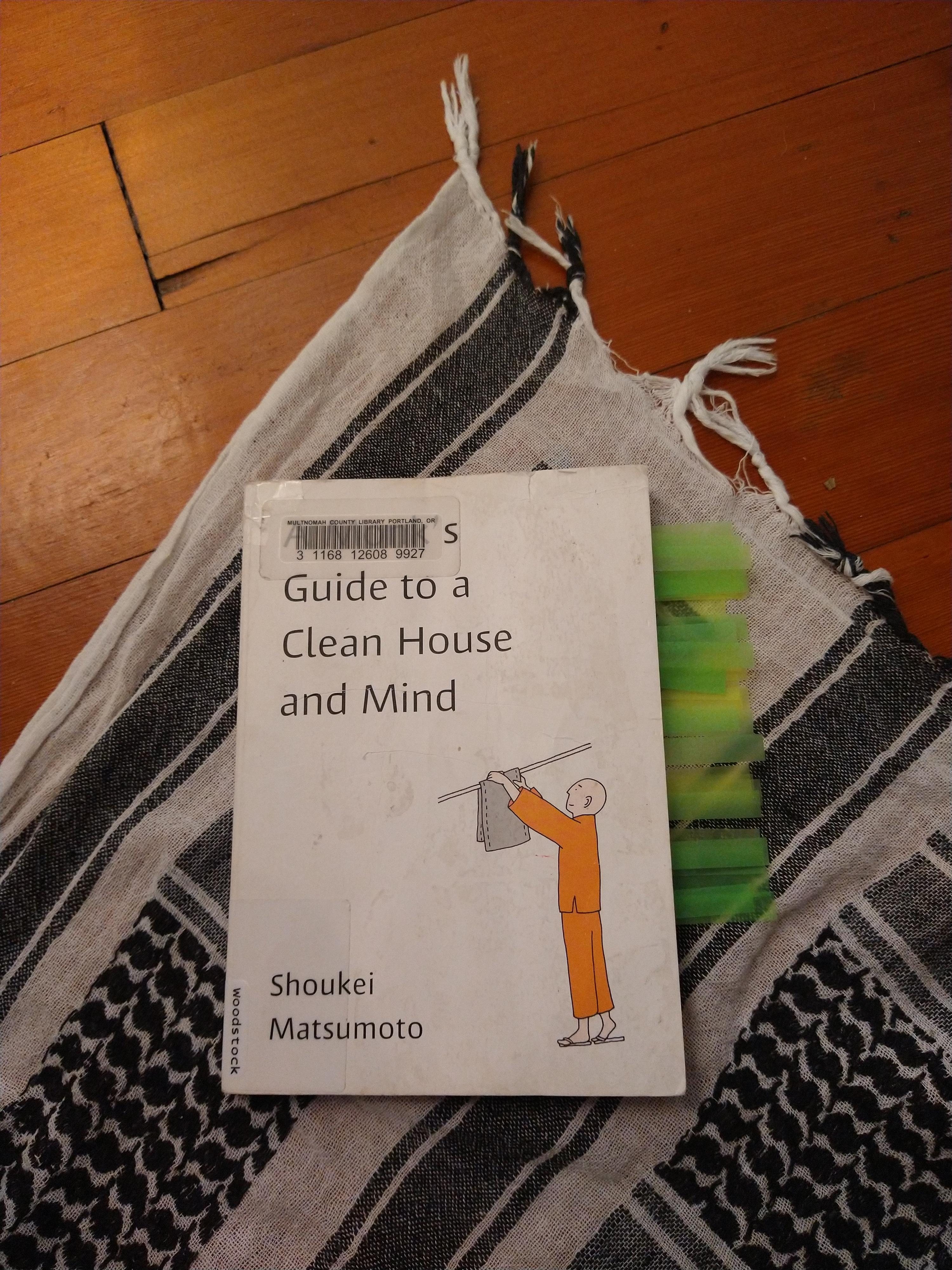
A Monk’s Guide to a Clean House and Mind by Shoukei Matsumoto

I found this little book after watching an excellent video on living out of one bag. The video creator recommended it. My reading of it occurred at just the right time in my life, as I examine my values and once again purge bags and bags of possessions for a move.

Some excerpts (italics are mine)

A monk’s day begins with cleaning. We sweep the temple grounds and gardens and polish the main temple hall. We don’t do this because it’s dirty or messy. We do it to eliminate the suffering in our hearts.

There is a notion in Japan that cleaning isn’t just about removing dirt. It’s also linked to cultivating the mind.

Family ties are the strongest of all human bonds. Use household chores as an opportunity to deepen them.

Zengosaidan. This isn’t just about how you feel. Do what you need to do without delay. Eliminate the seeds that distract your mind with unnecessary thoughts about things you will be dealing with tomorrow or things that went wrong yesterday. The longer you neglect the impurities of the heart, the harder it is to remove them. Never put off what you need to do until tomorrow, and enjoy each and every day.

Traditionally, in Zen Buddhism, practitioners wear funzoun clothing, that is, clothes made from old pieces of fabric that are sewn together. The wearing of these repurposed rags symbolizes the importance of caring for worldly objects as well as casting out conceit. This practice removes impurities from the heart.

This commitment to treasure objects until they can no longer be used or repurposed is at the heart of Buddhism.

Since the toilet is clean, you do not leave it dirty. Since you have not left it dirty, the toilet will stay clean. When this rule is broken, the toilet becomes dirty immediately. The first step to keeping your toilet clean is to adopt this mantra into your own life.

The point of housework is to clean up dirt and grime, isn’t it? So you might be wondering what the point is of cleaning something that is already spotless. But for monks the physical act of polishing the floor is analogous to cleaning the early dirt from your soul. This grime accumulates in your body and poisons your mind. This manifests itself as a dirty room and cluttered surroundings. Wipe your floor and see. Each blemish you find is a sign of unrest in your mind. Once you learn how to see how your inner turmoil manifests itself through your surroundings, you can reverse engineer this, mastering yourself by mastering the space in which you live.

It goes without saying that dust will accumulate in a home that is never cleaned. Just as you have finished raking the leaves, more are sure to fall. It is the same with your mind. Right when you think you have cleaned out all the cobwebs, more begin to form. Adherence to the past and misgivings about the future will fill your head, wresting your mind from the present. This is why we monks pour ourselves heart and soul into the polishing of floors. Cleaning is training for staying in the now. Therein lies the reason for being particular about cleanliness.

As you polish the floor, avoid any unnecessary thoughts, instead allowing your body to focus only on the task at hand. When doing this alone, you should be looking inward. When doing this with others, allow yourself to notice those around you, being conscious of your role in the team effort.

In the world of Buddhism, light is a symbol of wisdom and compassion. In order to cultivate wisdom and compassion in our lives, we should do our best to keep the sources of illumination in our homes free of grime or anything else that might obscure them.

The ultimate goal of Buddhist teachings is to conquer the suffering in people’s lives and open them up to enlightenment. In most cases we regard the root of human suffering as mumyo. Literally translating as “no light,” mumyo refers to the condition of being figuratively lost in the dark. Since you are unable to see the true nature of what is around you, your mind succumbs to worry and anxiety.

Dishes must be carefully held in both hands. Holding things in this way displays a sense of natural sophistication and shows that you take care of each and every thing you hold. I recommend that you give it a try.

Nowadays it is very easy to find a wide variety of items that are exactly alike and more or less serve the same function. When something breaks, rather than repairing it, many people buy a replacement because this is faster and cheaper. However, if you continue to live your life in this way, your relationships with others will begin to resemble how you relate to objects. This will lead to the exhaustion of your heart.

If you use an object for as long as you can, carefully, repairing it when necessary, you will find that not only your relationship with objects begins to change but so will the way you relate to people. This will help return your heart to a pure state.

Rather than chasing after the new, live a life in which you use the same objects for a long time. If you do this, you will naturally be able to care for and treasure the people around you as well.

People who endlessly chase after new things have lost their freedom to early desire. Only those who can enjoy using their imaginations when working with limited resources know true freedom. What sort of life do you wish to lead?

Glass is the very symbol of transparency and nonattachment. If your windows are cloudy or dusty, your mind will become cloudy as well. Buddhist teachings stress the importance of shattering the blurry filter of the self and viewing the world around you as it truly is. See and accept things the way they are. Learning to do so will help you achieve a state of enlightenment.

Temples will often have a long walkway, called a sando, leading up to the main building. The people who come to worship will take this path all the way to the altar, where they will straighten up their posture and offer a prayer. As we walk this path, we prepare our hearts to come face to face with Buddha. When you are on the path, try to stop at some point, take a deep breath, and let yourself be filled with gratitude.

You can create a clean and comfortable place for you and your loved ones to take care of business. Every time you step into your toilet you should appreciate how your body is expelling toxins and waste. You should feel refreshed and grateful.

We monks work hard all day, then read aloud from sacred texts, effectively using up all of our energy. When it is time to crawl into bed, our bodies never protest. We don’t have trouble falling asleep, and we always naturally get the right amount of sleep.

Quite honestly, a life free of possessions is very comfortable. After Ippen Shonin’s pilgrimage, he continued living a life without possessions and never again settled down to live in one specific place. By not being anchored down by worldly possessions, his mind was able to achieve true freedom.

There are some things you start to realize when living the Zen life of simplicity, namely, that you only keep things of good quality. They are the final products of many people’s diligent work. They are the kinds of things that you can continue to use again and again for many years.

Scrutinize merchandise thoroughly when you shop and consider whether or not you truly need an item before purchasing it. Also consider whether you can live comfortably with it. There is an old Zen saying that goes, “Where there is nothing, there is everything.” By letting go of everything, you can open up a universe of unlimited possibilities.

Use your possessions carefully and listen closely with your heart. Sooner or later you will begin to hear the voice as well. As you do so, you should also try to be knowledgeable about where to store things in your living space. Think of your home as an allegory for your body. Keep cleaning it every day. An object will tell you where it wants to be kept if you learn to see its true essence.

Clean your home thoroughly and let the seasons pour in. By stripping away unnecessary possessions and living simply, we can enjoy the seasons and our surroundings to the fullest extent. Get up and open a window. Take in the fresh air that blows through. The smell of the wind changes from season to season. The sounds of insects and the songs of birds tell us what season it is. Day in, day out, time marches forward and the seasons slowly shift. Buddha comes through nature and reaches out to us all. The nature you see around you is reflecting back at you what is in your heart.

Owning my neatness and tidiness

I keep my space neat and tidy and clean frequently. I sometimes arrange things according to a quasi-ritual order that’s personally pleasing to me. I sometimes got defensive in the past when others called my habits and spaces fastidious, sterile, immaculate, or anxiety-based.

But it is part of who I am. Now, I can laugh about it, I can flexibly respond, and I can often let things slide. I’ve eliminated rigidity just as I’ve eliminated clutter. I enjoy clearing out surfaces of stuff and placing one object of beauty, usefulness, or significance there instead. I enjoy examining each item that I initially assumed I would keep. Then I question that assumption rigorously and usually end up discarding it.

I think these overall habits came partly from the example set by a specific family member. Recently I noticed how neat and tidy this family member is. He abides by daily rituals of cleaning and arranging and laying practical things out for the next day. He does periodic deep cleans in tune with the seasons. He also decorates faithfully for the holidays, especially family-oriented ones.

On the other hand, I have another family member who grew up during the Great Depression and held onto useless junk such as thin plastic jars and lids for decades. I remember feeling exasperated at her habit of never letting go. Another family member accumulates DVDs, furniture, clothes, shoes, and other large, expensive collectibles that quickly lose their value. I am thankful for the influence of the tidy one. And I love getting rid of things that don’t matter, to make room for those that do.

The challenges of keeping a clean house and mind are with me, but addressing them brings me peace

I struggle against procrastination but cleaning quasi-ritualistically helps me a lot. I struggle to get rid of books and papers, but this helps me to internalize the ideas better and make room for new books and knowledge. I struggle to get rid of “aspirational” items, such as athletic gear I never took to. But I find peace by selling that shit to willing buyers starting a new hobby. And I like looking around my space and seeing only well-chosen essentials.

This book helped me connect my cleaning and discarding habits to a certain wider meaning and significance that I hadn’t fully articulated to myself.

Enjoying the Willamette Cove trail on a sunny January day

Today was sunny and 50 F in Portland and I took advantage of it with a trail run through Willamette Cove.

Birds

A flock of cackling geese (similar to Canada geese but smaller) descended from the air and settled into a field of tall grass.

Tiny Anna’s hummingbirds called out with their loud buzzing call and performed their dramatic hover-dive-swoop display near me. Seeing a hummingbird in January always brings me joy.

I observe that the Pacific madrone trees are a center of activity for wildlife. I (and the animals) seem to like this unusual tree and its bright orange berries and its bundles of white blossoms and its unusual, reddish, continually peeling bark.

Other people enjoyed the trail today

After a week of heavy rain, and amid another brutal wave of covid infections, I saw people extracting all they could of the day of sunshine. Two men were biking. Three young men were spray painting the bridge (I thanked them for decorating and told them I liked the green). A young woman was trail running with headphones on. Cathedral Park was full of active people and sun worshipers.

The Willamette River is at flood level because of the rain, and the water has blocked off the main trail at the midpoint. But if you clamber up onto the rail bridge you can run from the University of Portland to Cathedral Park. That is what I did today, along with savoring an extra hot cortado with the Sunday New York Times at my perch in a Saint Johns coffee shop.

Willamette Cove trail is a mix of good and bad

The area nurtures abundant plants and animals. There are also crazy people to be alert for: one guy was pushing a red sedan along the railroad tracks. Another couple had created a sprawling meth homestead full of garbage and loose dogs, blocking the unsanctioned trail access. Another burnt out van and RV has appeared, making the trail entry look apocalyptic and bleak.

I joined a volunteer group that cleared 3500 pounds of trash in the area

This gave me a good feeling of doing something to improve the place. The cynic in me wonders why the local government can’t clean up trash and clear burned out vehicles. But when you step over garbage again and again, eventually you stoop to pick it up out of sheer practicality.

A balanced view of the trail

I feel a profound affinity for the Willamette Cove trail because I have visited so many times and so often felt the joy of small discoveries in nature.

About the photo

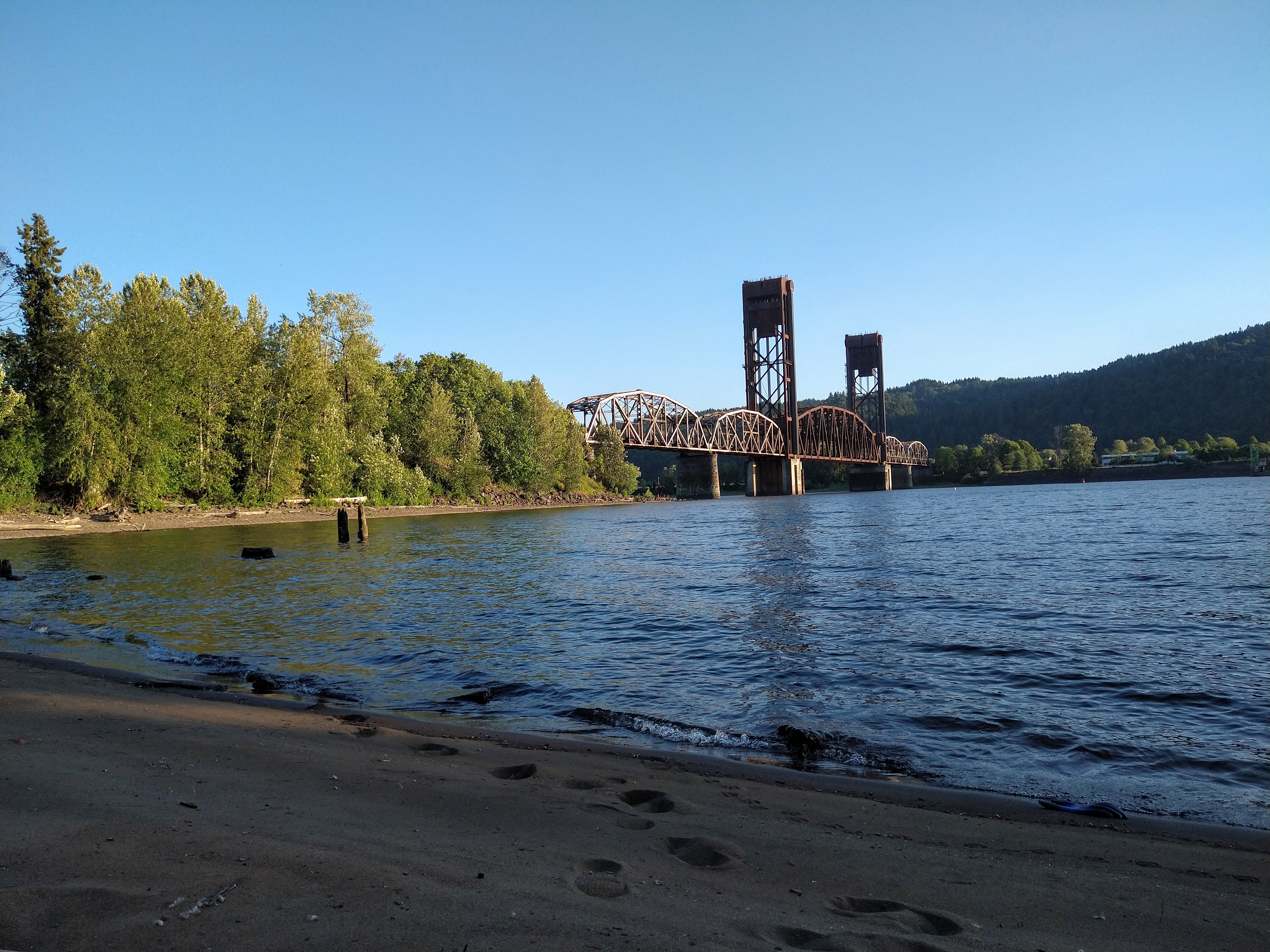
It’s of the cove in July 2021, the day I put out a fire set by some crazies.