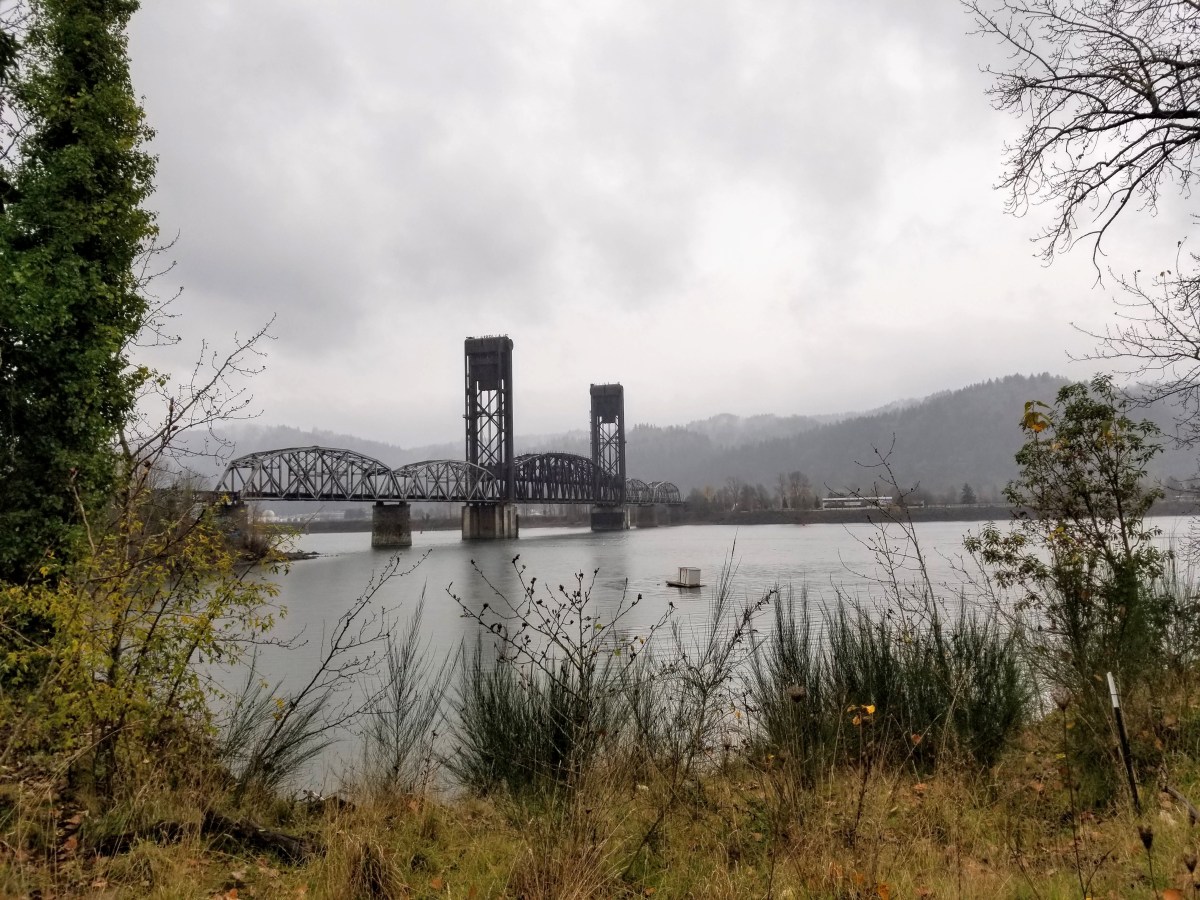
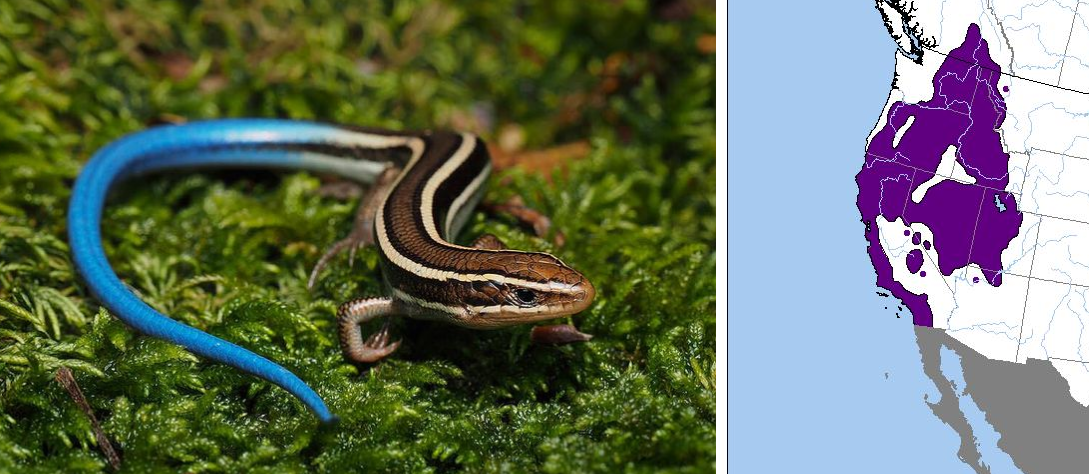
I spotted a western skink in Willamette Cove

This little reptile has a brilliant blue tail and loves to bask. I found it in Willamette Cove, which is a polluted Superfund site in North Portland where nature is thriving.

Unique blue tailed lizard

The western skink is rare enough in the city not to be mentioned at all in The Nature of Portland, which is a comprehensive guide to the nature and wildlife found here.

The other lizard that I see there on hot summer days is the western fence lizard. These little guys are numerous and wily. They seem to think they are hidden even when they are standing in plain view. The western skink is more furtive and darts away quickly, so all you see is a flash of its blue tail.

Willamette Cove Trail is special

I bike, bird, run and walk the Willamette Cove trail often and I developed a fondness and affinity for it. Because it is an unsanctioned trail, the sketchy entries keep people away. Homeless people leave trash, needles and stolen cars there. They start fires and let their mean dogs off leash to shit and intimidate people. Trains run through and leave plumes of diesel exhaust. Mysterious toxic flotsam washes up onto the shore.

These hazards don’t dissuade me because I can flee if needed. I don’t fear getting raped or robbed since I carry no vagina and nothing of value. I don’t mind the physical hazards such as broken rebar and broken concrete. I know how to get in even when parked train cars block the way and portions are flooded. I feel the attraction of this place where nature has taken over. I like how it shows that given a little space and time, nature will thrive, even in the space where a vast creosoting operation (and other industries) did their work.

Achingly slow progress on remediation

However, I regret that many people can’t or won’t enjoy the trail and the cove because of these risks and barriers to access. I came across an “update” on the government efforts to clean up the area and make it a safe, accessible space for recreation. It is full of euphemisms for non-action such as “characterized,” “evaluated,” “commented,” “considered options,” and “recorded a decision plan.”

A regional government agency bought the stretch of land in 1996 with the intent of making it a green space for people to visit. Roughly 25 years of emails, reports, and meetings have gotten us small, incremental improvements. I worry that another 25 years of these ineffectual activities will keep people out of this green space. Governments fear lawsuits from people injured by un-reclaimed industrial junk and toxics. What they don’t see is all the people who aren’t out there enjoying the space. All the people who might be birding, running, hiking there if not for the many years of delays.

North Portland is starved of accessible green space. In dozens of visits over many months, I occasionally saw crews of 2 or 3 people surveying the area and languidly picking up debris and junk from abandoned boats. It’s not enough and it’s not fast enough.

Weigh the risks and check it out yourself

I mention this beautiful unsanctioned trail to other runners and birders. I encourage them to visit and I describe and show how to do so. I point out the risks. And I mention the many small joys they’ll experience as they get their workout and see ospreys, northern flickers, coyotes, hummingbirds, goldfinches, bushtits, jays, chickadees, Cooper’s hawks, cormorants, brown creepers, vultures, red breasted sapsuckers, cedar waxwings, common mergansers, spotted towhees, garter snakes, western fence lizards, and western skinks.

Image sources

https://www.instagram.com/p/BhyjGAxg-ko/

https://fieldguide.mt.gov/speciesDetail.aspx?elcode=ARACH01110

Cooper’s spur hike

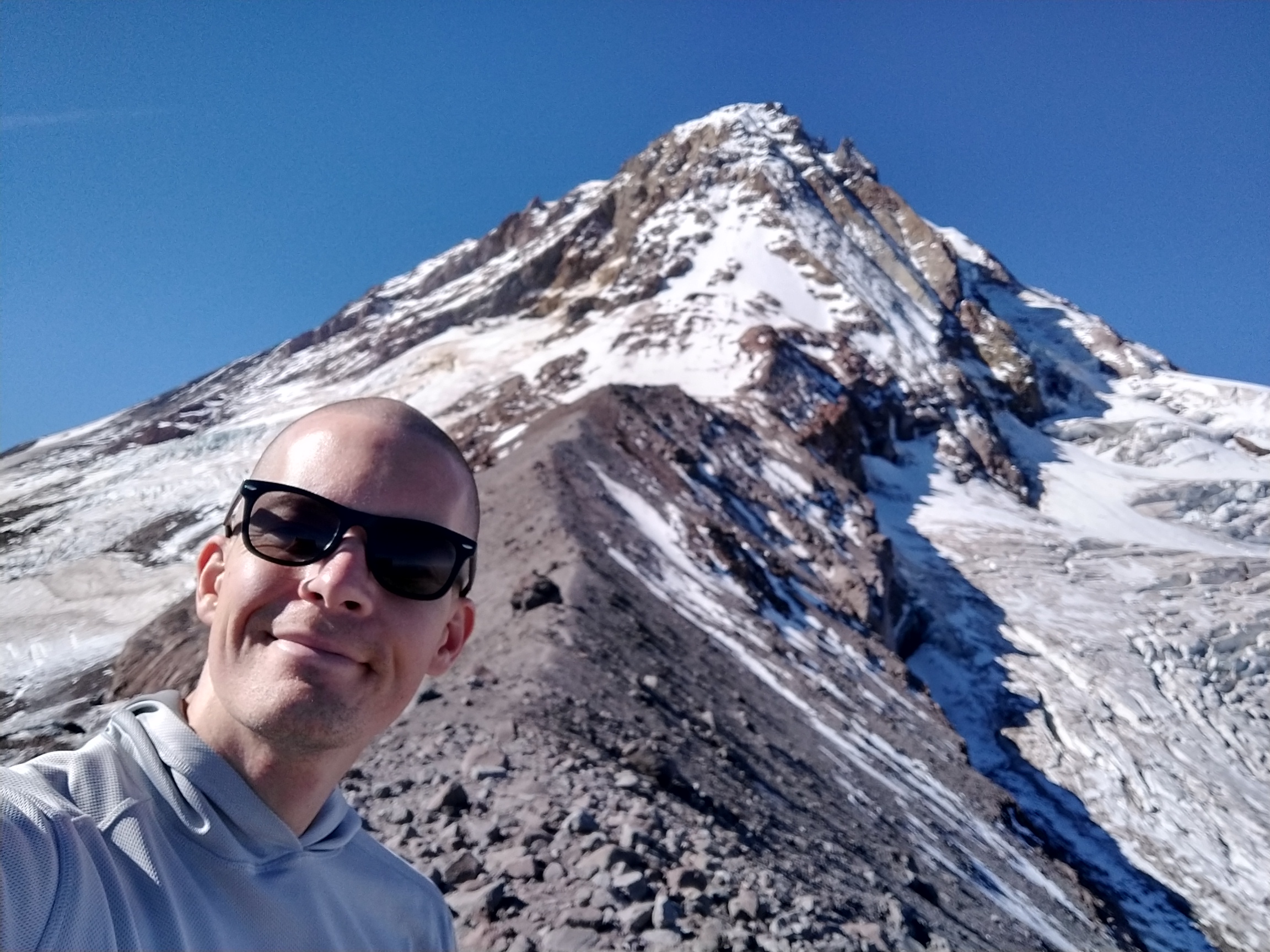
I hiked this spectacular trail with two cherished friends and their two dogs. It’s the closest you can hike to Mount Hood without beginning to climb a rock face.

When you begin the hike, the mountain rises like a shield over you above the wooded approach. Then as you plod up the sandy, rocky trail, you lose track of Mount Hood and it suddenly stands out boldly.

It’s accumulating snow right now and looks barren dark gray. The snowpack will feed the mountain dells in the spring.

Everything is bleak and clear out there. I watched a hawk swoop down a rocky waste. I had several moments like that, where I perceived a natural event with clarity that expanded beyond the moment.

Astonishingly my friends got tired out toward the end of the trail and stayed behind sipping bourbon and snacking while I got to the end.

It’s not ideal for a day trip from Portland. It’s better to camp there and take it all in as much as you like. But my friend drove and I napped with the dog in the back on the way home.

A visit to Minneapolis

I visited Minneapolis to bury my grandma, who died of covid at the age of 100. I checked out familiar spots in this native home of mine and connected with friends and family.

Burying Grandma

Cordelia was the only grandparent I really knew. She died of covid, with only a nursing assistant there due to virus restrictions. We were able to say goodbye over video the night before. It saddened me to think that her final decades were a bit lonely. And then to die without family, which she treasured, is sadder still.

She was born when the 1918 flu was circulating and she was there to witness the huge events of the 20th century. She hated losing her short-term memory as she aged, but loved visits with family and flipping through endless photo books with mementos of raising three children and of traveling the US and Norway.

At the ceremony we remembered her for her deep gratitude for those around her, her love of family, and her pride in her Norwegian immigrant culture. I spoke at the funeral despite being nervous. Without being too morbid, I saw it as practice for my mom’s death, which is not far off in terms of years, and for my dad’s death, which is more distant but also an inevitability.

Despite having weeks to prepare, I wrote up my comments the morning of the ceremony, consistent with my pattern of self-sabotage. But I did OK.

We buried Cordelia in a rural cemetery next to her husband Elmo who died 33 years ago. Many members of my distant Norwegian family are buried there and in small cemeteries in Minnesota and South Dakota.

That generation is dying away. I know so little about who they are. I know so little about their links to me, how they contributed to who I, my parents and my siblings are. I feel a sense of wonder about the people and locales where my ancestors derived their births. But the connection is tenuous. The connection is in continual tension with the desire for self-determination, for a clean slate and the desire for a future of my own choosing. I value both. And even living your life in the service of values involves deliberate and unconscious tradeoffs.

Rain and a violent storm moved over the area as we drove there and back. The rain let up briefly. It gave the mourners a comfortable window to listen to my dad read from Psalms. We then placed Cordelia’s urn on the tombstone next to the grave of her husband, my grandpa. People tell me I would have loved to know him growing up.

Visiting a mother with dementia

Early in the pandemic my mom finally entered a care home where they can handle her advanced Alzheimer’s disease.

I somewhat dreaded seeing this home. I feared a bleak, understaffed warehouse for the dying. But it was much better than I expected. My mom has daily stimulation and assiduous care. My dad visits every day to feed her lunch and take her for a stroll around the pond.

Although this brain disease is stripping away much of her existence psychologically, it has not destroyed the continuity of her personhood. She still delights (mostly nonverbally) in the things she always loved, such as flowers, gardens, children, and family. She will not have the long old age that my grandma (mostly) enjoyed, but she will have a doting husband up until the end.

This stage of the disease is less distressing to the victim but more so to the people who love and care for her. Early on she had a mind aware of its own deterioration and this was painful and depressing to her. Now, the progression of the illness is more the affair of those around her than her own and this is painful and depressing to them.

Meeting my nephew

He is a little mid-pandemic success. I never heard him scream or cry. I am surprised and curious when I see people having kids in 2021.

I’ll try to be a good uncle from several states away. Funny, even an angelic toddler like this only reinforces my determination never to procreate. I can’t think of a single thing that would change my mind.

In his early months he’s a mirror of the ancient faith and hope for the future that my grandma’s grandparents had when they left Norway for the plains of the midwest.

Connecting with friends

I saw several cherished friends I had not connected with since March 2020, just as we were learning how bad the virus would be. When I visit next, some will be getting married. Others have fast-growing children. They have changed in ways that are fascinating, especially so for the ones I’ve known since elementary school and high school. I relish being welcomed back as a friend, talking of shared memories and making new ones.

Walking the chain of lakes

I walked Lake Harriet, Bde Mkaska, and Nokomis. These lakes are absolute gems. The parks and trails of Minneapolis are part of a well-connected system that residents ought to treasure.

In Portland, the parks and trails are disjointed and they often dump you onto dangerous roads. Many Portland parks and trails are situated under polluted freeways and overpasses. My favorite trail in Portland is in fact a Superfund site. It’s a large former industrial tract in a state of benign neglect where nature has thrived.

Another trail is a polluted slough where river otters and egrets manage to survive next to a filthy asphalt plant. Yet another trail (the East Bank Esplanade) is a Boring Dystopia kind of place: a paved trail in the polluted shadow of Interstate 5. It’s a colossal failure of urban planning, where prime downtown waterfront was turned into a car sewer.

My dad and I walked many miles around these Minneapolis lakes and in the neighborhood thanks to his two new knees. I talked and walked with him more than I have in many years.

Again morbidly but with significance, I reminded myself of the "tail end" perspective: all the time I spend with my dad is probably the last 1% of the time I’ll ever be with him. With that in mind, I stayed totally present for every meal and walk and talk. I listened more than I spoke. I tried to learn from him and look at him with new eyes rather than just view him as the Dad I’ve always known. I noticed that he follows the pattern of the older person in reminiscing about memories from the past. And sometimes even asking, indirectly, whether he made the right choices in certain aspects of parenting.

A brief covid lull

I visited during a time of declining cases and deaths. There was a feeling of optimism, hope and normalcy. This turned out to be brief. Even as we sat unmasked in large groups in restaurants and cafes, the silent sub-plague of the Delta variant ate through the population. Once the reality of Delta became clear later in the summer, many restrictions were reimposed. Looking back, I feel alarmed at the way I loosened my own precautions during that summer of tentative hope.

George Floyd Square and liberals’ words not matching their actions

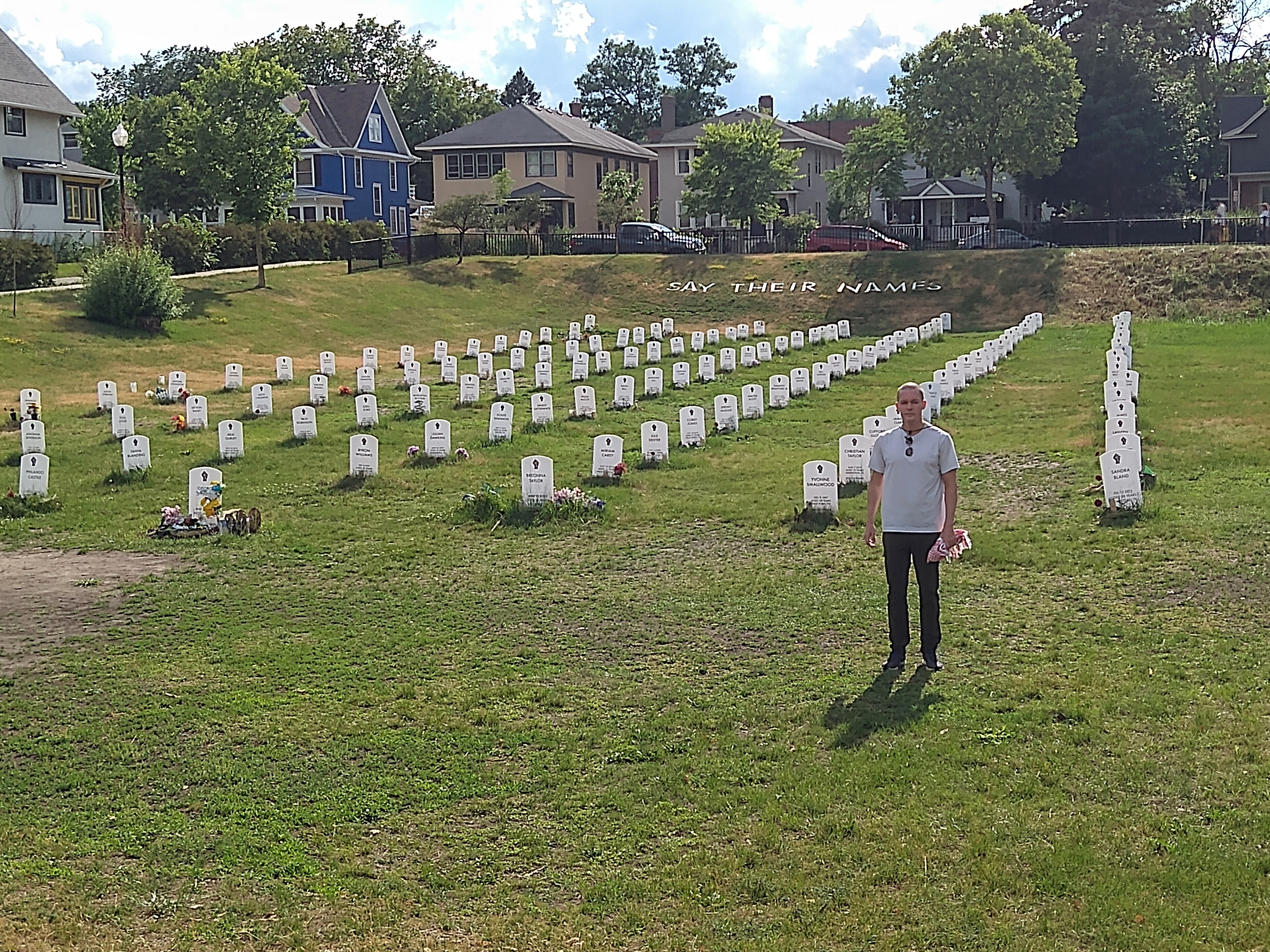
The murals, flowers and memorials moved me. Some were gravestones marking the black people killed by police in the months since Floyd was killed.

My family and I watched attentively as the officer who killed him was sentenced. The term was appropriate. I appreciate protesting against violence. I noted however that in the week before I visited, three children were shot in the head in poorer North Minneapolis. One of them died. No white liberals stormed the streets there to confront gang members, shout at them and shame them. The image is laughable because they’d just get hurt or laughed at. No one was in the streets demanding action over these dead children.

I recalled my white former manager, who called herself “antifa all the way,” and said that screaming at cops during Portland’s protests helped to relieve workplace stress. She is not involved in Black economic empowerment, in teaching or connecting people of different backgrounds. But when it’s time to shout empty slogans, she is the loudest and most in your face.

I recalled a family member who was quick to denounce racism on Facebook… and happy to buy a house in a black and hispanic neighborhood with her white wife and cat and dog. Their dog can now shit among those gravestone memorials. The black lives matter signs can now replace the black people in this neighborhood where they are getting priced out.

As my sister and I looked at a mural a woman approached us and asked for money for a bullshit George Floyd-related cause. She made no effort to attempt to conceal that it was a scam. We gave her cash just for the feeling of contributing to something and walked home.

The one Trump supporter in my family

The only non liberal I know of in my family approached me at the funeral and asked if Portland was really the lawless cartoon-like wasteland that Fox News depicted.

This person’s two sisters died of covid. He was hospitalized with it and then had a long recovery where he was completely dependent on caregivers. He was totally helpless and dependent on the care of a team of nurses and doctors. Yet he still will not get vaccinated due to Fox News indoctrination.

He lived with the now-dead sister for decades and never married. My dad called that part of the family “enmeshed” psychologically. Now that the sister is dead, he has to learn to do his own laundry. He lives in a barren agricultural speck of Minnesota and only leaves to preach to dwindling elderly congregations in other small towns.

So, this is my primary first hand impression of trumpists: misinformed, pathetic, small-minded, and very, very old.

My rats died in the second Portland heat wave of the summer

Salt and Pepper had a good life. But they were a bit older and frailer and sometime on the afternoon of the hottest day, they died.

The 116 F heat tripped a wall heater unit. The heater unit blasted hot air for hours, buckling the linoleum floors, leaving surfaces hot to the touch, and killing the rats. My roommate was checking on them daily and feeding and playing with them. I don’t think they suffered because rodents quickly decompensate. But I miss them and I wish I had done something more to prevent it.

Pepper was affectionate and calm. Her sister Salt was more active and quicker to investigate and snatch food. They both drank beer and wine with gusto. They even sipped at bourbon, making hilarious grabs at it despite the strong vapors. Both of them eagerly explored when I took them to the park or to my deck. During quiet times they napped peacefully in my shirt while I sipped coffee and read my book.

Meditating on the Minnehaha Creek

I had time to sit next to the Minnehaha Creek and on the chain of lakes to sit and meditate. I observed my mind ruminating over life’s basic questions of why.

Why did my grandma live to 100 while my mom developed advanced dementia before she even turned 70? Why did my uncle die in his 50s, with my mom (his sister) burying him? Which of my five siblings will be the first to suffer from serious illness and die? Will it be me? Will any of my six nieces and nephews die prematurely? My friends?

I went through an exercise of sending loving-kindness to a person you genuinely want to be happy and free of pain. That person was my dad.

I sat there by the Minnehaha Creek and thought of long walks there as a kid with my parents. On those walks I developed a deep love of nature and living things. This love of nature became my central affinity in life. When I sat under those cottonwoods and watched the downy woodpeckers and chickadees, I wondered: by doing so, do I stir up a link to my mom and grandma that reaches beyond life and beyond a diminished mind? Do I commune with family who I can’t really communicate with because they are dead or nonverbal? Or is that bullshit?

Last word

Minneapolis is a great city (but it’s too damn cold for me). I love to visit in the warm months. My family has had losses in terms of death, covid and dementia but we are still a growing family.

Hiking up Mount Defiance and swimming in Warren Lake

I spent Friday doing exactly what I planned: hiking up a challenging trail and swimming in an alpine lake with no one else around.

The trail is difficult but not grueling

This hike is labeled the most difficult in the Columbia River Gorge. The climbs are intense and require deliberate breathing and measuring every step. I took frequent breathers, water breaks, and moments to simply stop and enjoy the views across from me and the living things at my fingertips. I often checked in with myself mentally and did a deliberate centering exercise.

An interesting fact is that the trail follows ridges very closely. As a result you find yourself walking on a high point with stimulating sights to your left and to your right. The Oregon Hikers site describes it better than I ever could.

I prepared

I left early before the forecasted heat arrived. I brought a shit ton of water and drank every drop. I brought a large Powerade to drink when I got back to the car. I had consumed two bananas, three huge peanut butter burritos, and two boiled eggs by the time I was done. I picked and ate bright red berries throughout my trek up. 

I enjoyed Warren Lake 

I reached this mountain lake by noon and had it all to myself. I stripped down and swam. It’s shallow and the bottom is muddy but I found it easy to float and paddle leisurely. The sky was thankfully hazy by then so I did not burn.

I crouched in the water on a log to look around me and experienced a moment of horror when I thought I was standing on a deer carcass. It turned out the log had an antler-shaped projection but was just a log.

Psilocybin mushrooms

I ate so many mushrooms while perched naked on a rock on this lake. And I chewed them thoroughly. After trying four times to get high, with increasing doses, and feeling nothing, I intended to up the dose until I finally saw (at minimum) some visual hallucinations and (ideally) some insight into the mind. This did not happen. At an upcoming camping trip with friends, I’m going to triple the dose and eat the whole fucking bag in pursuit of something wild. My companions can hold me back if I start clawing at my eyes and ranting about forest nymphs. Psychedelics are a shortcut to certain truths about the mind and consciousness. I would never take them regularly, only on special occasions. And I make sure to integrate into my psyche the lessons I draw from each trip.

I meditated on the dubious boundaries of the self

I sat on the lake and meditated using the Waking Up app. Today’s meditation guided me in the following paraphrased way:

Keeping your eyes open, on inhalation, breathe in all the contents of your visual field. On exhalation, pour your self into your visual field. Then focus on the tension between these two actions. Focus on the transition between them. And when you try to see the transition, the moment you look at it you find there is nothing there. 

The guided meditation also emphasized contemplating how the sense that there is a self is anchored in the visual field. And looking for this transition, trying to define it, is impossible and so this exercise provides the preliminary seeds of dissolving the self and grasping a truth about unity and connectedness.

I alternate these guided meditations (usually 20 minutes) with a 20 minute meditation of complete silence, with no device whispering to me. I only watch my own thoughts, feelings, memories and sensations as they appear. And in my initial, amateurish practice, I turn my focus as best I can from the contents of awareness to awareness itself.

Without sitting there for so long, I would not grasp the spirit of the place. When I dwell in a special place, I learn to take it along with me. And I can return to it later in my thoughts. This fall or next summer I’ll camp on Warren Lake and absorb its character better.

On a long solo hike your thoughts can help or haunt you

I thought of two damaging patterns in my life: avoidance and regret. There were so many things I could have done with that day, and they were mostly online chores. I also thought, for some mysterious reason, of a stupid thing I said to an attractive female classmate when I was 16. 

I thought about how much I hate the barking dogs surrounding my apartment on all sides.

The music in my head that day was the flower duet from the opera Lakmé. It was a great thing to accompany me. Last year when I hiked Mount Defiance Rachmaninoff’s Elegiac Trio looped in my head endlessly, perhaps because it is a swelling and receding piece with no real finale, only emotional highs and lows.

I also mentally replayed Kings of Leon’s “Sex on Fire” again and again. It’s too bad the other tracks on that album suck.

Ecological succession

It is now four year after the Eagle Creek fire, and things are changing fast. In burned areas the green ferns look especially green against the charred tree trunks. The weeds in “sweetly blushing purple” are taking hold and protecting the slopes from erosion, doing some good even if they happen to be invasive. Many stands of dead burned out trees give slopes an eerie look. Other huge Douglas firs have charred trunks but otherwise look healthy.

Penis protection

Sadly I was subjected to non-therapeutic genital cutting (male circumcision) as an infant. One thing they never tell you is that you have to protect your penis from relentless abrasion over your lifetime or else your glans (penile head) gets keratinized (thickened and calloused).

So, when hiking I wear a simple fabric sheath I buy online. This helps my poor dick to be happy at the end of the day instead of chafed and abraded. Men and boys who were left intact do not have to worry about this.

If you cut your baby’s genitals for any of the following reasons, fuck you:

  • “We want him to match his father.”
  • “God said to do it.”
  • “It’s cleaner that way.”
  • “It won’t get diseased if it’s cut.”
  • “His future girlfriends will prefer it that way.”
  • “I prefer the look.”

When you cut a baby’s genitals in the absence of medical need, you violate the person’s bodily autonomy and bodily integrity and you inflict lifelong harm.

I saw only two other hikers

People who complain about crowds in outdoor areas are lazy and unimaginative. They are the same people who complain about the lack of abundant unlimited free parking in dense cities. A hike like this thins out the stroller crowd and welcomes Leave No Trace practices. I did see some toilet paper traces from where sloppy people shat in the woods. Now if only those who reach the summit would stop making dumb rock cairns everywhere…

The summit

Beyond Warren Lake is the summit. There is an ugly communications installation there. But it’s easy to ignore when you have magnificent Mount Hood across from you at eye level. I sat there among the huge boulders and scarfed down my trail food and watched this timeless mountain. I found a small rodent jaw and examined the long curved incisor snaking through a cavity above the molars. A raptor must have decapitated it and left it on the rock there. 

I enjoyed the sights for half an hour under light sprinkles from very high clouds. All the distant sights were visible despite high cloud cover, making it perfect for my tender Norwegian skin. The wind was steady in intensity but constantly shifting direction.

Life is wonderful

I live in a great city I chose. Within an hour I can get to remote trails and enjoy astonishing natural beauty. 

I can sit on the edge of an alpine lake and hear the knowledge and teachings of a world class neuroscientist and philosopher, as if he was my personal companion in understanding the mind. I try to think critically, as this same person gets preoccupied with Twitter feuds and cannot let go of his fixation on the problems of wokeness. I live in the most “woke” city in the world and yet to me my fellow city dwellers are the same as anywhere else in the US.

I can enjoy relatively safe psychedelics (not yet legal but getting there) and a safe, pure, legal supply of cannabis. I have the knowledge and trip reports of thousands of other hikers to keep me safe. I have health knowledge honed by dedicated scientific minds to power me through a day of exertion in the heat.

I am thankful for a splendid body that can meet the challenges I give it, and respond by growing stronger. I am thankful for staff who maintain the bathrooms, monitor the trails close to the parking lot, and for Trailkeepers of Oregon, who had done extensive and noticeable work in the days before I hiked this trail.

I am thankful that a hike like this does not take much out of me. I was in the gym the next day (doing upper body exercises only). I did not feel the knee soreness I did last time. This is because I leaned heavily into my walking sticks with every stroke of the arms, taking weight off my knees and using arm strength instead of straining my joints.

Wildlife I saw

  • Salamander in a small pool of a creek. It may live its whole life in that little pool. I only noticed it when I stooped to splash my face with water and scrub pine sap off my hands.
  • Garter snake
  • Raven
  • Small fish
  • Damselflies mating (are they always mating?) and eating fly prey on my arm
  • Brilliant blue dappled dragonflies and their nymphs rowing underwater
  • Northern flickers
  • Western scrub jays
  • Water striders
  • A group of 11 grouse (I think they were ruffed grouse)
  • Chickadees
  • Beargrass blooms in abundance (is this what was giving me strong whiffs of semen odor?)
  • Coyote scat
  • Pileated woodpecker pair
  • Turkey vultures
  • Bald eagles
  • Unidentified songsters (vireos or sparrows)
  • Chipmunk

A visit to Denver, an arid peer city of Portland

I checked out this mountain metropolis recently. All six days I was there were spectacularly sunny and nice. It was my first flight since the very beginning of the covid pandemic. It felt great to be fully vaccinated and subject to zero quarantine requirements or pretty much any other restrictions. I found the city appealing. It is one of several cities where I’d be happy to spend my days hiking, biking, birding, and eating.

What we saw

  • An excellent mezcaleria. A book (and film) called Under the Volcano gave me a fascination with mezcal. I try out this smoky tequila-like spirit whenever I can. Mezcalerias are popping up everywhere but sipping it is still a novel experience.
  • RiNo arts district. The opening game of the baseball season had people out in the streets carousing. It seemed wonderfully normal after so many months of pandemic lockdown. We took in the murals in this section of town. We appreciated that nothing really has to be ugly in a city. Even a vast wall in a back alley can be a template for an artist’s imagination.
  • Ouzel Falls trail. We took this snowy hike to its terminus, which was a waterfall buried under snow. A family walked right past it and left without knowing they had seen it. We enjoyed Colorado cannabis (taxed much higher than in Oregon) and survived punching through the deep snow accidentally. 
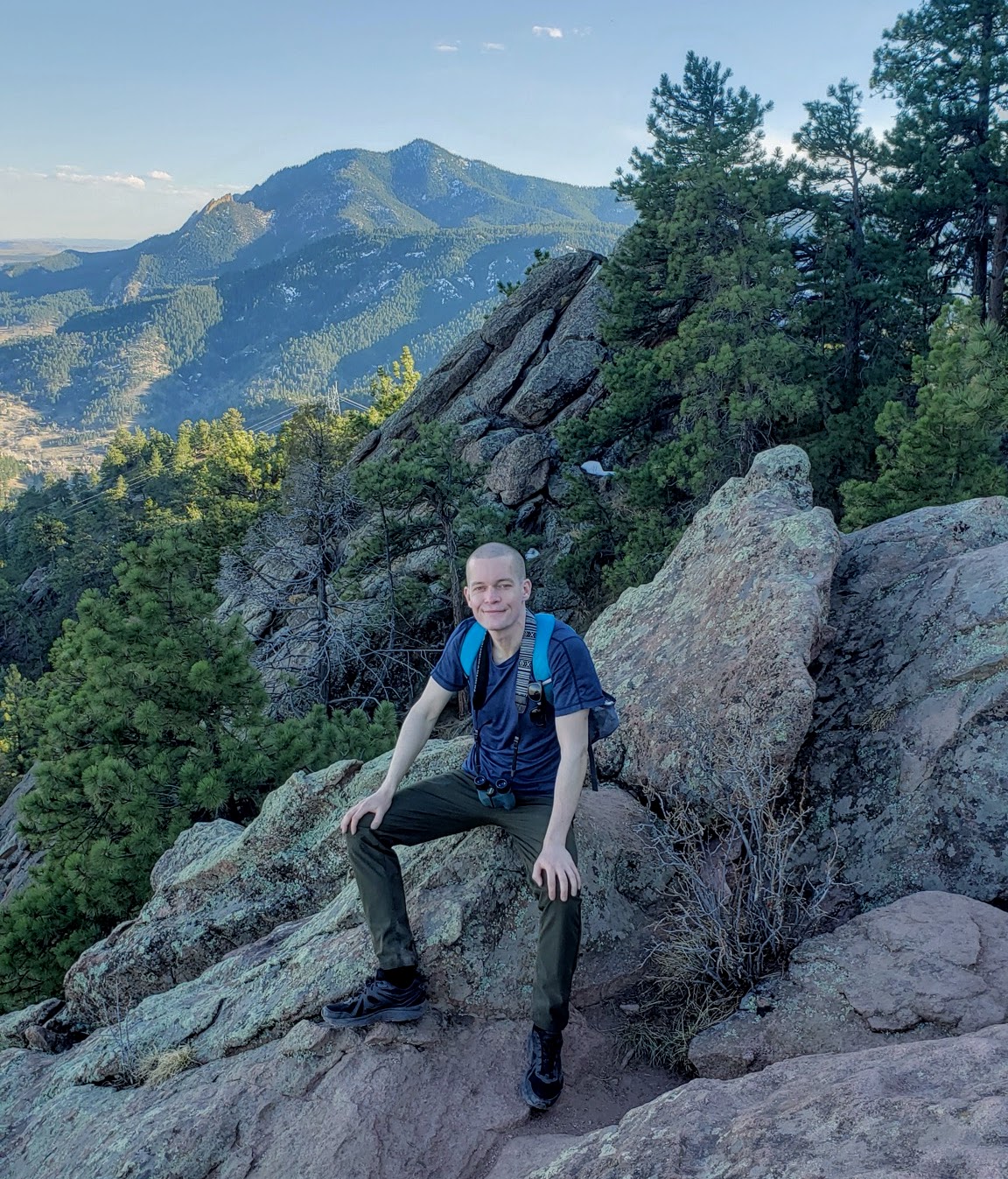
  • Mount Sanitas trail. This was a beautiful hike outside Boulder. The red oblique rock formations, speckled with ponderosa pine, are very different from what I see in Oregon. We watched magpies and got some great drone footage.
  • Rocky Mountain Arsenal National Wildlife Refuge. We saw bison and some migratory birds on the sparse ponds here. It was so damn dry, it was hard to imagine life springing back in the summer. I suppose snowmelt sustains life here. There were bison and there were many scraggly-looking mule deer.
  • The Denver Selfie Museum. This was fun. I got good photos in the banana room and with a glowing orb.
  • The Paint Mines. We drove at the buttcrack of dawn to see the sunrise here. I was rewarded. These formations are like nothing else on earth. It did however remind me of the Black Hills of South Dakota. I saw western meadowlarks, a first for me. They are hard to see but their melodious song alerted me.
  • The Royal Gorge Train. This was a great way to see the Arkansas River valley up close. I enjoyed watching the turkey vultures and ravens make a hardscrabble life in the dry valley. I also saw an American dipper, a first for me.
  • Garden of the Gods. This place is truly unique. Red rocks and spires seem to emerge from the earth like they were strewn about by Titans. My friend got amazing drone footage. 
  • Red Rock Canyon. We saw two sunrises here. Watching the sun rise over the distant plains and over the awakening city puts daily human striving in perspective. 
  • The Denver Art Museum and the Denver Botanical Gardens were disappointing. Only half of each is actually open because of their idiosyncratic covid restrictions. In the botanic gardens I did enjoy the southwestern landscape exhibit. And it was there that I identified my first-ever Townsend’s solitaire.
  • Pike’s Peak. We drove up and saw this amazing summit. The Rockies are spectacular.

Denver has better looking people than Portland

In Denver, people wear pants when they step outside the house instead of sweatpants, pajamas, or whatever they happen to have on. Instead of dirty looking beards and ugly tattoos, the men shave and pursue fitness and health. The women are not as fat and don’t look ironically frumpy and like they’ve given up.

There are fewer shitty diesel trucks polluting the roadways. Drivers display legitimate license plates instead of temporary tags or nothing at all. Cars are in a better state of repair. There seemed to be few traffic snarls and the neighborhoods are good for walking. They probably have actual large employers to go to instead of everyone just being a bartender or server.

There are also fewer fucked up people walking the streets. Homeless mentally ill drug addicts are there, but they have not annexed entire parks, trails and highway ramps like they have in Portland. Not seeing drug binges, psychotic breaks, and trash everywhere presents less of a psychological burden to someone just going about their day.

My friend wants to move there and take me and her boyfriend but I am reluctant

I transplanted from Minneapolis to Portland in 2018 and it was one of the best decisions of my life. I have met amazing people and explored coasts, mountains, rivers, forests and deserts I never imagined.

I encourage other people to move to a place they desire, after they do their research and several visits and a lot of planning and preparation. A new city, a big change in your life, is a great thing. Such transplantation is getting rarer in America over the decades. Strangely, compared to previous decades, people are less mobile.

However I recognize that there is no “there” there. Once you arrive at what you’ve sought, you still must live with yourself and with your met and unmet aspirations in life. If you’re unhappy sipping coffee and reading a book in one city, you’ll be the same in another city.

My friend, a dynamic, vibrant person, once looked around while we were exploring Seattle and sighed, “I wonder if every place is the same…” This restlessness and pursuit of contentment struck me deeply. She is continually surprising me, seeking novelty and excitement. Yet what she wants is something ineffable. It can’t be attained by moving to a new city. Moving might help, but there is something else that’s needed, such as a personal reinvention or a re-centering on what one already values in life.

The trip was too pricey for me

We followed an itinerary and hit up a hike and then a cultural spot and then a restaurant and then a bar, and then a sunset, one after another after another. It was expensive, intense, gasoline-powered consumptive travel.

If I had planned the trip I would have done it a LOT slower. I would have walked the city, rented bikeshare bikes, made more food at the airbnb, and so on. Slow travel gives you a feel for the city and the people and saves a lot of money. It’s ideal for when you have a month off and are on the other side of the globe in a place where the cost of living is low. But this trip provided a good sample of how richer people than me do travel.

Portland, Denver and Austin: three peer cities with an undeniable draw

Each of these are great places to live (I’ve never been to Austin but so I’m told). There is movement between all three. I met a young woman in Portland who left Austin just before covid. Some people are leaving Portland because they are fed up with the trash, crazy people and smallness. 

I think I would be happy in any of them. But Seattle has a special draw for me. Portland seems small but what I want out of life is big. Seattle has the Pacific Northwest landscapes along with an impressive cityscape and high-paying jobs. The state of Washington is doing many things right and they have good governance. Also there are fewer lifted diesel pickup trucks there. 

Denver is too dry. There were vast fields of brown dead nothingness. The nearest metro is hundreds of miles away and also dry. In 20 years the region will have even less water. My poor cuticles looked haggard. It would be sad to have so few lakes and swim holes around. I imagine Austin is even drier, plus there are fire ants.

I saw new birds

New to me

  • Townsend’s solitaire
  • Black billed magpie
  • Western meadowlark (I had only seen the eastern previously)
  • American dipper

Not new but still great

  • Mountain chickadee
  • Peregrine falcon
  • Red breasted nuthatch
  • Ravens

“Muse, let the memories spill through me”: Frederick Ahl’s translation of The Aeneid

“Muse, let the memories spill through me.” 

This is the line that drew me in to The Aeneid, Frederick Ahl’s translation. It’s the classic invocation of divine assistance that you find at the beginning of an epic, where the author sets out the grand scope of the task and asks for help. I had listened to the poem on audiobook just to enjoy the words and rhythm. I then picked through a translation from 1697 but felt that something was missing from its archaic language.

By accident I found the above line in a commentary comparing translations of the first passage. And it drew me in immediately.

The following blog post is about what this book, and this reading of it, means to me.

How I found this book

I first heard of Virgil, The Aeneid’s author, when I read with difficulty the Inferno of Dante when I was 15 years old. It was sitting on my parents’ bookshelf. Dante portrays Virgil as his guide and mentor through Hell, which he must pass through in order to get to Purgatory and then Heaven. For 15 or 20 years, Virgil loomed in my imagination as a towering intellect from ancient times who had left his mark on the subsequent millennia. Yet there was sadness and wistfulness to his story in the Inferno, since he could serve as a guide and mentor but not enter heaven. He was a wise shade but not a living character. And there was sadness in his actual biography since he died relatively young.

I picked up the Fitzgerald translation and it sat on my shelf for years, untouched.

Later I found a character in one of my favorite books (The Magic Mountain) revered Virgil. The character (Settembrini) even got provoked into a little spat when his intellectual adversary made a jab at the Latin poet.

I later read about how the Aeneid was one of the most important books in western literature for over 2000 years. What book written today will still be widely read and studied 2000 years from now?

I learned about how the first half of it corresponds to the Iliad of Homer (a story of warfare), and the second half corresponds to the Odyssey (a story of a soldier’s homecoming). This indicates its grand ambition, to continue and echo a revered poet from the rival civilization of the Greeks. This ambition is condensed in those first lines, “Arms and the man I sing…”

All this had me dancing around the book without cracking it open directly and seeing what it has to offer.

The personal allure of epics

Epics have a special allure for me. The grand ambition, the wide scope, the elevated language, and the desire of the author to link the story he tells to the greater cosmos can be captivating.

Yet the allusive or allegorical style and the language can keep even interested readers away. I tended to read the first “book” of each epic and then, satisfied that this was the best part, put it down. I got around this, and fed my completionist tendencies, by listening to audiobooks. First I listened to the Iliad, then the Odyssey, then the Aeneid, then the full Divine Comedy, and then Paradise Lost and Paradise Regained. And finally I listened to an abridged version of the Bhagavad Gita (with commentary to help me make sense of it). But only the Aeneid, and only this translation, really drew me in.

The translator tells of his love of the poem

In his translator’s note he writes:

“Yet although the immediate popularity of the Aeneid was certainly fostered by the model it offered to the sons of the elite as future leaders, the epic would not have absorbed and kept the interest of even disillusioned generations like our own if it had not been rich with both moral and aesthetic complexity, with depth of implications and beauty of expression.”

“What makes such an apparently hopeless labour worthwhile for me is an irrational love of the poem which drives me to want to convince others about its magnificence. That is why I, like many before me, have spent years trying to produce an exciting, readable, and performable translation that is intelligible to listeners as well as readers, one that might catch and hold the attention of even the reader in a hurry, despite the fact that it refuses to simplify the text. I wanted it to be a version that the literary minded could appreciate, but which would not play fast and loose with the original to win approval. On the contrary, I tried to stay close enough to the original for a struggling Latin student, if necessary, to be able to use it as a crib.”

In every passage I can see the thoughtfulness, the love of the text, and the painstaking care put forth by the translator. In his footnotes he frequently describes the decision making process he went through in selecting one word or phrase instead of another. He describes tradeoffs and concessions. And he helpfully explains the many allusions and references that would baffle the modern reader.

“The epic should be allowed to speak, in so far as a translation can achieve this goal, for itself. English, with its vastly larger vocabulary than Latin in most areas, allows one to generate distinctions Roman writers had no means of expressing, and to justify changes in the original by using the dictionary shrewdly.”

“Virgil rarely presents us with a consistently binary opposition between right and wrong, truth and falsehood, reality and illusion. His is more the world of paradox, of multiple and apparently conflicting simultaneous realities which often flare in unexpected ways as different planes of meaning intersect. Wherever I sensed the text leading me in different directions at the same time, I have left the reader the ambiguity or contradiction Virgil left me.”

My reading of The Aeneid is linked with my own self-discovery

2020 was the year that I named and addressed my anxiety head-on. The book is linked in my mind with courageous work on the psyche that I have done. In particular, it is linked to acceptance and commitment therapy, or ACT. 

A metaphor in my workbook struck me: 

“To be willing and accepting means noticing that you are the sky, not the clouds; the ocean, not the waves. It means noticing that you are large enough to contain all of your experiences, just as the sky can contain any cloud and the ocean any wave.”

There is no feeling, thought, sensation or memory that is intolerable because as the moment passes, I have already tolerated and accepted it. And what I reflexively view as “intolerable” is actually a fear about the next moment, or an ill-defined moment that is far in the future.

I learned about turning off the “struggle switch,” about dropping the rope in the futile game of tug-of-war, about not turning away from the richness of experience, about being willing and eager to feel everything life has to offer.

My psychologist once painted a vivid image of a battle. He asked me how much easier it would be to ignore the battle if it was not near me, but a mile away.

ACT is about not just diagnostic labels, but psychological pain. It’s about how avoidance only worsens the pain and its importance and turns it into suffering. It spells out clearly about how innate human problem-solving abilities and human language skills are counterproductive in addressing this suffering.

I noted in the Aeneid how the hero eventually faces his fate after a long journey and a long war, which was spelled out in the first lines. As part of the program I clearly mapped out my values and learned to accept pain as part of living a vibrant, engaged life and getting to something important.

I did a CTRL+F on the Dryden translation and found 26 instances of “anxious.” The author saw no contradiction in letting his heroes, gods and supporting characters feel and express this difficult emotion. As my workbook states, “Anxiety is a normal response… The problem is that we can bring these consequences into the current situation at any moment through verbal relations.”

This and other observations in ACT opened me up to mindfulness practice, to becoming an emotion scientist and an observer of my own thoughts, feelings, sensations and memories. It opened me to the realization that there are much better things to do with each moment than trying to regulate its psychological content. It opened me to acceptance, without defense, instead of effortful (and futile) control.

Although these tales of war captivate me, I am now awakened to the idea of stepping off the field of battle entirely, and of no longer being at war with myself.

Amazingly, in the footnotes of Ahl’s translation I found an explicit link to the willingness component of ACT: the Roman Stoic saying that “Fate leads the willing and drags the unwilling.” It came in the context of this passage:

“What does divine anger, when it is strong, portend of the future? What does fate’s sequence of causes demand? She gave him the answers. He touched Aeneas’s lonely thoughts with words bringing comfort: ‘Child of a goddess, let’s follow where fate drags us, onwards or backwards. Each turn of fortune we meet, we survive, and defeat, by endurance. Help does exist.”

This reading is connected with a time and a place

When you read a long, dense book, it becomes linked with who you are and where you are at the time you read it.

I read this epic over the course of several weeks in the height of the global covid pandemic. I worked at a mediocre job I’ve put up with for far too long. I saw one friend fade away while my relationship with another blossomed. I took cannabis and read the poem. And once or twice I took LSD and went on long, 15 mile hikes through Forest Park and downtown Portland, Oregon while masked against the virus. Lines from the epic turned in my head again and again and became linked to unexpected parts of my life and to the things and people I saw that day.

On one of these long walks I mounted the Saint John’s Bridge on a morning when it was draped in flowing mists only to the level of the roadway. I was crossing to reach the Ridge Trail. As I climbed the gentle slope upward I felt the illusion of being accompanied by the souls of my fathers. This was an echo of a passage from the book that must have been working within me to have appeared with such vividness at that moment. And so this green-painted steel bridge, this sensation of ghostly connection with my ancestors, and that damp morning in December 2020, will be part of my memories forever.

There are many descriptions and metaphors of nature and living things

Mountain ash, oaks, bulls, lions, deer, rivers, oceans, skies, bees, doves and the stars, moon and sun are present everywhere. This fits with Virgil’s two major previous works, which were pastoral in subject. These works (Eclogues and Georgics) are referenced by the translator frequently in the footnotes. The way Romans viewed signs from birds, the luck that bees bring, etc. is well-explained and helps you understand the text.

The most terrifying character is Allecto

“Her name comes from Gk. allektos, “unstoppable,” ‘insatiable,” (Latin insaturabilis). She is the essence of Juno’s determination, capable (unlike the gods) of sustained focus on a project and of interconnected strategies of action. Though she may be Virgil’s invention, she has characteristics of a traditional Greek Erinys (Fury), and operates mostly by insinuating herself into people’s minds.”

“From the grip of the shadows below, from the home of the Demons, she summons Allecto, the bringer of grief, whose delight is in dismal war and in anger, betrayal, and damaging criminal charges. Pluto, her own father, loathes her, her sisters in Tartarus loathe her; she, even there, is a monster, transforming herself into countless faces and  vicious expressions, and darkly erupting with serpents.”

“You have names by the thousand, a thousand artistic methods of hurting the world. So shake down the fruits of your bosom, scatter the sheaves of this peace, sow grievances leading to warfare. Make youths want, demand, reach for their weapons in one single instant!”

“There people point out the sight of a spine-chilling cavern where brutal Dis breathes out, where a whirlpool enlarged by the Acheron’s upward thrust yawns open its toxic jaws. It was through these the Fury, shocking the eyesight, plunged, thus lightening the earth and the heavens.”

Passages I flagged

The famous first lines:

“Arms and the man I sing of Troy, who first from its seashores, Italy-bound, fate’s refugee, arrived at Lavinia’s Coastlands. How he was battered about over land, over high deep Seas by the powers above! Savage Juno’s anger remembered Him, and he suffered profoundly in war to establish a city, Settle his gods into Latium, making this land of the Latins Future home to the Elders of Alba and Rome’s mighty ramparts. Muse, let the memories spill through me. What divine will was wounded, What deep hurt made the queen of the gods thrust a famously righteous Man into so many spirals of chance to face so many labours? Anger so great: can it really reside in the spirits of heaven?”

Passages I flagged:

“This was the time when sleep’s first wave sweeps over our mortal frailty, and gods’ most agreeable gift slithers into our beings.”

“When she’d said this, though I wept and so wanted to utter so many words, she deserted me, fading away on the winds without substance. three times i tried to encircle her neck with my arms as i stood there, three times, alas, all in vain. For the image eluded my grasping hands, like a slight puff of air, as a dream flutters off from a dreamer.”

“”I’m Polydorus, and spiked into me was a seeding of iron weapons which sprouted and yielded a harvest of sharp-pointed spear-shafts.’ Fear then assumed a more complex face. mind crushed by the portent, stunned, hair standing on end, voice caught in my throat, i stood stock-still.”

“next we bring bowls full of warm, frothing milk, bear chalices holding blood from the sacrificed beasts, and we settle the soul of the dead man deep in his tomb while our voices blare Last Call at the graveside. Then, just as soon as the main can be trusted, and winds give us lake-smooth waters, and rustling softness of south winds summons us seaward, sailors begin to haul ships to the surf, fanning over the beaches. out of the harbour we sail, and the cities and land are receding.”

“What a year of destruction! People let go of the sweet breath of life or they dragged ailing bodies painfully.”

“There in a grove by the stream of a make-believe Simois, she held rites of remembrance, with food for the dead, sad gifts, and libations, calling on hector’s empty tomb that she’d hallowed with green turf, and upon altars, twinned, like the cause of her tears: son and husband.”

“Does he still grieve now for his lost mother, and does his father’s fame, does Aeneas inspire him to old-fashioned courage, a real man’s greatness of soul, does the thought that his uncle was Hector inspire him?”

“Alas, you were saved from such perils for nothing. This was a grief neither helenus, seer as he was, in his many forecasts of horror, predicted to me, nor did fearsome Celaeno. This was my hardest test, the decisive turn on a long road. Then a god drove me clear off the course, to your people and your shores.”

“Dido and Troy’s chief come down together inside the same cavern. Earth gives the sign that the rites have begun, as does juno, the nuptial sponsor. The torches are lightning, the shrewd sky’s brilliance is witness, hymns for the wedding are howling moans of the nymphs upon high peaks.”

“My hope, if righteous forces prevail, is that, out on some mid-sea reefs, you’ll drink retribution in deep draughts, often invoking dido’s name. When I’m absent, I’ll chase you with dark fire! When cold death snaps away body from soul, evil man, my dank ghost will haunt you. My destination is yours. There’ll be no impunity. You’’ll pay. Tireless rumour will come to my buried remains. I will hear her.”

“Such was the pounding of voices, this way and that way, the hero underwent ceaselessly; He, in his great heart, felt all the anguish. But, in his mind, he remained unmoved; tears flood, but are wasted.”

“Using a mixture of honey and sleep-bringing opium poppy, she, with the right spells, claims she can liberate minds when she chooses, but that, in others, her power can induce intractable anguish.”

“Death-doomed, she calls upon gods and the fate-telling stars to bear witness, prays to a power that is just (if there is one), a power that remembers, whose jurisdiction embraces all lovers with one-sided contracts.”

“No love must ever exist between our two people, no treaties. Rise from my bones, my avenger – and there will be an avenger! – so you can hound these dardan settlers with hot fire and cold steel, now or some day in the future, whenever that strength coalesces.”

“Juno almighty pitied her difficult death with its painful anguish long drawn out, and dispatched to her, down from Olympus, iris, to unmoor her struggling soul from the limbs’ web of bondage. Dido was dying a death that was neither deserved nor predestined, but premature: a poor woman, swept up by the quick fire of madness. So, as Proserpina hadn’t yet taken the locks of her golden tresses, and thereby consigned her being to Stygian Orcus, Iris, rosy with dew, skimmed down through the sky upon crocus wings. And her wake, as she passed by the sun, traced colors in thousands. Standing by dido’s head, she spoke: ‘i take, as instructed, locks consecrated to Dis. i untether your self from your body.’ then, as her right hand severed the hair, all warmth escaped dido; and as it did, life fluttered away from her into the breezes.”

“Nautes, an elder, broke in at this point. Pallas, god of tritonis, made him her one student, bringing him fame for his deep skill and learning. What does divine anger, when it is strong, portend for the future? What does fate’s sequence of causes demand? She gave him the answers.”

“Now the same mothers, the same men who saw, only recently, brutal harshness etched in the face of the deep, and who hated to hear sea mentioned, were ready to go, and endure all the struggles of exile.”

“You’re telling me not to monitor salt sea’s mood when there’s no swell, when it appears to be calm? You want me to trust ominous stillness? Why should I now be untrusting Aeneas to treacherous breezes and to the skies? I’ve so often been tricked by delusory calmness!”

“He was my journey’s companion, he sailed every seaway beside me, constantly bore every menace the deep and the heavens inflicted. He wasn’t strong – yet his vigor surpassed what is normal in old age.”

“He’s propelling his skiff with a pole, trimming canvas sails as he ferries the bodies across in his iron-girt vessel, elderly now – but there’s fresh green sap in his elderly godhood.”

“Instantly voices are heard: massed wailing, the weeping of children: souls never able to speak, just over the boundary’s threshold, stolen by death’s dark day, ripped away from the breasts of their mothers, plunged in the grave’s bitter sourness without any share of the sweetness life brings.”

“Innocent folk who despaired are their neighbors: people whose own hands birthed their own deaths in disgust at the world’s light, cast away living souls. How they’d long to get back now beneath sky’s limitless, open brightness, and suffer in poverty, tolerate gruelling labours! Heaven forbids it; and that grim lake’s unlovable waters bind them; the spiralling Styx loop ninefold moats of constriction.”

“It was no choice of my will, good queen, to withdraw from your country. Rather, commands of the gods, which now compel me to pass through ghost-shadows, regions vile with decay, night’s oceans of darkness, drove me with power supreme. And I couldn’t believe I was bringing grief so intense, so painful to you, when I made my departure.”

“I heard rumours, that final night: people said you’d collapsed on a mountain of intertwined corpses, worn out by killing Pelasgians during an orgy of slaughter.”

“She, in their midst, was brandishing fires that could ruin a nation, calling Danaans forth from the citadel’s crest.”

“Here there are clusters of men who were wounded defending their country, priests who kept chastity’s vows intact through the course of their lifetimes, poets and seers who were righteous and spoke words worthy of Phoebus, all who enriched human life with the arts and the skills they discovered, all whose noble deeds earned life in the memory of others.”

Anchises (Aeneas’s father) explains from the Underworld the punishment that shades undergo before being reincarnated. He links this process to all of creation through what the translator notes as “elements from several ancient philosophical schools”:

“First, you must grasp that the heaven and earth and the sea’s liquid flatness, also the gleaming sphere of the moon, constellations, the huge sun feed on internal energy. Mind, which suffuses these cosmis limbs, pervades the vast body and keeps the mass vital. This mixture generates life within humans and beasts, flying creatures, and also monsters Ocean spawns below marbled plains on its surface. Fire endows them with force, and the source of the seeds for that fire is, though it’s slowed and restricted by noxious bodies, the heavens. Earth-made flesh, limbs slouching to death, dull much of its vital force, causing people to fear and desire, suffer pain, and feel pleasure, fail to see open skies in their prison of darkness and blindness.”

The clash of Pompey and Julius Caesar is prophesied:

“Those, though, the souls that you see all ablaze in identical armour, hearts so harmonious now – and as long as the darkness constrains them – oh, what a massive war, what battles they’ll kindle between them, what great slaughter, if they should arrive in the light of the living!”

Another invocation of the Muse occurs later in the book, before the author begins another difficult task of grand scope:

“All this I will explain, I’ll recall what led to the start of the fighting. You, goddess, prompt your seer. I’ll speak about hideous warfare, I’ll speak of battle, of kings who were driven to death by their courage, what part Etruscans played, how Hesperia’s whole land was bullied into the fight. As the worldview birthing within me is great. My labour’s greater too.”

This line of Juno’s is sometimes quoted as, “If I can’t move the minds of heaven, then I will raise hell”:

“I, Jupiter’s mighty wife, though I, who couldn’t leave any challenge untried or direction unprobed, am denied my fulfilment. I’m being crushed by aeneas. And if my own authority isn’t great enough, i shouldn’t balk at appeals to more adequate sources. If I can’t influence powers above, I’ll move Acheron’s waters.”

“Off you go then, and be mocked as you hazard your life to face dangers unthanked! Flatten Etruscan lines, shield the peace of the Latins! This is what Saturn’s almighty daughter, in person, commanded me to tell you to your face while you lay in night’s stillness, unconscious. Come on, be glad to arm up for a fight, get your lads into armour, ready to march through the gate. Burn out these Phrygian captains squatting on our lovely river and burn up their brightly daubed navy! Spirits of heaven with huge raw force so bid.”

“Still, though, the goddess at crossroads buried Hippolytus far off, hiding him in her remote shrine, the nymph Egeria’s woodlands, so he could live life alone and unknown within Italy’s forests, renamed virbius: saving his life by erasing its meaning.”

“This is the threshold victorious Hercules crossed, and this palace was ample enough to contain him. Dare to be worthy of this god, my guest, and think nothing of riches: pattern your being on his. Don’t be harsh on my poverty. Enter.”

“All through the earth other conscious creatures were yielding their anxious tensions to sleep. Their hearts had forgotten the weights of their burdens.”

“But he arose as the enemy neared and Euryalus plunged his blade hilt-deep in his chest, then withdrew. Death came in abundance. Spewing the crimson of life, he returns to the bowl a new mixture: wine and his blood as he dies.”

“Turnus, himself now fully equipped in his armour, is rousting men to take arms. Each chief hones lines that are battle-keen, bronze-clad, whetting the edge of their wrath with assorted rumours and stories.”

“Visions of empire arouse me no more; I cherished them only while there was still such a thing as albeit changeable Fortune.”

“Her strength is her blood that’s Etruscan. Hate of Mezentius arms five hundred from here to oppose him. Mantua’s river-god, crowned with his father Benacus’s grey reeds, sails as their flagship, the Mincius, hate hewn into his pine planks.”

“Like weather-fronts fiercely warring in vast shared skies, with their wind gusts equal in power, neither they and their clouds, nor their strong seas, yield in the contest, stalled in prolonged deadlock, all nature frozen in conflict, just so the Trojan front and the Latin front, as they battled, fought, foot jammed against foot, dense packed, man pitted against man.”

“Jupiter spoke to him, father to son, with a friend’s understanding: ‘Each man has his day marked. Life’s short years can’t be recovered. That’s why a man’s real task is to reach beyond life in achievement, pass beyond fate, beyond rumour to fame.”

Virgil makes a rare exclamation. His author’s voice is varied throughout the book.:

“Witness the human mind, knowing nothing of fate or the future, nothing about moderation when puffed with success and good fortune! Turnus will find there’s a time when he’ll wish he could purchase an unscatehed Pallas, a time when he’ll hate these spoils and the day that he won them.”

“‘Die now. Don’t abandon your brother, good brother.’ Then he reveals life’s lair in the chest with a skilful incision. Such were the deaths that the Dardan commander dispensed on the flatlands, out of control, like a torrent in flood, like a raging tornado black in the sky.”

“Smiling at this, and yet also enraged, Mezentius answered: ‘Die now. In my case, the father of gods and the ruler of mortals handles the details, I think.’ Then he tugged the spear out of the body. Rigid rest and an ironclad sleep slammed eyes into blindness: light and perception were damned to a night of darkness eternal.”

“Ferocious wrath flares yet more intensely now in the dardan chief. As the Fates pluck the last threads of Lausus’ lifespan, Aeneas thrusts, full force, with his powerful sword’s blade clear through the young man’s belly and buries it hilt-deep inside him. Through the light shield, no match for his challenge, the point, penetrating, pierces the tunic of soft supple gold that his mother had woven. Blood gushes over his lap as he sings; life flees from his body, sad on the breath of the winds to its place among lingering shadows.”

“‘Fate, with identical horrors of war, calls us, from our tears here, elsewhere to others. Goodbye for eternity, wonderful Pallas, through all eternity, here’s my farewell!’ That was all. He now headed back to the high walls, directing his stride straight into the fortress.”

“Turnus, not they, should have faced this death. That would have been fairer. If he’s prepared to end war with his hand, and get rid of hte Teucrians, these are the weapons, and I am the man honour called him to challenge.”

“Three times, arrayed in their bright-flashing armour, they run round the burning Pyres; three times they ritually circle the funeral’s mourning flames upon horseback, and howling mouths halloo loud lamentation. Earth is bedewed with the same damp tears that bedew all their armour.”

“Then everywhere vast fields rival each other with close-set clusters of blossoming fires. Daylight had pushed the cold shadows aside for a third time; the mourners started to break down high-heaped ash and unsortable tangled bones from the pyres and compress them beneath a warm earthen embankment.”

“Now he adds weight to the forces of anger, expands their dimensions. ‘No one is blind to this crisis you seek our advice on. It doesn’t need my voice to explain it, my lord. They admit that they all grasp history’s plan for our people, but limit their comments to mumbling. Let this man allow freedom of speech, and suppress his own windy bluster. I’ll speak, though he threatens to bring me death with a sword-thrust.’”

“Yet how I wish we could muster a trace of traditional manhood! Blessed in his labours beyond other men, as I see it, transcending ordinary souls is the man who meets death to avoid seeing conduct just like this, who bites dirt with his teeth only once and for ever.”

“But, if we have the resources and youths still able of body, if there are cities to help us in Italy, people surviving, and if the glory the Trojans won cost a great deal of bloodshed – they had their own losses too, for the storm struck all sides with equal power – then why do we yield in disgrace on the very first threshold? Why do our limbs start shaking before any bugle has sounded? Much does improve in a day. Man’s labours vary as seasons change. And since fortune must visit so many in turn, she will sometimes make us look stupid and then us back in a solid position.”

“Clytius’ soon, Euneus, was first. And she hurled a long pine-shaft clear through the chest he exposed when he turned round to face her. Collapsing, vomiting rivers of blood, he kept biting the ground he’d made gory, writhing in spasms of death round the very wound that destroyed him.”

“Now the pursued was pursuer. He pleaded and begged as she rose up higher and hacked through the arms of the man, through his bones, with her mighty axe-blade, again and again. Gashes flooded his whole face with hot brains.”

“Meanwhile Aeneas, who’s no less a savage in armour his mother gave him, is honing his own martial edge, self-lashed in his anger, thrilled that the war’s being settled on terms that this treaty has offered.”

“Sword unsheathed, he’s poised for a strike, when the other swings back his axe, splits open his lax foe’s forehead and jawbone, irrigates flanges of armour with spattered blood. And upon him rigid repose steals, binding his eyes in a prison of iron slumber, their brightness jailed in eternity’s night-time of blindness.”

“Now, like Mars unleashing wars in the land of the ice-cold Hebrus, a vision of blood, his shield vibrating like thunder, setting his frenzied stallions loose at a wild gallop over sprawling flatlands, faster than southerlies, faster than zephyrs, wringing groans from the distant borders of Thrace with their hoofbeats, circled by faces of Dark Terror, Anger, and Ambush, the god’s own retinue, so too Turnus ferociously lashes his horses, steaming with sweat, to the hub of the battle and crushes his grimly butchered foe.”

“After invoking as witness both Jupiter and the mistreated pact many times, he now finally enters the thick of the fighting, fearsome, with Mars on his side, wreaking indiscriminate, savage slaughter. He throws off all further restrain and unleashes his anger.”

“Well, shall I run? Will this land see Turnus’s back as he’s fleeing? Is drying really so bad? Oh souls of the dead, I implore you, show me some kindness since powers above now will my destruction. Let my soul, unacquainted with charges of cowardice, go down pure to your world.”

“Shocked stock-still and confused by the mixture of images conjured, Turnus just stood there in silence and stared. In this one heart, a maelstrom seethed: huge eddies of shame, cross-currents of grief and of madness, love and courageous awareness of self set boiling by fury.”

“The pair appears flanking jupiter’s throne at the savage king’s threshold, honing the fears he inspires among humans, sickly and death-doomed, each time the king of the gods masses hideous death and diseases over their heads, or brings terrors of war upon cities that earn them.”

“This is his compensation to me for virginity ravished! What did he grant me eternal life for, stripping me of life’s basic terms, that we die, and of power to end, as I certainly would now, all my pain, and to walk at my poor brother’s side through the shadows? I cannot die! What joy will I have in anything round me, brother, without you? Has earth no abyss deep enough to devour, de-deify me, dispatch me to death’s abysmal remoteness?’ Such were her words. Then, shrouding her head with the grey of her mantle, groaning profoundly, the goddess entombs herself deep in her waters.”

Lastly, from earlier in the book:

“Amor now tries to surprise, with a living passion, a heart where the fire has died and where love is a memory. ”

About the photo

It’s another view of Cape Horn and Phoca Rock in the Columbia River gorge from Dec 2020.
Hiking the Cape Horn loop in the Columbia River Gorge

I saw some great landscapes and birds on the Cape Horn loop. On this seven-mile hike I led a friend out beyond his physical capabilities and he got hurt. From his moaning and blood I learned to be a better aide and companion on the trail.

Landscapes 

Diverse landscapes crowd this loop, including two waterfalls, a prairie, and many vistas overlooking the gorge. The river water looked very green in contrast to the distant bluish mountains.

We checked out Phoca Rock, which changed dramatically in luster and hue as the sun set. I can’t verify, but the thing must be named after the French phoque, for seal (the marine mammal). In fact there is a user-submitted Google Maps image of a big ol’ fat sea lion lounging on this conspicuous rock in the middle of the Columbia.

Being out there on a sunny day on one of the shortest days of the year was special. Newly built overlooks were put in place in 2020.

Birds

The trail opens into a small prairie. We watched a northern harrier hunting buoyantly in a steady wind. I think it was a juvenile because of its brown coloration. I look forward to seeing this hawk again and studying its appearance, including the “gray ghost” adult male.

We observed ravens, spotted towhees, a red-tailed hawk, a kinglet (could not tell whether ruby-crowned or golden-crowned), hairy woodpecker, nuthatches and chickadees. 

I need some help distinguishing the chestnut-backed chickadee from the Pacific plumage variant of the black-capped chickadee. I think I may have seen this richly colored brown bird, but I couldn’t be certain without getting back home to my Sibley guide. Next time I see one, I will know.

Part of the trail is closed February to July to protect peregrine falcon nests. If I saw one of these falcons hunting in the gorge I would lose my shit.

My companion got hurt

He complained of “debilitating pain” in his toes on the many descents over rock-strewn parts of the trail. I waited as he improvised by stuffing gloves into the toe section of his shoes. Inexplicably, he had worn steel-toed shoes.

Shortly after this he fell and cut his hand right at the knuckle where a vein was split open and bled profusely onto his light-colored jacket. He struggled to apply pressure properly, continually disrupting the coagulation process while accusing me of leading him on an extra-long leg of the trail that he didn’t know about.

I made a few mistakes. Next time, I will judge the physical conditioning of my trail buddy beforehand, and err on the side of caution because of the risks of being out there during covid and wintertime. I will state specifically what gear and clothing they should bring. I will do a quick readiness check before we even leave the city. And during the hike, I will continually communicate where we are at. I won’t make the assumption that they saw and understood the trail markers and maps that I did.

Lastly, I will be more patient when a buddy is flailing, and I will put blame aside.

We got enchiladas once back in town

They were OK. I think once the pandemic is over I’ll continue to avoid eating out. Because most bars and restaurants suck at their jobs and serve you crap.

My comment on the city’s Clean Air, Healthy Climate Proposals

Dear City of Portland,

I live in North Portland and according to city maps, I am surrounded on both sides of the peninsula by heavy industrial polluters. These industrial sites are mixed in closely with dense housing. On top of that, I live near Lombard Street and the constant vehicle exhaust from diesel and poorly maintained gasoline engines. Diesel defeat devices and large fuel-guzzling trucks and SUVs are rampant in my neighborhood. I also endured the wildfire smoke of fall 2020.

I check current air quality daily at IQAir.com. On many days this year and last, I have limited my outdoor activities because of the bad Portland air. I am fortunate to be a healthy adult. But I would never raise a child in this city for fear of developmental problems, childhood cancer, and asthma.

I believe the current air quality standards are already too lenient, and we will look back decades from now and wonder why we traded respiratory health and got nothing in return.

I think immediate action on every source of air pollution is needed in Portland.

Healthy climate fee:

$25 per ton of GHG is completely reasonable for this huge amount of emissions. In fact, treating the air we breathe as an open sewer should be much more expensive for polluters. What if it cost only $25 to dump a ton of liquid waste into the Willamette River? Please move forward with this fee.

Clean Air Protection Fee:

I believe this would help to reduce local substantial hazardous air pollution.

I believe much current air pollution occurs because there is very little cost to it. The costs of air pollution are externalized, and it is considered acceptable to treat the air above us as an open sewer. In addition, fuel is cheap. This is why you see vast fields of idling rail cars, idling construction machinery, and inefficient building practices. By putting a greater cost on pollution, behavior will change without much of an economic impact. Fees such as this are straightforward and they serve to organize many smaller decisions to reduce the overall amount of air pollution.

Please move forward with the proposed fees, and consider raising them further.

Thank you for reading my comment and prioritizing environmental and human health,
Mr P.P. Poopenfarten III

Comment at https://www.portland.gov/bps/climate-action/healthy-climate by 08 Jan 2021. See the excellent work being done by Neighbors for Clean Air.

A visit to Long Beach, Washington

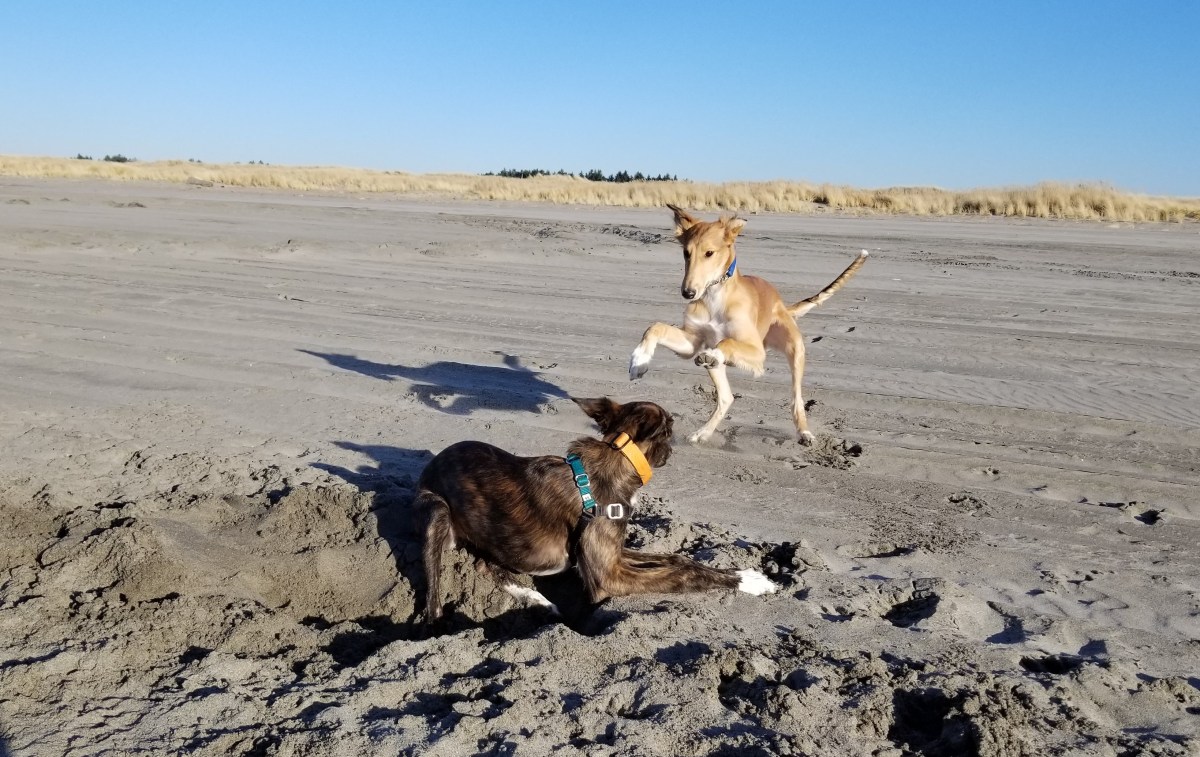
I visited coastal Long Beach, Washington for a puppy play date.

The breed is called a silken windhound, and it’s a relatively new breed. The dog belongs to my friend, and she reunites with her siblings regularly.

This visit was special. There were 3 littermates present, along with two borzois, which are a large, elegant breed of dog with a loping gait that provided the genetic raw material (along with whippets) of the silken windhound breed.

These dogs engaged in pure play and exploration for three hours straight. They were inexhaustible (or they were too excited to notice their exhaustion).

We checked out sights in Astoria. This town at the mouth of the Columbia River impressed me with the way the infrastructure wraps around the estuary. It’s much bigger than the coastal specks of a town that I had visited. We took in the bridges, the city tower, and the stately oceangoing ships.

On the beach I enjoyed watching the sandpipers, the gulls, and the fragments of crabs, jellyfish and molluscs. I sat at the tree that marked the westernmost point that Lewis and Clark reached in their expedition. I ran in the grassy dunes with the five dogs as they went BERSERK.

On the long drive back I learned more about the family tragedies that have punctuated my friend’s past. I also learned of the slower-burning problems – the difficult, tangled ones.

I look for people who will expand my horizons, who will broaden my view of the world. These individuals are the ones I will take with all my heart, who I will embrace into my future, as long as they will be with me in special natural places and at special times.

When we got back to town we enjoyed an eggnog/bourbon cocktail by my fire while we stroked the soft brindle fur of the spent dog.